
Reclaiming Judicial History: How Early High Courts Shaped India’s Constitutional Destiny
In the formative years of India’s Constitution, High Courts like Madras served as pioneering constitutional laboratories, delivering landmark judgments that actively shaped fundamental rights and state power before the Supreme Court emerged as the central arbiter. Through cases like Champakam Dorairajan and V.G. Row, the Madras High Court not only struck down discriminatory policies and executive overreach but also directly catalyzed the First Amendment, which established the constitutional basis for reservations.
These early courts operated with significant autonomy and authority under the original federal design, interpreting key provisions on equality, freedom, and taxation with a mastery that was often affirmed by the Supreme Court. However, this influential role has been largely forgotten due to the subsequent centralization of judicial power in the Supreme Court, a shift that diminished the High Courts’ stature as primary constitutional interpreters and obscured their crucial contribution to laying the foundational doctrines of Indian constitutional law.
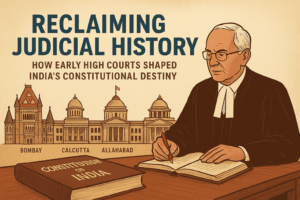
Reclaiming Judicial History: How Early High Courts Shaped India’s Constitutional Destiny
In the formative years of India’s democracy, it was often the High Courts, not the Supreme Court, that stood as the first line of defense for fundamental rights and constitutional principles.
When we celebrate India’s constitutional journey, our gaze instinctively turns toward the Supreme Court—its landmark rulings, its larger-than-life justices, and its evolving doctrines. Yet this focus obscures a foundational truth: in the Constitution’s nascent years, it was the High Courts that first breathed life into its provisions, interpreting fundamental rights, checking executive overreach, and establishing principles that would endure for decades. Senior Advocate Arvind Datar’s recent reflection on this “forgotten contribution” invites us to reconsider not just legal history, but the very architecture of Indian judicial federalism.
The early High Courts of Bombay, Calcutta, Allahabad, and Madras served as crucial constitutional laboratories, where the abstract ideals of the Constitution met the complex realities of a newly independent nation. Their judgments, now often overshadowed by Supreme Court pronouncements, established interpretive traditions, defended civil liberties against state encroachment, and in several landmark cases, directly catalyzed constitutional amendments.
The Pioneering Role of Early High Courts
In the immediate aftermath of independence, India’s judicial landscape looked markedly different from today’s centralized hierarchy. The Supreme Court, though established as the apex court, was initially conceived with a limited, federal role—to resolve disputes between states and between states and the Centre, and to provide authoritative opinions on important questions of law. High Courts, by contrast, were intended as self-sufficient judicial worlds with full jurisdiction over their territories, and they commanded tremendous prestige.
Legendary chief justices like M.C. Chagla in Bombay (1947-1958) and P.V. Rajamannar in Madras (1948-1961) presided over courts whose influence rivaled that of the Supreme Court itself. So esteemed were these judicial leaders that both declined invitations to join the Supreme Court, preferring to remain “masters of their continents” where their word was held as law.
This decentralized strength was by design. The Constitution originally positioned High Courts as primary constitutional adjudicators, with the Supreme Court serving as a specialized federal court for specific matters. The framers envisioned that most constitutional questions would be settled at the High Court level, with appeals to the Supreme Court requiring certification that the case involved “a substantial question of law of general importance” that needed the apex court’s resolution.
Table: Foundational Judgments from Early High Courts and Their Lasting Impact
| Case | High Court | Year | Key Constitutional Issue | Lasting Impact |
| Champakam Dorairajan v. State of Madras | Madras | 1951 | Caste-based reservations violating equality rights | Led directly to First Amendment adding Article 15(4), foundation of reservation system |
| V.G. Row v. State of Tamil Nadu | Madras | 1951 | Executive power to declare associations unlawful | Strengthened freedom of association under Article 19(1)(c); affirmed by Supreme Court |
| Gannon Dunkerly v. State of Madras | Madras | 1954 | State power to levy sales tax on works contracts | Established limits on state taxation powers; affirmed by Supreme Court in 1958 |
| Romesh Thappar v. State of Madras | Supreme Court (originated in Madras) | 1950 | Freedom of speech and public order restrictions | Provoked First Amendment broadening Article 19(2) exceptions |
Constitutional Catalysts: How High Court Rulings Shaped Amendments
The Madras High Court’s jurisprudence during the 1950s offers perhaps the most striking examples of how High Courts directly influenced constitutional evolution. In Champakam Dorairajan v. State of Madras (1951), a Full Bench struck down the “Communal G.O.”—a 1927 government order that reserved seats in educational institutions based on caste and religion. The Court held that this violated Articles 15(1) and 29(2), which prohibited discrimination on grounds including religion, race, and caste.
This judgment created an immediate constitutional crisis. The government, committed to affirmative action for historically disadvantaged communities, found its policy framework invalidated. The response was swift: Parliament passed the First Amendment in 1951, introducing Article 15(4), which expressly enabled the state to make special provisions for socially and educationally backward classes. Thus, what became the constitutional foundation for India’s entire reservation system emerged directly from a High Court’s uncompromising defense of equality principles.
Similarly, in V.G. Row v. State of Tamil Nadu (1951), the Madras High Court confronted executive overreach with remarkable boldness. The case challenged a notification declaring the People’s Education Society an unlawful association, with penal consequences for its members. When the Advocate-General argued for virtually unlimited executive discretion to ban associations, Justice Viswanatha Sastri’s response has entered judicial legend: he remarked that such arguments had not been heard since the time of the Magna Carta. The Court struck down the notification as violating Article 19(1)(c)’s guarantee of freedom of association, delivering a masterful discussion on Articles 14 and 19 that would later be affirmed by the Supreme Court.
The Erosion of a Federal Judicial Vision
The dynamic, constitutionally significant role that early High Courts played stands in stark contrast to their diminished position in today’s judicial hierarchy. The constitutional design of a balanced judicial federalism has gradually given way to what scholars term an “imbalance in the power equation”.
The primary mechanism of this shift has been the expansive use of Article 136, which grants the Supreme Court discretionary power to grant special leave to appeal from any court or tribunal. Originally intended as an “extraordinary remedy against aberrant and gross failure of justice” for rare use, this provision has become a floodgate. Today, “virtually every order, interim or final, of a court or tribunal where the losing party is sufficiently aggrieved and sufficiently possessed of money to pay more legal bills becomes the subject of a Special Leave Petition before the Supreme Court”.
The consequences are profound. The constitutional filter—where High Courts certified which cases involved substantial questions of law needing Supreme Court resolution—has been “completely upstaged”. High Courts have been “reduced to being just one more stage short of the final rung of the ladder,” their authority constantly subject to second-guessing from Delhi. This centralization has ironically occurred even as the Supreme Court groans under a caseload that forces it to spend “more than half their total time” sorting through special leave petitions, “like a farmer spending half his time just in selecting the seed for the field”.
Contemporary Echoes and Institutional Reflections
The early contributions of High Courts remain relevant today, as contemporary judgments continue to demonstrate their capacity for constitutional innovation. Recent years have seen High Courts:
- Recognizing internet access as a fundamental right under Article 21
- Affirming that social media criticism of government doesn’t constitute sedition without incitement to violence
- Granting legal recognition to marriage between a cisgender man and transgender woman
- Enforcing bans on manual scavenging and protecting sanitation workers
Yet these significant rulings occur within a system where High Courts no longer possess the institutional stature their predecessors enjoyed. The appointments process exemplifies this diminished status. While the Constitution envisioned consultation with High Court judges in Supreme Court appointments, today “they do not even figure in the deliberations of the collegium of the Supreme Court”. Their role is largely confined to originating proposals for appointments within their own courts, with Supreme Court judges from particular High Courts carrying more weight in Delhi than the High Court’s own chief justice.
This hierarchical shift has transformed what was meant to be a relationship between constitutional equals into a vertical structure of subordination. As one analysis notes, when the same set of judges in Delhi “lay down the law in important cases” and also “decide if you are going to be appointed to be chief justice of a High Court, or get elevated to the Supreme Court,” the personal equation inevitably becomes more hierarchical.
Toward a Rebalanced Judicial Federalism
Recovering the history of High Courts’ constitutional contributions isn’t merely an academic exercise—it offers insights for contemporary debates about judicial reform. The original constitutional vision of strong, autonomous High Courts served important functions: it dispersed constitutional interpretation across the country, allowed regional legal cultures to develop, and created multiple centers of constitutional authority that could check one another.
Current discussions about case backlogs, judicial efficiency, and access to justice might benefit from reimagining the role of High Courts. Some have suggested specialization within the judiciary, with judges developing expertise in particular areas like corruption, family matters, or economic offenses. Others emphasize the need to reinforce the filtering function that would allow the Supreme Court to focus on cases of national importance while High Courts serve as courts of last resort for most matters.
What the early history demonstrates is that constitutional interpretation thrives when it emerges from diverse judicial centers engaging with local realities while upholding national principles. The Madras High Court’s rulings on reservations, association freedoms, and taxation weren’t merely regional applications of central doctrines—they were creative constitutional interpretations that sometimes preceded and shaped Supreme Court jurisprudence.
As India’s Constitution continues to evolve through judicial interpretation, legislative amendment, and social change, the forgotten legacy of early High Courts offers a reminder: robust constitutionalism requires not just a strong apex court, but a vibrant ecosystem of constitutional courts throughout the federation. The “forgotten contribution” that Arvind Datar highlights is more than historical footnote—it’s a vision of judicial federalism that might still hold relevance for a 21st-century India seeking to balance national unity with regional diversity, judicial efficiency with thorough deliberation, and centralized authority with distributed wisdom.
You must be logged in to post a comment.