
Rajasthan’s Prescription for Change: How Well-Being Centres Aim to Heal the Healers of Tomorrow
In a proactive response to the escalating mental health crisis within medical education, the Rajasthan government has unveiled a comprehensive, three-tiered initiative aimed at fundamentally shifting the culture of medical training. This structured framework involves establishing dedicated well-being centres in all medical colleges to provide holistic psychological and emotional support, appointing specific deans in each institution to ensure accountable oversight of student mental health, and creating a central state-level welfare cell to standardize and strengthen these efforts system-wide. The move recognizes that the traditional, high-pressure environment often compromises both student welfare and the quality of future healthcare, positioning this initiative not as a peripheral welfare activity but as a crucial investment in building a more resilient, empathetic, and effective medical workforce. If successfully implemented, it could serve as a transformative national model by addressing the root causes of burnout and stigma, thereby ensuring that the rigorous process of creating doctors is both humane and sustainable.
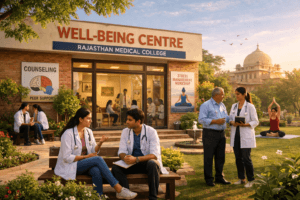
Rajasthan’s Prescription for Change: How Well-Being Centres Aim to Heal the Healers of Tomorrow
In a landmark move that could redefine medical education in India, the Rajasthan government has announced the establishment of comprehensive well-being centres in every medical college across the state. This initiative, coupled with a state-level mental health welfare cell and dedicated deans for student mental health, marks a significant pivot from a traditionally rigid, high-pressure training model to one that acknowledges the profound human cost of creating doctors. This isn’t just an administrative order; it’s a cultural intervention, and its success or failure will offer critical lessons for the entire nation.
The Silent Epidemic: Why This Move is Urgent
To understand the importance of Rajasthan’s decision, one must first confront the grim reality of medical education. The journey from a first-year MBBS student to a qualified physician is famously grueling, characterized by information overload, relentless examinations, long clinical hours, and often, a culture of stoicism that stigmatizes vulnerability. Studies, including those by the Indian Psychiatry Society, have consistently shown that medical students and residents experience depression, anxiety, and burnout at rates significantly higher than their non-medical peers and the general population. The tragic instances of student suicides are only the most devastating tip of this iceberg.
The mental health crisis among medical trainees is not merely a personal tragedy; it’s a public health concern. Burnout correlates with reduced empathy, clinical errors, and professional disillusionment. A system that breaks its students risks producing broken doctors. Rajasthan’s task force, led by Medical Education Commissioner Naresh Goyal, is effectively diagnosing a systemic flaw and attempting to treat it at an institutional level.
Decoding the Rajasthan Model: A Three-Pronged Approach
The state’s strategy is notable for its multi-layered structure, moving from the individual college to the state apex.
- The Well-Being Centre: More Than a Counseling Room The promise of a “comprehensive well-being centre” in every college is the cornerstone. The key lies in the word “comprehensive.” For this to be transformative, it must move beyond a token room with a visiting counselor. A truly effective centre would integrate:
- Psychological Services: Confidential, accessible, and stigma-free counseling with professionals trained in the unique stresses of medical education.
- Peer Support Programs: Structured forums where senior students mentor juniors, normalizing struggles and sharing coping strategies in a way faculty sometimes cannot.
- Skill-Building Workshops: Teaching concrete skills like stress management, time management, financial literacy for interns, and communication skills to navigate difficult patient interactions.
- Physical Wellness Spaces: Quiet zones, recreational areas, and perhaps partnerships for physical activity, recognizing the mind-body connection.
- The Dedicated Dean: Accountability at the Leadership Level Appointing a dean specifically for student mental health is a masterstroke. It creates a point of accountability and ensures the issue has a voice in the highest echelons of college administration. This dean’s role will be crucial in translating policy into practice—overseeing the well-being centres, sensitizing faculty, streamlining academic workloads, and ensuring that students seeking help face no academic retaliation. They become the institutional champion for a cultural shift.
- The State-Level Mental Health Welfare Cell: The Macro View This cell will provide the necessary overarching framework. Its functions should include standardizing protocols across colleges, organizing advanced training for counselors, monitoring data (while ensuring anonymity) on student well-being metrics, and acting as a think tank for continuous improvement. It ensures initiatives don’t fizzle out as isolated college projects but are part of a sustained, state-wide mission.
The Deeper Challenge: Moving Beyond Crisis Management to Cultural Change
The real test for Rajasthan will be in implementation. Establishing centres is one thing; fostering an environment where students feel safe to use them is another. The initiative must tackle deep-seated cultural barriers:
- Combating the “Weakness” Stigma: The pervasive belief that struggling is a sign of inadequacy for a future doctor must be actively dismantled. This requires continuous advocacy from respected faculty and alumni, sharing stories of resilience.
- Re-examining the “Churn” Culture: While the government mentions strengthening academic systems, this must critically address pedagogical practices. Is learning purely rote and punitive? Are working hours for interns and residents inhumanely long? Well-being centres cannot just be clinics to treat the casualties of a toxic system; the system itself must be reformed.
- Faculty Sensitization: Often, the greatest stress emanates from hostile or insensitive faculty. Mandatory sensitization programs for professors and senior doctors are non-negotiable to create a more supportive learning environment.
A National Model in the Making?
Rajasthan’s holistic approach positions it as a potential leader. Other states have taken piecemeal steps—some helplines, occasional workshops—but this structured, three-tiered framework is arguably the most ambitious institutional response proposed by any Indian state government to date.
The lessons from Rajasthan will be invaluable. If successful, it could provide a replicable blueprint, demonstrating that investing in student mental health is not a diversion from creating excellent doctors, but its very foundation. It could show that a medical education system can be both rigorous and humane, producing clinicians who are not only knowledgeable but also resilient and empathetic.
The Road Ahead: Cautious Optimism
The announcement, dated February 2026, sets a visionary direction. The coming months will be about resource allocation, thoughtful design of the well-being centres, and the selection of empathetic individuals for the dedicated dean roles. Civil society, student bodies, and mental health professionals must partner with the government to hold the system accountable to its promise.
Rajasthan’s prescription is bold. It recognizes that you cannot pour from an empty cup, and that the healers of tomorrow need healing today. By choosing to institutionalize care, the state is sending a powerful message: the well-being of a medical student is as important as their grades. In doing so, Rajasthan isn’t just building centres; it’s attempting to build a more compassionate future for Indian healthcare, one student at a time. The nation will be watching.
You must be logged in to post a comment.