
Rafah Crossing Reopening: A Tentative Lifeline in Gaza’s Fragile Ceasefire
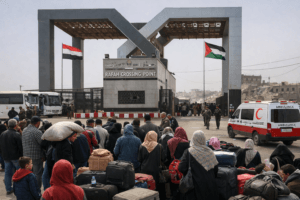
Rafah Crossing Reopening: A Tentative Lifeline in Gaza’s Fragile Ceasefire
For 14-year-old Yousef, who suffers from a rare genetic disorder, and thousands of other Palestinians, the metal gates at Rafah represent not just a border, but the fragile threshold between suffering and survival.
The announcement that Israel will reopen the Rafah border crossing marks a critical juncture in the tentative peace following the two-year war in Gaza. This development, directly tied to Israel’s recovery of the remains of the last hostage, Police Sergeant Ran Gvili, opens a humanitarian corridor for pedestrians for the first time since May 2024.
However, the limited reopening—for pedestrian passage only under full Israeli inspection—reveals the deep complexities and contested visions that define the next phase of Gaza’s future, where hope for recovery collides with the political realities of demilitarization, governance, and reconstruction.
The Human Cost of a Closed Gate
The Rafah crossing is Gaza’s only gateway to the outside world not controlled by Israel. Its closure has had devastating human consequences. For families like Khitam Hameed’s, the crossing represents a lifeline for medical salvation. Her 14-year-old son, Yousef, suffers from Ehlers-Danlos Syndrome, a painful genetic disorder affecting his bones and heart. Before the war, he underwent 16 surgeries. Since the crossing closed, his condition has deteriorated without access to monitoring or treatment.
“He falls often… and my heart is in my throat every time,” Khitam says, describing a life in displacement where answers about her son’s health are impossible to find.
The medical crisis is vast. Local estimates indicate over 22,000 patients and injured people, including approximately 5,200 children, are stranded without access to necessary external treatment. Among them is 15-day-old Hur Qeshta, born with a large neck tumor that impedes her breathing and swallowing. She requires urgent surgery unavailable in Gaza’s decimated healthcare system. Her mother, Doaa, links the condition to the trauma and malnutrition of war-time pregnancy, living in a tent amid nearby shelling.
Beyond medicine, the closure has frozen lives. Students with scholarships, like 20-year-old Rana Bana, watch academic opportunities in Egypt and Turkey slip away. Families remain separated, like that of Mahmud Al-Natour, who hasn’t seen his wife and children since they left Gaza two years ago. “My children are growing up far from me,” he says, “and the years are passing by as if we are cut off from the world and life itself”.
A Political Bargaining Chip: Hostages and Ceasefire Phases
The reopening of Rafah did not occur in a humanitarian vacuum but as a fulfillment of a specific political condition within a U.S.-brokered ceasefire framework known as the “Comprehensive Plan to End the Gaza Conflict”.
The first phase of this plan, which began in October 2025, established the current ceasefire and mandated the exchange of all hostages and detainees, a partial Israeli withdrawal, and an increase in humanitarian aid. While Hamas released all living hostages quickly, the process of returning the remains of those who had died dragged on for months. Israel made the return of all hostages, living and dead, a non-negotiable precondition for reopening Rafah.
The final piece was Master Sergeant Ran Gvili, a 24-year-old police officer killed defending Kibbutz Alumim on October 7, 2023. His body was taken to Gaza. For his family, the political linkage was personal. “First and foremost, Ran must be brought home,” they stated, opposing any crossing opening before his return. On January 26, 2026, the Israeli military announced it had recovered Gvili’s remains from a cemetery in northern Gaza, declaring, “With this, all hostages have been returned from the Gaza Strip”.
With this condition met, Israel confirmed it would proceed with a “limited reopening for pedestrian passage only, subject to a full Israeli inspection mechanism”. This paves the way for the contested and far more ambitious second phase of the peace plan.
The Peace Plan: Competing Visions for “Phase Two”
The table below outlines the key components and starkly different interpretations of the next phase, which the Rafah reopening is meant to facilitate.
| Aspect of Phase Two | U.S./International Plan (Per Comprehensive Plan) | Israeli Government’s Stated Priority |
| Primary Focus | Reconstruction, governance, and eventual Palestinian self-determination. | Demilitarization and security. |
| Key Mechanism | A technocratic Palestinian committee (NCAG) and an international Board of Peace (BoP) to oversee Gaza. | Israeli security control and inspections at crossings. |
| Rafah’s Role | A vital conduit for people, aid, and reconstruction materials to rebuild Gaza. | A controlled pedestrian crossing, with aid still funneled through Israeli-inspected routes. |
| End Goal | A pathway to a reformed Palestinian Authority governing Gaza. | A demilitarized Gaza with Hamas disarmed. |
The dissonance is clear. On the very day Gvili’s remains were returned, U.S. envoy Jared Kushner discussed postwar construction starting with “workforce housing” in Rafah. Hours later, Israeli Prime Minister Benjamin Netanyahu told parliament, “The next phase is not reconstruction,” but rather “the disarmament of Hamas and the demilitarization of the Gaza Strip”.
The international framework is complex. A new Palestinian National Committee for the Administration of Gaza (NCAG), led by Ali Shaath, is intended to run public services. Oversight was meant to come from a UN-backed Board of Peace (BoP). However, the U.S.-ratified BoP charter has drawn skepticism, granting former President Donald Trump permanent chairmanship with veto power and allowing countries to pay for permanent seats. Key allies like France, the UK, and Germany have declined to join, citing concerns over its mandate and structure.
What “Limited Reopening” Actually Means
The initial euphoria over the reopening announcement is tempered by its severe limitations.
- Pedestrians Only: The agreement is explicitly for people on foot, not for cargo trucks. This does little to address the massive need for food, shelter materials, and reconstruction supplies. Aid convoys, like a recent Egyptian Red Crescent shipment of over 7,000 tons of aid, must still route through Israeli inspection at Kerem Shalom.
- Stringent Controls: Israel will operate a “full inspection mechanism,” with approval required from both Israeli and Egyptian security for anyone crossing. Travel will initially be prioritized for medical cases, injured individuals, students with visas, and foreign passport holders.
- Uncertainty and Fear: For Palestinians, the process is shrouded in anxiety. Many, like student Rana Bana, fear that leaving might be a one-way ticket, part of a perceived Israeli plan for permanent expulsion. Egypt, which wants the crossing open in both directions, has also been adamantly opposed to the permanent resettlement of Palestinians, adding another layer of precariousness.
The Road Ahead: Rubble, Diplomacy, and the Right to Return
The context for this reopening is a landscape of utter devastation. Even with a ceasefire in place, the UN reports that over 477 Palestinians have been killed in intermittent violence since October. More than a million people need emergency shelter, with winter storms destroying thousands of tents.
The return of displaced people has already begun on a massive scale. In October 2025, following the ceasefire, thousands streamed north along Gaza’s coastal road, returning to homes they knew were destroyed. “We are going now to check on our destroyed homes, and we don’t know where we will live afterward,” said one woman, Umm Mahmoud.
The reopening of Rafah is a small valve on a pressure cooker of immense need. It will allow some medical evacuations and family reunifications, fulfilling urgent humanitarian imperatives. However, it leaves the fundamental political and logistical challenges of Gaza’s survival unanswered. The dispute over whether the next phase is about rebuilding Gaza or demilitarizing it remains unresolved, and the crossing itself—damaged, contested, and tightly controlled—is a symbol of that unresolved future.
For now, families like Khitam Hameed’s cling to hope. “Just the idea of travelling eases us a bit psychologically,” she says. “It feels like a door might open”. That door is now officially ajar, but how wide it will swing, and for how long, depends on a peace process still fraught with distrust, competing agendas, and the immense weight of two years of war.
You must be logged in to post a comment.