
Queensland’s New Hate Speech Laws: Protecting Communities or Chilling Free Speech?
Queensland is introducing controversial hate speech laws that will impose up to two years’ imprisonment for using banned symbols and slogans, including Nazi imagery and specific phrases linked to the Israeli-Palestinian conflict such as “from the river to the sea” and “globalise the intifada.” Premier David Crisafulli frames the legislation as a necessary stand against antisemitism, aiming to protect the Jewish community following a rise in intolerance. However, the move sparks significant debate, with proponents viewing it as a vital shield for vulnerable groups and critics warning it sets a dangerous precedent for stifling political expression and disproportionately targets one side of a deeply contested geopolitical issue, raising fundamental questions about the balance between public safety and civil liberties in a democratic society.
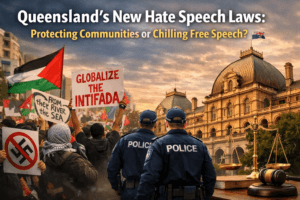
Queensland’s New Hate Speech Laws: Protecting Communities or Chilling Free Speech?
Introduction: A Legislative Line in the Sand
In a move that has ignited fierce debate, the Queensland government is set to table legislation this week that will criminalise the use of specific symbols and slogans deemed hate speech, with penalties of up to two years imprisonment. Premier David Crisafulli frames the laws as a necessary stand against antisemitism, declaring the government’s intent to “stamp out the embers of hatred.” However, beneath the surface of this announcement lies a complex web of legal, social, and political questions about the balance between public safety and civil liberties, the definition of hate, and the role of the state in policing language.
This isn’t merely a Queensland story; it’s a local manifestation of a global tension. In the shadow of the Bondi terror attack and amidst a reported rise in religious and ethnic intolerance, Australian states are grappling with how to legislate against hatred without undermining foundational democratic principles. The Queensland bill, with its explicit targeting of phrases like “from the river to the sea” and “globalise the intifada,” places it squarely at the centre of one of the world’s most polarising conflicts, raising the stakes considerably.
Decoding the Banned Phrases: Slogans as Symbols
At the heart of the new legislation are two specific slogans tied to the Israeli-Palestinian conflict. To understand the law’s impact, one must first understand the charged semantics it seeks to regulate.
“From the river to the sea, Palestine will be free” is a decades-old Palestinian nationalist rallying cry. For many pro-Palestinian advocates, it expresses a longing for freedom, equality, and self-determination across the territory between the Jordan River and the Mediterranean Sea. However, for many in the Jewish community and supporters of Israel, the phrase is interpreted as a call for the elimination of the State of Israel and, by extension, a threat to Jewish people. The Anti-Defamation Commission in Australia has labelled it antisemitic, arguing it implicitly denies Israel’s right to exist. The Queensland law adopts this latter interpretation, rendering its public use a criminal act.
“Globalise the intifada” is a more recent slogan seen at pro-Palestine protests worldwide. “Intifada” translates to “uprising” or “shaking off,” referring specifically to the Palestinian rebellions against Israeli occupation. To call to “globalise” it is, for supporters, a call for international solidarity and resistance against oppression. For critics, it is seen as advocating for the spread of violent conflict and terrorism targeting Jews globally. By banning it, the legislation categorises this call for global solidarity as an incitement to violence.
The ban extends to Nazi symbols and the Hizballah emblem, which carry more universally recognised connotations of hate and terror. The inclusion of the Palestinian slogans, however, is what transforms this from a broadly uncontroversial anti-Nazi measure into a deeply contested political act. It represents a state taking an official position on the meaning of highly contested political speech.
The Legal Landscape: A Tighter Net of Control
Queensland’s proposed laws are part of a clear national trend. Following the tragic Bondi attack, New South Wales moved to ban Nazi symbols and the performance of the Nazi salute. Victoria has strengthened its hate speech laws twice in the past year. The Queensland bill mirrors these efforts but expands the net to include specific verbal slogans.
Key provisions of the bill include:
- New Offences: Public use of the banned slogans and display of banned symbols (Nazi, Hizballah).
- Increased Penalties: Raising the maximum penalty for displaying terrorist symbols from six months to two years imprisonment.
- Protection of Worship: Introducing severe penalties of up to seven years for assaulting or threatening a religious official or damaging a place of worship.
Attorney-General Deb Frecklington states the bill proves the government is “backing and protecting the Jewish community.” Undoubtedly, for communities that have felt threatened by public chants and symbols, these laws offer a sense of security and governmental validation. The explicit focus on antisemitism addresses a genuine and documented surge in incidents following the outbreak of the Israel-Hamas war.
The Core Debate: Safety vs. Liberty
This legislative action forces a difficult societal conversation. Proponents argue that in an age of heightened social tensions and real-world violence, certain forms of speech cross the line from political expression into hateful incitement. They contend that allowing such language normalises extremist ideologies and creates an environment of fear and intimidation for targeted communities. The law, in this view, is a protective shield for vulnerable minorities.
Critics, however, see a dangerous precedent. Legal and free speech advocates warn of a “slippery slope.” Who decides which political slogans are banned tomorrow? Could a future government use similar laws to criminalise speech from environmental activists, unionists, or other political groups? The concern is that defining hate speech is inherently subjective and politically charged. Banning a phrase used by one side of a deeply felt international dispute can be seen as taking that side, potentially stifling legitimate political protest and debate.
There is also a practical question of enforcement. Will chanting a banned slogan at a protest lead to mass arrests? How will police and courts interpret context? A phrase shouted aggressively at a Jewish community event may be intended to intimidate, while the same phrase chanted at a general political rally may be intended as a statement of solidarity. The law, as reported, does not appear to distinguish intent, which is a cornerstone of many legal systems.
Political Timing and the National Context
The announcement’s timing is politically significant. It comes as Israel’s President Isaac Herzog plans a visit to Australia, promising to spark further protests. The government appears to be pre-emptively equipping law enforcement with clear tools to manage these demonstrations. Furthermore, it allows the government to project a image of strength and action on a issue of national concern, following the lead of other eastern states.
However, this also risks politicising community safety. Some may view the laws less as a principled stand against hate and more as a political manoeuvre in a sensitive electoral landscape, or as a disproportionate focus on one form of hatred over others. Communities facing other forms of racism or intolerance may question why their experiences are not met with equally specific legislative action.
Conclusion: A High-Stakes Experiment in Social Cohesion
Queensland’s proposed hate speech laws represent a bold and controversial attempt to legislate social harmony. They are a direct response to genuine fear within the Jewish community and a societal reckoning with the limits of tolerance in a pluralist democracy.
The ultimate test of this legislation will not be in its passage—which seems likely given the government’s stance—but in its application. Will it successfully dampen hatred and make targeted communities feel safer without creating a chilling effect on legitimate political discourse? Or will it inflame divisions, push certain viewpoints underground, and set a template for the censorship of unpopular ideas?
As Queensland draws this “clear line in the sand,” it embarks on a high-stakes experiment. The nation will be watching to see whether these new laws extinguish the embers of hatred, as Premier Crisafulli hopes, or whether they inadvertently fan the flames of division in an already fractured public square. The balance between security and freedom has never been more delicate, and the consequences of getting it wrong, never more profound.
You must be logged in to post a comment.