
Pythium Keratitis: A Rising Threat Mistaken for Fungal Infection
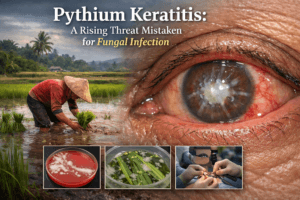
Pythium Keratitis: A Rising Threat Mistaken for Fungal Infection
Introduction: An “Imposter” Eye Infection
In tropical regions across the globe, a dangerous and deceptive eye infection is on the rise. Pythium insidiosum keratitis is a rapidly destructive corneal infection that closely mimics a common fungal ulcer but is entirely resistant to standard antifungal treatments. This mismatch leads to devastating delays in care, often resulting in corneal perforation and irreversible vision loss. From being a rare veterinary curiosity, it has transformed into a significant public health threat, particularly in agricultural regions of India, Thailand, and other parts of Southeast Asia.
The Biological “Mismatch” That Drives Danger
The core challenge with Pythium keratitis lies in its fundamental biology. Despite growing like a fungus with filamentous hyphae, Pythium insidiosum is not a fungus. It belongs to a group of organisms called oomycetes, more closely related to algae and diatoms than to true fungi.
This distinction has critical clinical implications:
- Cell Wall Composition: Unlike fungi whose cell walls contain chitin and the sterol ergosterol, Pythium has a cellulose and β-glucan-rich cell wall and lacks ergosterol entirely.
- Treatment Resistance: Most antifungal drugs (like natamycin, voriconazole, and amphotericin B) work by targeting ergosterol. Because Pythium lacks this target, these conventional antifungals are completely ineffective, yet they are often the first-line treatment due to misdiagnosis.
Who Is at Risk?
Pythium thrives in warm, stagnant water like rice paddies, ponds, and flooded fields. The infective form is a motile zoospore that can actively seek out and invade damaged corneal tissue.
Demographic and risk patterns include:
- Agricultural workers, particularly those involved in paddy cultivation, are at highest risk due to frequent exposure to contaminated water and vegetative trauma.
- A strong seasonal surge is seen during and after monsoon rains, correlating with increased outdoor agricultural activity and ideal conditions for the pathogen.
- While often associated with rural, agricultural settings, cases have been reported in urban populations with no clear history of trauma, including software professionals, students, and homemakers, suggesting diverse exposure pathways.
Table: Comparative Profile of Pythium vs. Fungal Keratitis
| Feature | Pythium Keratitis | Fungal Keratitis |
| Organism Type | Oomycete (fungus-like) | True fungus |
| Key Cell Wall Component | Cellulose, β-glucan | Chitin, Ergosterol |
| Response to Standard Antifungals | Poor / Noneffective | Often Effective |
| Classic Clinical Sign | Tentacular projections, peripheral guttering | Satellite lesions, feathery margins |
| Typical Culture Medium | Grows best on blood agar | Grows on Sabouraud dextrose agar |
| Recommended Medical Therapy | Topical antibacterials (Linezolid, Azithromycin) | Topical antifungals (Natamycin, Voriconazole) |
Spotting the Difference: Clinical Clues
Early clinical suspicion is paramount. While Pythium lesions can look very similar to fungal ulcers, experienced clinicians have identified several subtle but distinctive features.
Hallmark signs of Pythium keratitis include:
- Tentacular or Reticular Infiltrates: Linear, branch-like extensions radiating from the main ulcer into the clear cornea, resembling tentacles or a net.
- Peripheral Guttering: A unique finding where the peripheral edge of the infiltrate shows a hollowed-out or thinned appearance.
- Rapid Limbal Spread: A tendency for the infection to spread quickly toward the edge of the cornea (limbus).
- A Key Diagnostic Red Flag: Rapid worsening or no response to intensive antifungal therapy within 48-72 hours should immediately raise suspicion for Pythium.
The Diagnostic Challenge and New Tools
Diagnosis remains a major hurdle. On standard microscopy (KOH mount, calcofluor white), Pythium appears as broad, ribbon-like, sparsely septate filaments that are easily mistaken for molds like Mucor. It often grows poorly on standard fungal culture media but shows better growth on blood or chocolate agar within 24-48 hours.
Confirmatory tests include:
- Zoospore Induction (“Leaf Incarnation”): Considered a gold standard, this technique involves incubating the organism with sterile grass leaves in water to induce the formation of its motile zoospores.
- Molecular Methods: Polymerase chain reaction (PCR) and DNA sequencing of specific genetic regions provide definitive identification but are often only available in specialized centers.
Emerging diagnostic advances aim to close this gap. In vivo confocal microscopy can visualize the characteristic hyphae in the living cornea. Research is also focused on developing rapid, point-of-care tools like lateral flow immunoassays and portable molecular devices (e.g., LAMP, RPA) to enable faster, accurate diagnosis outside tertiary care hospitals.
A Paradigm Shift in Treatment
The Indian medical experience has been instrumental in redefining treatment protocols, moving away from futile antifungals toward a novel strategy.
- Medical Therapy: Antibacterials, Not AntifungalsGiven its biological difference, Pythium shows susceptibility to certain antibiotics that inhibit protein synthesis. The current first-line medical therapy, supported by clinical studies, involves:
- Topical Linezolid (0.2%) and Topical Azithromycin (1%), used in combination.
- Adjunct Systemic Antibiotics like oral minocycline or doxycycline, which may have a dual antimicrobial and anti-collagenolytic effect to reduce corneal melt.
- Surgical Therapy: Often Necessary and EarlyDue to the aggressive nature of the infection, medical therapy alone is frequently insufficient. **Early therapeutic penetrating keratoplasty (TPK)**—a full-thickness corneal transplant—is a cornerstone of management for advanced or progressive cases.
- The surgery must be performed with wide margins (1-1.5 mm beyond visible infection) to minimize the risk of recurrence at the graft edge.
- Outcomes from South India highlight the challenge: in one study, 67.6% of patients required TPK, and 54.2% of those grafts developed reinfection. This underscores the need for meticulous surgical technique and aggressive postoperative medical treatment.
Prognosis and the Path Forward
The visual prognosis for Pythium keratitis remains guarded and is heavily dependent on the speed of correct diagnosis and intervention. Delays lead to deep corneal destruction, perforation, and high rates of graft failure or even eye loss (evisceration).
To combat this emerging threat, a multi-pronged approach is essential:
- Enhanced Clinical Awareness: Training ophthalmologists, especially in endemic regions, to recognize the clinical clues of Pythium keratitis.
- Improved Diagnostics: Making faster, affordable diagnostic tests available at secondary care centers to reduce turnaround time.
- Public Health Measures: Educating high-risk communities about seeking prompt care for eye injuries and the dangers of traditional eye remedies.
- Research Priorities: Developing standardized drug susceptibility testing, optimizing surgical protocols, and exploring novel therapies like immunotherapy or cellulose biosynthesis inhibitors.
Conclusion
Pythium insidiosum keratitis represents a significant and evolving challenge in corneal infectious disease. Its masterful mimicry of fungal infection, combined with its resistance to conventional therapy, makes it a formidable threat to vision. The lessons learned from managing outbreaks in India and Southeast Asia are forming a new global blueprint for tackling this pathogen. The key to saving sight lies in suspicion, swift and accurate differentiation from fungal infection, and the immediate initiation of an antibacterial-based treatment strategy.
You must be logged in to post a comment.