
Putin’s India Visit: A Defiant Embrace and a New Phase for a Strategic Partnership
Putin’s India Visit: A Defiant Embrace and a New Phase for a Strategic Partnership
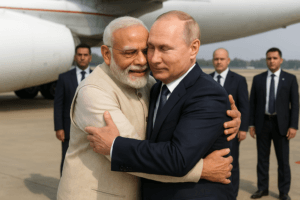
The image was powerful and deliberately chosen: Indian Prime Minister Narendra Modi breaking diplomatic protocol to personally welcome and embrace Vladimir Putin on the tarmac of Delhi’s Palam Air Force Base. This moment, captured ahead of their formal summit in December 2025, was more than a gesture of personal bonhomie. It was a calculated diplomatic signal to Washington and its allies, asserting that the eight-decade-old partnership between India and Russia remains “steady like the North Star,” immune to external pressure.
Putin’s first visit to India since the full-scale invasion of Ukraine in 2022 was a high-stakes balancing act for New Delhi. It unfolded under the shadow of punitive 50% U.S. tariffs imposed on Indian goods—a direct punishment for India’s continued purchase of discounted Russian oil. The visit served dual purposes: for Russia, it was a showcase against diplomatic isolation; for India, a defiant assertion of strategic autonomy in a polarized world.
The Substance Behind the Symbolism
While the “Modi hug” dominated headlines, the summit’s outcomes revealed a relationship evolving under new global pressures. The leaders announced an ambitious roadmap to double bilateral trade to $100 billion by 2030 and inked agreements spanning migration, shipping, critical minerals, and pharmaceuticals.
A pivotal announcement was Putin’s pledge of “uninterrupted shipments” of oil, gas, and coal to fuel India’s growing economy. This was a direct rebuttal to U.S. pressure. Notably, Indian officials offered a more muted response, with Foreign Secretary Vikram Misri emphasizing that energy purchases remain subject to “evolving market dynamics,” highlighting the government’s caution.
Defense, the traditional pillar of the relationship, saw a qualitative shift. No major new arms purchase was announced, signaling India’s diversification efforts. Instead, the focus was on joint development and production, aligning with India’s “Aatmanirbhar Bharat” (self-reliant India) initiative. A significant, though quietly finalized, deal was the lease of a Russian nuclear-powered attack submarine to India, valued at roughly $2 billion.
The following table summarizes the key outcomes and notable omissions from the summit:
| Area of Focus | Key Outcomes & Agreements | What Was Notably Absent or Constrained |
| Energy & Trade | Pledge of “uninterrupted” oil supplies; Target of $100bn trade by 2030; 96% of bilateral trade now in rupees/roubles. | No new concrete mechanism to shield oil trade from sanctions; India already reducing Russian oil imports by 38% (Oct 2025 data). |
| Defence Cooperation | Focus on joint production & advanced platforms; Ratification of Reciprocal Exchange of Logistic Support (RELOS) pact; Finalization of nuclear submarine lease. | No announcement of major new platforms (e.g., Su-57 jets, S-400 units); Public acknowledgment of Russian delivery delays due to Ukraine war. |
| Strategic Messaging | Affirmation of “special & privileged strategic partnership”; Rejection of “with us or against us” blocs. | No major shift in India’s stance on Ukraine beyond calls for “peaceful resolution”. |
| Diversified Cooperation | Agreements on critical minerals, space research, pharmaceuticals, Arctic shipping, and visa-free travel. | Historical trade imbalance remains; Russia is only India’s 26th-largest export destination. |
Walking the Geopolitical Tightrope
India’s hosting of Putin was a masterclass in multi-alignment. It demonstrated that New Delhi can, and will, engage with all major powers on its own terms. As former diplomat Dilip Sinha noted, India must “protect the India-America relationship from the Trump problem,” while also valuing Russia’s historically reliable defense cooperation.
This balancing act is becoming more precarious. The U.S. sees India as a crucial counterweight to China in the Indo-Pacific, making a complete rupture unlikely. However, Washington’s duplicity has been noted: while pressuring India, the U.S. has itself increased imports of Russian fertilizers and precious metals. Former Pentagon official Michael Rubin criticized this hypocrisy, stating that if the U.S. cannot offer India cheaper energy alternatives, its “best approach is simply to shut up”.
For Europe, the visit presented a dilemma. Envoys from the UK, France, and Germany took the unusual step of publishing a joint op-ed in an Indian newspaper criticizing Russia ahead of the visit. Yet, the EU’s strategic and economic vulnerabilities limit its options. Eager to finalize a free trade deal with India and offset the impact of U.S. tariffs, Brussels is likely to maintain a pragmatic separation between security concerns and trade policy.
The China Factor and the Future of the Partnership
An unspoken but critical dimension of the summit was China. Russia’s “no limits” partnership with Beijing is a profound concern for New Delhi. India’s cultivation of Russia is, in part, an effort to prevent Moscow from drifting completely into Beijing’s orbit, which would fundamentally alter Asia’s security landscape to India’s detriment.
The partnership is also transforming from within. It is moving beyond its post-Cold War model of simple buyer-seller transactions in defense and energy. The new emphasis is on joint development in technology, space (including human spaceflight and orbital infrastructure), and building alternative financial and logistics corridors like the International North-South Transport Corridor (INSTC). This shift acknowledges India’s rise as a technological and strategic power seeking more equitable partnerships.
However, significant constraints remain. Russia’s defense industry is strained by the war, leading to delays in existing Indian orders. Furthermore, as analyst Rajan Kumar warns, should the Ukraine war grind on without diplomatic progress, India could face increased Western pressure, including more sanctions, limiting its room for maneuver.
Ultimately, the Delhi summit was less about dramatic breakthroughs and more about reaffirming continuity in a turbulent world. It sent an unequivocal message that India defines its national interest independently. As former Indian ambassador P.S. Raghavan wrote, by fronting the visit, Modi signaled that the “looking-over-one’s-shoulder” phase of Indian foreign policy is over. In a multipolar world order taking shape, India is demonstrating that it intends to be a pole in its own right, guided by its own constellation of relationships. The steadfast “North Star” of its partnership with Russia, despite its complexities, illuminates that path forward.
You must be logged in to post a comment.