
Putin in New Delhi: A Strategic Embrace in a World Reordering
Russian President Vladimir Putin’s December 2025 visit to New Delhi, marked by Prime Minister Narendra Modi’s rare personal welcome, was a powerful demonstration of a “time-tested” strategic partnership actively navigating a fractured global order. Occurring against the backdrop of the Ukraine war and Western sanctions, the summit highlighted how both nations leverage this historical bond to assert their strategic autonomy—India by balancing its ties with the West while securing crucial Russian energy and defense supplies, and Russia by breaking its international isolation.
Their cooperation, spanning defense, nuclear energy, and trade now nearing $70 billion, is adapting through local manufacturing and new payment systems to withstand external pressure. Ultimately, the meeting served as a joint statement for a multipolar world, affirming that their convergences of national interest and civilizational friendship remain resilient amidst contemporary geopolitical storms.
Putin in New Delhi: A Strategic Embrace in a World Reordering
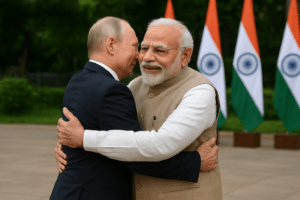
A rare personal welcome at the airport signaled more than diplomatic courtesy; it was a public reaffirmation of a “time-tested” bond between two nations determined to navigate global turbulence on their own terms.
When Russian President Vladimir Putin stepped onto the tarmac at New Delhi’s Palam Airport on December 4, 2025, he was greeted not by a junior minister but by Indian Prime Minister Narendra Modi himself—a rare protocol-breaking gesture reserved for only the closest of allies. The personal warmth of their handshake and embrace set the tone for a two-day summit that was much more than a routine diplomatic exchange. Occurring against a backdrop of unprecedented global sanctions on Russia and a reshuffling of U.S. foreign policy under President Donald Trump, this visit underscored a partnership that refuses to be sidelined by Western pressure.
This 23rd India-Russia Annual Summit is a powerful testament to the resilience of a relationship forged in the Cold War and adapted for a multipolar world. While headlines focus on defense deals and energy imports, the deeper story is one of strategic autonomy, where both nations are leveraging their historical ties to secure their interests in an increasingly fractured international order.
A Partnership Forged in History
The roots of the modern India-Russia relationship stretch back to the foundations of independent India. The Soviet Union’s diplomatic and material support during the 1971 Bangladesh Liberation War, including crucial vetoes at the UN Security Council, cemented a bond of trust that has endured for over half a century. During the Cold War, the Soviet Union became India’s primary supplier of advanced military platforms, a dependency that evolved into a deep, institutionalized partnership.
This historical capital provides a reservoir of goodwill that both leaders frequently invoke. As Congress MP Shashi Tharoor noted during the visit, “the value of Russian friendship has been proven,” from energy security to defense. The relationship was formally elevated to a “Special and Privileged Strategic Partnership” in 2010, a designation that commits both nations to annual summits and continuous high-level engagement, regardless of the global political weather.
The Pillars of a Modern Partnership
The enduring India-Russia relationship is built on several interconnected pillars, each demonstrating a blend of historical dependence and forward-looking adaptation.
Table: The Multifaceted India-Russia Partnership
| Partnership Pillar | Key Components & Examples | Strategic Significance |
| Defense & Security | S-400 air defense systems, Su-30MKI & MiG-29 jets, T-90 tanks, BrahMos missile (joint development), discussion of Su-57 fighters. | Ensures military readiness (60-70% of Indian equipment is Russian-origin) and supports India’s indigenous defense manufacturing through technology sharing and licensed production. |
| Energy Security | Russia is India’s top crude oil supplier (over 35% of imports). Fuel delivery for Kudankulam Nuclear Plant Units 3 & 4 during the visit. Cooperation on Small Modular Reactors (SMRs). | Provides discounted energy, stabilizes India’s economy, and supports long-term clean energy goals through civil nuclear cooperation. |
| Economic & Trade | Bilateral trade nearing $70 billion, heavily skewed by oil imports. Goal to reach $100 billion by 2030. New talks on fisheries, meat, dairy, and agricultural trade. | Aims to rebalance trade through increased Indian exports. Explores alternative payment mechanisms to bypass Western sanctions. |
| Diplomatic & Global | Alignment in multilateral forums (BRICS, SCO, G20). Shared rhetoric on “strategic autonomy” and a “multipolar world”. | Allows both nations to counter Western dominance, with Russia supporting India’s bid for a permanent UNSC seat. |
Navigating the Strategic Tightrope: India’s Balancing Act
Perhaps the most critical dimension of this summit is what it reveals about India’s masterful, and sometimes precarious, multi-alignment foreign policy. New Delhi is simultaneously deepening a landmark defense partnership with the United States (including a potential deal for U.S.-made jet engines) while rolling out the red carpet for the leader of a nation the West has sought to isolate.
This balancing act is not born of contradiction but of cold, pragmatic calculation. As analysts note, India does not view ties with Russia and the U.S. as a zero-sum game. Instead, each relationship serves distinct strategic needs. The U.S. partnership is central to India’s Indo-Pacific strategy and counterbalancing China, while Russia remains an irreplaceable source of military hardware and a stable, discounted energy supply.
The timing is particularly pointed. The visit comes as the Trump administration has imposed tariffs on India, partly over its continued purchases of Russian oil. This pressure has, paradoxically, increased the strategic value of the Russian relationship for New Delhi. As former Indian Foreign Secretary Kanwal Sibal explained, “The US cannot dictate what India’s foreign policy should be. We must accommodate and resist”. Putin’s visit is a clear signal of that resistance, demonstrating that India’s foreign policy operates on its own terms.
The Ukraine War: The Unspoken Context
The war in Ukraine, now in its fourth year, forms the unspoken backdrop to every handshake and agreement. India has consistently refused to condemn the invasion, instead calling for dialogue and diplomacy. This neutral stance, often frustrating to Western allies, is rooted in practical necessity and principle.
From a practical standpoint, condemning Russia would jeopardize the S-400 air defense systems that India relies on for its national security and would disrupt the flow of discounted oil that has been a boon to its economy. On principle, India’s stance reflects its longstanding commitment to strategic autonomy—the right to judge international issues based on its own national interest rather than aligning with any bloc.
During the visit, Putin himself framed the partnership in this light, stating that the India-Russia collaboration “is not directed against any country” but is “solely aimed at safeguarding the national interests of the two sides”. This rhetoric directly counters Western narratives that frame engagement with Russia as a hostile act.
Challenges on the Horizon
Despite the public displays of friendship, the partnership faces significant structural challenges that the summit must address:
- A Glaring Trade Imbalance: The bilateral trade of nearly $70 billion is overwhelmingly skewed, with Indian imports (mainly oil) accounting for about $64 billion and exports languishing at under $5 billion. Closing this gap is a top Indian priority, with discussions on exporting pharmaceuticals, agricultural products, and machinery.
- The “China Factor”: Russia’s deepening “no-limits” partnership with China introduces a fundamental tension. For India, a Russia that is increasingly economically and strategically dependent on Beijing is a less reliable partner, especially amid ongoing border tensions with China.
- Sanctions and Transactional Hurdles: Western sanctions have created immense difficulties in establishing reliable payment channels for trade, slowing down even agreed-upon deals. A major agenda item is creating a “third-country-proof” rupee-ruble payment mechanism to insulate bilateral trade from external pressure.
The Road Ahead: More Than a Transactional Friendship
The outcomes of the 23rd Annual Summit will reverberate beyond the signing ceremonies. The expected agreements on defense localization, long-term energy contracts, and connectivity corridors like the International North-South Transport Corridor (INSTC) point to a relationship that is adapting for the long term.
Ultimately, the significance of Modi and Putin’s meeting lies in its powerful symbolic message to the world. In an era where nations are often pressured to choose sides, India and Russia are demonstrating that civilizational friendships and convergences of national interest can withstand immense external pressure. They are jointly asserting a vision of a multipolar world order where middle powers and great powers alike can maintain a web of independent relationships.
As the world watches, the embrace in New Delhi is a reminder that the old geopolitical maps are being redrawn. The India-Russia partnership, steeped in history and recalibrated for contemporary challenges, remains a crucial axis in this new, uncertain world—a steadfast bond proving its worth in the storm.
You must be logged in to post a comment.