
Purim, Prayers, and Projectiles: Inside Israel’s Shift from a War on Terror to a Biblical Crusade
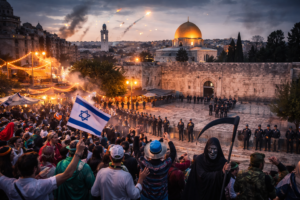
In a striking juxtaposition, Jerusalem embodies a profound dissonance as thousands of Israeli Jews celebrate the Purim holiday with carnival-like festivities while, just a mile away, the Al-Aqsa Mosque remains closed for the fifth consecutive day during Ramadan under security pretexts, symbolizing Israel’s escalating shift from a secular national conflict to a messianic religious crusade. Israeli leaders, from Prime Minister Benjamin Netanyahu to secular opposition figures, increasingly invoke biblical narratives—casting Iran as the ancient enemy Amalek and its late leader as the villain Haman from the Purim story—to justify regional violence and territorial expansion, transforming what was once a negotiable conflict over land into an absolute, non-negotiable religious war. This theological framing, embraced even by secular politicians who now speak of “biblical mandates” and view current events as divine prophecy fulfillment, renders political compromise impossible while alarming Palestinians who find themselves fighting not just an occupation but a growing messianic fundamentalism that threatens to ignite the broader Islamic world.
Purim, Prayers, and Projectiles: Inside Israel’s Shift from a War on Terror to a Biblical Crusade
The night sky over Jerusalem has become a canvas for competing anxieties. In the upscale neighbourhoods of Rehavia and Nahlaot, the sound of air-raid sirens warning of incoming Iranian missiles has, over the past week, been replaced by a more ancient, triumphant noise: the rhythmic clapping, singing, and dancing of thousands of Jewish Israelis celebrating Purim. Just a few kilometres away, in the walled enclave of the Old City, the silence is deafening. For the fifth consecutive day, the calls to prayer from the minarets surrounding the Al-Aqsa Mosque have been silenced. The brass plates on the heavy wooden doors of the compound remain cold to the touch. It is the middle of Ramadan, the holiest month for fasting and reflection, yet the gates are shut. The pretext is security. The reality is a profound and terrifying dissonance.
In one part of the city, a carnival of religious deliverance. In another, the quiet of spiritual imprisonment. This is the new reality of a nation gripped by a fervour that its leaders are increasingly framing not as a geopolitical struggle, but as a pre-ordained biblical war.
For decades, the conflict between Israelis and Palestinians, and by extension between Israel and its regional adversaries like Iran, was presented to the world—and often to itself—as a tragic clash of nationalisms. It was a dispute over land, borders, refugees, and security. Land, as the saying goes, is negotiable. It can be divided, traded, and discussed around conference tables in Oslo, Camp David, or Geneva. But what happens when the language of realpolitik is replaced by the language of prophecy? When a prime minister stands before a missile-damaged home and quotes not from a UN resolution, but from the Book of Deuteronomy?
Israel is crossing a threshold. It is moving from a state defending its existence against hostile neighbours to a movement animated by messianic destiny. And in doing so, it is transforming a conflict that had parameters into an infinite war.
The Carnival and the Curfew
To understand the shift, one must understand the texture of daily life in this divided city. On Wednesday night, I stood at the edge of a Purim celebration in downtown Jerusalem. The streets were a blur of colour. Children dressed as superheroes, soldiers, and ancient kings ran through the crowds. Grown men wore grotesque masks of modern-day politicians. The air was thick with noise and the smell of street food.
Among the revellers, I spotted a woman dressed in a grim costume. She wore a black executioner’s hood and carried a prop axe. It was a shocking sight, but it was merely a mimicry of political reality. Just days prior, Limor Son Har-Melech, a Knesset member from the far-right Otzma Yehudit party, had attended the President’s official Purim reception dressed in an identical grim reaper-style executioner’s outfit. Her costume was not merely for shock value; it was a statement of intent. Her party is the primary driver behind a bill currently progressing through the Knesset that seeks to impose the death penalty on Palestinian prisoners convicted of murder. The line between political theatre and lethal policy is blurring.
Just a mile away, the contrast could not have been starker. In East Jerusalem, the streets leading to the Lion’s Gate were empty save for Israeli police units. Inside the Al-Aqsa compound, the courtyards that would usually be filled with tens of thousands of worshippers breaking their fast or performing the night prayers of Taraweeh were barren. Shopkeepers in the Old City’s Muslim Quarter sat on plastic chairs outside their shuttered stores, sipping bitter coffee in silence.
Abu Ahmad, a textile vendor who has had a shop near the Via Dolorosa for forty years, watched the distant celebrations on his phone. “They are celebrating their holiday by dancing on the graves of our holy days,” he said quietly. “They say it is because of the war, because the missiles are falling. But the missiles fall on them, not on the Haram (the sanctuary). They close our mosque to punish us for what Iran does. We are the hostages they keep in their own city.”
The Modern Amalek and the New Haman
The intellectual and emotional engine driving this shift is the invocation of two specific figures from the Hebrew Bible: Amalek and Haman.
Prime Minister Benjamin Netanyahu, a leader known for his rhetorical flair, has historically framed his security policies in secular terms: the need to prevent a nuclear Iran, the right to self-defence, the fight against terrorism. But since the October 2023 attacks, and especially in the current escalation with Iran, his language has taken a markedly theological turn.
Visiting the site of an Iranian missile strike in Beit Shemesh, which tragically killed nine Israelis, Netanyahu stood among the wreckage and declared: “We read in this week’s Torah portion, ‘Remember what Amalek did to you.’ We remember, and we act.”
The reference to Amalek is one of the most loaded and dangerous in the Jewish textual tradition. In the Bible, the Amalekites attacked the Israelites from behind as they fled Egypt, targeting the weak and weary. God commands the Israelites to “blot out the memory of Amalek from under heaven.” It is a commandment of total war against an enemy deemed irredeemably evil. To invoke Amalek is to strip your opponent of their humanity and to frame your struggle as one of existential survival against a force that seeks your annihilation.
This is not merely political poetry. It is a theological weapon. By labelling the Iranians—or previously, Hamas—as Amalek, Netanyahu is not just condemning their actions; he is casting them as a trans-historical force of evil that must be eradicated, not merely contained or negotiated with.
This narrative was supercharged by the timing of the conflict with the holiday of Purim. The Book of Esther tells the story of Haman, a vizier in the Persian court who plots to destroy the Jewish people. His plan is foiled by Queen Esther and her cousin Mordechai, and he is ultimately hanged on the very gallows he built for them.
The parallels were too potent for many Israelis to ignore. On social media, the image of the late Iranian Supreme Leader, Ayatollah Ali Khamenei, was photoshopped with the “ears of Haman”—a reference to the triangular pastries, hamantaschen, eaten during the holiday.
On mainstream media, the comparison was embraced with unsettling enthusiasm. Avri Gilad, a popular secular TV host on Channel 12, dressed as a pilot for his Purim broadcast. With a straight face, he marvelled at the cosmic coincidence of history. “It’s amazing that it comes after 2,000 years, and it’s really the same thing… the whole story closing on an astonishing historical scale.”
This is the danger of living inside a story. When the leaders and the popular culture convince the public that they are living through a replay of a sacred text, the stakes become absolute. Compromise becomes heresy.
The Secular Believers
Perhaps the most telling sign of this shift is how the language of messianism has been adopted by those outside the traditional religious camp. For years, the religious Zionist and ultra-Orthodox parties were the primary drivers of the “Greater Israel” ideology, viewing the settlements in the West Bank as a divine commandment. But now, the centre and even the secular opposition are borrowing from the same hymn sheet.
Yair Lapid, the leader of the opposition and a figure often associated with the secular, liberal elite, recently made a statement that would have been radical a decade ago. “Zionism is based on the Bible,” he said. “Our mandate over the Land of Israel is biblical.”
This is a significant departure from the classic Labour Zionism of Israel’s founders, who, while they revered the Bible as a history book, largely viewed it as a source of cultural identity rather than a legal deed to property. By framing the mandate as “biblical,” Lapid moves the discourse away from international law (UN resolutions, the Geneva Convention) and places it in a metaphysical realm that cannot be challenged by the “gentile” nations of the world.
Even in the reaction to the military operations, this religious framing pervades. Following the assassination of Ayatollah Khamenei, Yulia Malinovsky, a Knesset member from the secular, Russian-dominated Yisrael Beiteinu party, posted on social media: “The modern Haman has been eliminated.”
It is a linguistic takeover. The secularists are using the theologists’ playbook.
Eitan Lasri, a former adviser to Netanyahu, articulated this worldview on the right-wing Channel 14 website with chilling clarity. He framed the current war with Iran not as a geopolitical conflict over nuclear enrichment or regional hegemony, but as a replay of the Purim miracle. “The campaign of Purim… is a struggle between the desire to destroy and the right to live. Just as in the days of Mordechai and Esther, the threat turned into victory; so too in our generation we can turn the threat into an opportunity.”
The View from the Other Side of the Wall
For Palestinians, watching this transformation is like watching someone you are in a fight with slowly convince themselves that you are a demon. It renders the political impossible.
For 75 years, the Palestinian national movement has struggled against an occupation. They have fought tanks, checkpoints, and settlements. These are tangible things. You can document them, protest them, and take them to the International Court of Justice. But how do you fight a ghost? How do you fight a belief?
Mahmoud, a father of four from the Shuafat refugee camp, put it to me bluntly. “They used to say they needed security, so they took our land. Now they say God gave it to them. What am I supposed to negotiate with God? I can argue with a politician. I can make a deal with a general. I cannot argue with a priest who believes he is Mordechai.”
The closure of Al-Aqsa Mosque during Ramadan is the physical manifestation of this theological shift. Al-Aqsa is not just a building; it is the third holiest site in Islam. For Palestinians, it is the last symbol of their sovereignty and presence in Jerusalem. By closing it—under the flimsy pretext of war safety, while simultaneously allowing thousands of armed and costumed Israelis to flood the streets—the Israeli government is sending a clear message: In this biblical war, your rites of worship are subordinate to our security concerns, and your presence is contingent on our mercy.
A War Without End
The greatest danger of this messianic turn is that it makes peace an impossibility. If the war is against Amalek, there is no white flag that Amalek can wave that would be acceptable. If the land is a divine mandate, there is no partition plan that a politician can sign that would be valid.
The author of the original piece, Lubna Masarwa, notes that for years, the conflict had parameters. It was ugly, bloody, and oppressive, but it was defined. “Land is negotiable; religion is not,” she writes.
By reframing the struggle as a religious crusade, Israel is not just changing its own self-perception; it is guaranteeing the response from the other side. The Islamic world, from the Shia militias in Iraq to the Sunni masses in the Arab street, may not have risen as one to fight for Palestine as a nationalist cause. But if the conflict is framed as a war on Islam, as an attack on the sanctity of Al-Aqsa by a messianic Jewish power, the calculus changes entirely.
As I walked back through the city that night, the sounds of Purim fading behind me and the silence of the closed mosque looming ahead, I was struck by the words of Etsiq, the food shop owner the reporter spoke to. “We like wars. It’s also good for the food business.”
It was a crass, cynical, and perhaps honest statement of survival. But it misses the point. Wars fought for land eventually end. The land runs out, or the people get tired. But wars fought for God, fought to fulfil a prophecy, fought to avenge a story written thousands of years ago, do not have a natural conclusion. They only end when one side ceases to believe. And in Jerusalem tonight, belief is the only currency that seems to matter.
You must be logged in to post a comment.