
Pune Winter Deepens: Unpacking the Science Behind the Sharp Drop in Night Temperatures
Pune is experiencing a pronounced drop in minimum temperatures, driven by clear post-monsoon skies and dry northerly winds that allow heat to escape rapidly at night, with areas like Pashan recording 12.5°C. This cooling trend highlights striking micro-climates within the city, where greener suburbs cool faster than urban heat-retaining cores like Chinchwad.
While these conditions are expected to intensify further after mid-December with colder northwesterly winds, the IMD notes that Maharashtra remains unaffected by the cold waves and fog impacting Central and Eastern India, setting the stage for Pune’s characteristic winter of warm days and sharply chilly nights.
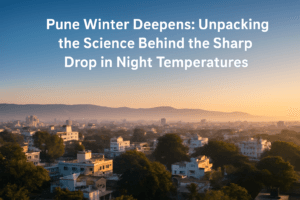
Pune Winter Deepens: Unpacking the Science Behind the Sharp Drop in Night Temperatures
If you stepped out early this morning in Pune, the crisp bite in the air was unmistakable. The familiar, gentle coolness has sharpened into a more assertive chill, marking a definitive shift in the city’s seasonal rhythm. As reported by the India Meteorological Department (IMD), clear skies and dry northerly winds are orchestrating a significant dip in minimum temperatures across the district, with locations like Pashan (12.5°C) and Shivajinagar (12.9°C) already feeling the effects. But this isn’t just a fleeting cold snap; it’s a calibrated seasonal transition driven by specific atmospheric mechanics, with implications for our health, routines, and the character of Pune’s famous winter.
The Mechanics of the Chill: Why Clear Skies Mean Colder Nights
The current weather pattern is a classic textbook chapter on post-monsoon winter setup in the Deccan Plateau. To understand why your morning is colder, you need to look up at the night sky. The “clear skies” mentioned by the IMD are the primary architect.
During the day, the sun heats the earth’s surface. At night, this accumulated heat is radiated back into the atmosphere. When clouds are present, they act like an insulating blanket, trapping a portion of this long-wave radiation and keeping temperatures relatively moderated. With the monsoon retreat complete, the cloud cover has vanished. The result is an unobstructed escape route for terrestrial heat, allowing it to vanish into the upper atmosphere—a process known as “radiational cooling.”
This effect is powerfully amplified by the dry northerly and north-easterly winds now sweeping across Maharashtra. Moist air holds heat more effectively than dry air. These continental winds, originating from the cooler interiors of North India, are devoid of moisture. As they sweep over Pune, they not only bring in cooler air but also facilitate faster evaporation and more efficient cooling of the ground surface. It’s a double-barreled effect: no blanket overhead and a dry, cool fan blowing across the city at night.
A Tale of Two Cities Within a City: Hyperlocal Temperature Variations
The IMD data reveals a fascinating micro-climate narrative within Pune itself. The variation between readings—from 17.3°C in Chinchwad to 12.5°C in Pashan—isn’t random. It’s a direct consequence of urban geography and the “Urban Heat Island” (UHI) effect.
- Urban Cores (Like Chinchwad, Koregaon Park): Dense concentrations of concrete, asphalt, and human activity absorb and retain heat much more efficiently than natural landscapes. This stored heat is released slowly through the night, cushioning the drop in minimum temperatures. Higher pollution levels can also sometimes create a minor, localized blanketing effect.
- Peripheral & Green Areas (Like Pashan, Shivajinagar): These areas, often closer to the city’s outskirts or rich with vegetation and open spaces, cool down much faster. With more permeable ground cover and less thermal mass from buildings, they radiate heat away quickly, leading to lower minimum temperatures. The Lohegaon station’s drop into the “double-digit range” similarly reflects its airport location, typically more open and exposed.
This disparity means that while a resident of Pashan is reaching for a thick sweater, someone in central Pune might still find a light jacket sufficient. It’s a reminder of how lived weather experience can vary dramatically across short distances.
The Broader Canvas: Cold Waves, Fog, and Isolated Rains
While Maharashtra remains under the influence of dry, cooling winds, the IMD’s national forecast paints a more dramatic picture for other parts of India. The predicted cold wave conditions over Central and Eastern states like Madhya Pradesh, Chhattisgarh, and Odisha are driven by more potent systems, including the movement of western disturbances and the establishment of strong surface-level high-pressure areas that funnel cold air southwards.
The dense fog alerts for the Northeast and Himachal Pradesh are a related but distinct phenomenon. Fog requires moisture. In these regions, despite the cold, sufficient low-level moisture persists. The calm winds and clear nights that cause radiational cooling also cool the air near the ground to its dew point, causing water vapor to condense into tiny droplets and reducing visibility to a few hundred meters—a major disruptor for travel logistics.
Meanwhile, the light rain forecast for the northern hill states and the Andaman & Nicobar Islands is tied to entirely separate weather systems—an upper-air circulation and a trough in the easterlies. As the IMD correctly notes, these systems have no bearing on Maharashtra’s weather, underscoring the complex, multi-theatre nature of subcontinental meteorology in December.
Looking Ahead: The Intensifying Winter and Human Impact
The IMD’s projection of a further dip in minimum temperatures over the coming week, with daytime maxima remaining near normal, sets the stage for Pune’s quintessential winter character: pleasantly warm, sunny afternoons that belie the sharp chill of the mornings and evenings. This large diurnal range (the difference between day and night temperatures) is a hallmark of a dry continental winter.
Experts point to a key timeline: after December 15. This is when the full establishment of the winter-time pressure pattern typically directs stronger, colder northwesterly winds from the snow-clad Himalayas across the Indo-Gangetic plains and down into the Peninsula. Pune’s winter often finds its true peak intensity in the last two weeks of December and through January, once this pattern is locked in.
Beyond the data, this cooling has tangible human impacts:
- Health: The sharp diurnal shift is a common trigger for respiratory issues, sore throats, and aggravated allergies. The dry air can lead to skin and lip chapping. It’s a season that demands layered clothing to adapt to the day’s thermal journey.
- Agriculture: For the rural belts of Pune district, these cold, dry nights (known as “शीतपढ़” or sheetapadh) are crucial for certain crops like grapes and winter vegetables, influencing sugar accumulation and quality.
- Lifestyle: Mornings begin later, evening strolls require planning, and the quest for sunshine becomes a daily ritual. The city’s social life subtly migrates from open chowks to sun-drenched balconies and cafes in the afternoon.
Embracing the Seasonal Shift
The current drop in temperature is more than a statistical blip; it’s the opening movement of Pune’s winter symphony. It’s a season that asks for a slight recalibration—of our wardrobes, our daily schedules, and our health precautions. As we move deeper into December, the clear, starry nights will grow colder, the morning mist over the Mula-Mutha will thicken, and the afternoon sun will become a cherished commodity.
Understanding the science behind the chill—the clear skies, the dry winds, the urban heat islands—adds a layer of appreciation for this dynamic season. It connects the personal experience of reaching for a blanket to the grand dance of continental wind patterns and radiational physics. Pune’s winter is arriving, not with a stormy announcement, but with a steady, quiet, and increasingly crisp insistence.
You must be logged in to post a comment.