
Preserving Heritage, Nourishing Futures: How Odisha’s Traditional Finger Millet Varieties Are Revolutionizing Sustainable Agriculture
A landmark study in Odisha, India, has identified four traditional finger millet varieties—Gupteswar Bharathi, Kundra Bati, Laxmipur Kalia, and Malyabant Mami—that deliver stable yields even under marginal conditions while offering exceptional nutritional value (high calcium, iron, and zinc) and abundant stover for livestock. By combining scientific evaluation with the knowledge of tribal farmers who have conserved these varieties for generations, the research demonstrates that mainstreaming such traditional crops can simultaneously boost food security, preserve agrobiodiversity, and support sustainable agriculture. The findings, rooted in a Globally Important Agricultural Heritage System (GIAHS) site, underscore how integrating farmer-led conservation with formal recognition (including potential Geographical Indication status) provides a replicable model for building resilient, nutrition-sensitive farming systems worldwide.
Preserving Heritage, Nourishing Futures: How Odisha’s Traditional Finger Millet Varieties Are Revolutionizing Sustainable Agriculture
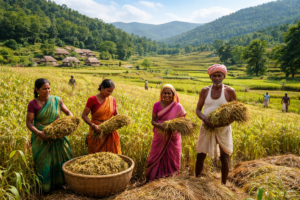
In the rolling hills of Odisha’s Koraput region—a landscape so rich in agricultural biodiversity that the Food and Agriculture Organization (FAO) has designated it a Globally Important Agricultural Heritage System (GIAHS)—a quiet agricultural revolution has been taking root. Here, where tribal farming communities have cultivated finger millet for generations, a groundbreaking study is demonstrating that the path to sustainable agriculture may lie not in abandoning tradition, but in embracing it with scientific rigor.
The recently published research in Scientific Reports, led by Arabinda Kumar Padhee and a team of agricultural scientists from across India, represents a pivotal moment in how we think about crop diversity, food security, and the future of smallholder farming. By systematically evaluating thirteen traditional finger millet varieties conserved by tribal farmers, the study has identified four exceptional varieties that outperform modern expectations while preserving the genetic heritage that makes agriculture resilient.
The Hidden Treasure in Farmers’ Fields
For decades, agricultural development has been dominated by a narrative of modernization—high-yielding varieties, chemical inputs, and monoculture systems that promised to feed the world. While this approach succeeded in boosting production in many contexts, it came at a staggering cost: the erosion of crop genetic diversity that had evolved over millennia of farmer selection and adaptation.
The situation with finger millet (Eleusine coracana) in Odisha reflects this global pattern. Despite being a nutritional powerhouse—rich in calcium, iron, and zinc—finger millet had been pushed to the margins of agricultural policy and research. Traditional varieties, each adapted to specific microclimates and cultural preferences, were disappearing as farmers increasingly turned to a handful of standardized varieties.
What makes the current study remarkable is its starting point. Rather than beginning in a research station with elite breeding lines, the scientists turned to the true custodians of genetic diversity: the tribal millet farmers of Odisha. From a larger collection of 46 traditional varieties maintained by these farming communities, the research team selected thirteen for rigorous evaluation across four diverse growing regions—Koraput, Malkangiri, Mayurbhanj, and Rayagada.
This approach recognizes something fundamental that top-down agricultural development has often overlooked: farmers are not merely recipients of technology but active innovators who have been conducting their own selection experiments for thousands of years. The varieties they preserve are not random collections of plants but carefully curated genetic resources, each with specific characteristics that matter to the communities that grow them.
The Four Champions: Varieties That Defy Expectations
After comprehensive multi-location trials, four traditional varieties emerged as clear standouts: Gupteswar Bharathi, Kundra Bati, Laxmipur Kalia, and Malyabant Mami. Each tells a story of adaptation and potential that challenges conventional assumptions about traditional varieties.
Gupteswar Bharathi proved to be the most broadly adapted, demonstrating superior performance across all four test locations. With a grain yield of 1863.9 kg per hectare under marginal conditions—where modern varieties often struggle—this variety offers a compelling alternative for farmers who cannot afford or choose not to use intensive inputs. Its consistent performance across diverse environments suggests a genetic robustness that modern breeding programs would do well to study.
Kundra Bati (1776.6 kg/ha) excelled in three of the four locations, demonstrating particular strength in Malkangiri, Mayurbhanj, and Rayagada. Laxmipur Kalia (1735.3 kg/ha) and Malyabant Mami (1686.1 kg/ha) showed more specialized adaptation, performing best in specific locations—a reminder that biodiversity means matching the right variety to the right place, not searching for a single solution that works everywhere.
But yield is only part of the story. Perhaps more striking than their productivity is what these traditional varieties offer beyond grain weight. The nutritional analysis revealed exceptional levels of micronutrients that matter profoundly for human health: grain iron ranging from 20.4 to 23.2 parts per million, grain zinc between 17.5 and 19.6 ppm, and calcium content that is nothing short of extraordinary—2692 to 3221 parts per million.
To put these numbers in perspective, finger millet is already recognized as one of the richest plant sources of calcium, but these traditional varieties push that advantage even further. For communities where dairy consumption is limited and nutritional deficiencies are common, access to such nutritionally dense grains can mean the difference between health and chronic malnutrition.
Beyond Grain: The Full-Plant Value
One of the most insightful findings of the study relates to what farmers have always known but researchers often overlook: the value of a crop extends beyond its grain. The four identified varieties produced stover yields exceeding 8000 kg per hectare—a critical consideration in mixed farming systems where crop residues provide essential livestock feed.
In Odisha’s smallholder farming systems, where agriculture and animal husbandry are deeply intertwined, this dual-purpose characteristic is not a minor benefit but a fundamental feature of sustainability. Farmers who grow these varieties are not just producing food for their families but also fodder for their animals, which in turn provide manure, draft power, and additional income. This integration—so central to traditional farming systems—is precisely what modern agricultural development has often fragmented in pursuit of specialization.
The Environment Effect: A Nuanced Understanding of Nutrition
The study revealed something fascinating about the interplay between genetics and environment. When the researchers analyzed the nutritional content of varieties grown specifically in Koraput, they found approximately 20 percent higher grain protein and micronutrient levels compared to the same varieties grown elsewhere.
This finding carries profound implications for both nutrition policy and agricultural development. It suggests that certain growing environments—like the Koraput region with its unique combination of soil, climate, and traditional management practices—have the capacity to enhance the nutritional quality of crops. This is not merely a matter of genetic potential but of the conditions under which that potential is realized.
For efforts to address malnutrition through agriculture—an approach often called “nutrition-sensitive agriculture”—this finding underscores the importance of place. It suggests that interventions to improve nutrition cannot be reduced to simply distributing seeds of nutritionally enhanced varieties. The environment in which those varieties are grown, including the traditional knowledge and practices applied to them, plays a crucial role in determining the final nutritional value.
Conserving Diversity Through Use
The study’s most significant contribution may be its demonstration of a principle that conservation biologists have long advocated but rarely succeeded in implementing at scale: the most effective way to conserve genetic diversity is through use.
Traditional varieties are not museum pieces to be preserved in genebanks, though ex situ conservation remains important. They are dynamic populations that continue to evolve in response to changing conditions, shaped by farmer selection and adaptation to local environments. When these varieties are no longer grown, the evolutionary processes that sustain their diversity cease.
By notifying these four varieties for large-scale cultivation in their target locations, the researchers and agricultural authorities have created conditions for their continued evolution. Farmers who grow these varieties will continue to select plants with desirable characteristics, adapting them to local conditions and changing climates. This ongoing process of co-evolution between farmers and crops is what has produced the diversity we now seek to conserve.
The study’s location in Koraput adds special significance to this effort. As a GIAHS site, the region carries global recognition for its agricultural heritage. This designation is not merely ceremonial—it acknowledges that the landscapes and farming systems of Koraput represent something of value to all humanity. The successful mainstreaming of traditional finger millet varieties in this context demonstrates how such designations can support practical conservation outcomes.
The Participatory Approach: Science Serving Farmers, Not the Reverse
What distinguishes this research from conventional plant breeding is its participatory foundation. The study did not begin with laboratory protocols and controlled environments but with the varieties that farmers themselves had chosen to conserve. Custodian farmer Raimati Ghiuria, listed among the authors, represents the knowledge holders whose expertise shaped the entire research process.
This approach represents a fundamental shift in how agricultural research is conducted. Too often, “farmer participation” means consulting farmers after research priorities and methods have already been determined. Here, the very definition of what varieties were worth studying came from the farming communities who had maintained them.
The implications extend beyond the immediate findings. When farmers see that the varieties they have preserved are being scientifically validated and officially recognized, it reinforces the value of their knowledge and practices. This recognition is crucial for sustaining the intergenerational transmission of agricultural knowledge that is essential for continued on-farm conservation.
Looking Forward: Geographical Indication and Beyond
The researchers note that their findings suggest scope for securing Geographical Indication (GI) status for finger millet from Koraput and other traditional growing regions. GI status—a form of intellectual property that identifies a product as originating from a specific place with qualities or reputation linked to that origin—could provide several benefits.
For farmers, GI status would offer market differentiation, potentially commanding premium prices for millet from these traditional growing regions. For conservation efforts, it would create economic incentives to maintain traditional varieties and practices. And for consumers, it would provide assurance of authenticity and quality.
The nutritional analysis, particularly the enhanced nutritional content observed in Koraput-grown varieties, strengthens the case for GI protection. If the region can be shown to consistently produce millet with superior nutritional characteristics, that becomes a defining feature of the product’s identity.
A Model for Sustainable Agriculture
The significance of this research extends far beyond finger millet or Odisha. It offers a replicable model for how agricultural research and development can support biodiversity conservation while improving food security and nutrition.
Key elements of this model include:
- Starting with the genetic resources that farmers have already selected and maintained
- Conducting multi-location trials that respect the diversity of growing conditions
- Evaluating varieties not only for yield but for nutritional quality and multiple uses
- Recognizing the role of environment in shaping nutritional outcomes
- Using formal recognition mechanisms to support continued cultivation
- Integrating traditional knowledge with scientific methods
In an era of climate change, the importance of such approaches becomes even more urgent. Genetic diversity provides the raw material for adaptation to changing conditions. Traditional varieties, with their broad adaptation and stress tolerance, may hold traits that become increasingly valuable as weather patterns become more unpredictable.
The Road Ahead
The four traditional varieties identified in this study will now be available for large-scale cultivation in their target locations. But their real value lies not in their immediate spread but in what their success represents: a validation of the knowledge and practices of farming communities who have maintained agricultural biodiversity for generations.
The study’s funding by the Shree Anna Abhiyan—the Government of Odisha’s flagship program for millet promotion—signals policy commitment to this approach. And the involvement of multiple institutions, from the Indian Council of Agricultural Research to local NGOs like WASSAN, demonstrates the partnerships needed for such work to succeed.
Yet challenges remain. Ensuring that the benefits of these varieties reach the farmers who conserved them, maintaining the genetic integrity of traditional varieties as they become more widely grown, and continuing the participatory research that made this work possible—all require sustained commitment and resources.
Conclusion: A Different Way of Seeing Agriculture
What makes this research transformative is not just its findings but its worldview. It approaches agriculture not as an engineering problem to be solved with standardized technologies but as an ecological and cultural process to be nurtured. It sees farmers not as beneficiaries of research but as partners. It values not only productivity but nutrition, sustainability, and resilience.
The traditional finger millet varieties of Odisha represent thousands of years of farmer innovation—a heritage of selection and adaptation that has produced plants uniquely suited to the landscapes and needs of the region. By bringing these varieties into formal cultivation systems, the research has done more than identify good varieties. It has demonstrated that conservation and development need not be in tension, that traditional knowledge and science can complement each other, and that the path to sustainable agriculture may be found not in escaping our agricultural heritage but in embracing it.
As the world grapples with the interconnected challenges of climate change, malnutrition, and biodiversity loss, the example from Odisha offers hope. It suggests that by working with farmers, respecting traditional knowledge, and valuing diversity in all its forms, we can build agricultural systems that are not only productive but sustainable, not only efficient but resilient, not only modern but wise.
The four varieties—Gupteswar Bharathi, Kundra Bati, Laxmipur Kalia, and Malyabant Mami—are more than seeds. They are living repositories of knowledge and adaptation, products of co-evolution between farmers and crops. Their successful mainstreaming is a testament to what becomes possible when we recognize that the future of agriculture depends on honoring its past.
You must be logged in to post a comment.