
PRAGATI at 50: How a Digital Platform is Rewiring India’s Governance for a $10 Trillion Future
At the landmark 50th review of the PRAGATI (Pro-Active Governance and Timely Implementation) platform, Prime Minister Narendra Modi emphasized the mantra of “reform, perform, transform” to drive future governance, highlighting a decade of success where the technology-driven system has accelerated projects worth over ₹85 lakh crore by breaking bureaucratic silos and ensuring cooperative federalism. By reviewing 377 projects and resolving 94% of identified issues, PRAGATI has revived long-stalled legacy projects and shifted focus toward outcome-oriented implementation, as seen in directives for the PM SHRI schools scheme to become national benchmarks for education. This approach, scaling up from the earlier SWAGAT model, aims to institutionalize accountability, timely coordination, and citizen-centric impact as essential accelerators for achieving India’s Viksit Bharat @2047 vision.
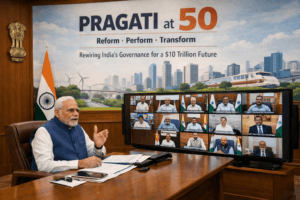
PRAGATI at 50: How a Digital Platform is Rewiring India’s Governance for a $10 Trillion Future
In a virtual meeting that connected the highest echelons of India’s bureaucracy, Prime Minister Narendra Modi chaired a significant milestone: the 50th review session of PRAGATI. More than just a meeting, this event marked a decade of a quiet yet profound revolution in how India governs itself. The platform, whose name translates to “progress,” has accelerated projects worth a staggering ₹85 lakh crore (over $1 trillion) in ten years. At this juncture, the Prime Minister distilled the philosophy behind this success into a powerful three-word mantra for the future: Reform, Perform, Transform. This is the story of how a technology-driven platform is breaking decades-old silos, reviving forgotten projects, and attempting to redefine the very culture of governance in the world’s largest democracy.
The Genesis: From SWAGAT to PRAGATI
The story of PRAGATI (Pro-Active Governance and Timely Implementation) begins not in New Delhi, but in Gandhinagar. As Chief Minister of Gujarat, Narendra Modi launched SWAGAT (State Wide Attention on Grievances by Application of Technology), a platform to address public grievances with transparency and time-bound action. This experiment in tech-enabled governance proved that real-time monitoring and direct accountability could cut through bureaucratic delays.
Upon assuming office at the national level in 2014, this model was scaled up and evolved into PRAGATI. The platform integrated three critical streams: reviewing large infrastructure projects, monitoring major government programs, and addressing public grievances—all on a single, digital platform. It brought together the Prime Minister, Cabinet Secretary, Chief Secretaries of all states, and senior officials of central ministries for a monthly review, creating an unprecedented architecture for cooperative federalism.
Decoding the Mantra: Reform, Perform, Transform
At the 50th meeting, PM Modi outlined a clear roadmap for the next phase, built on three pillars:
- Reform to Simplify: Moving from a focus on bureaucratic process to delivering citizen-centric solutions. This means simplifying procedures to enhance both the “Ease of Living” for common people and the “Ease of Doing Business” for entrepreneurs.
- Perform to Deliver: Emphasizing a balanced focus on time, cost, and quality. The goal is outcome-driven governance where projects are not just started but completed within set timelines and budgets.
- Transform to Impact: The ultimate test. Transformation is to be measured not by government reports, but by tangible improvements in citizens’ lives—faster services, quicker grievance resolution, and an overall enhanced quality of life.
This mantra moves beyond aspirational rhetoric; it is a direct response to the identified root cause of government inefficiency: a lack of coordination and silo-based functioning. PRAGATI attempts to solve this by forcing all stakeholders onto one platform, aligned with one shared outcome.
The Proof in the Numbers: Impact and Scale
The quantitative impact of PRAGATI over the past decade offers compelling evidence of its effectiveness:
- Cumulative Project Value Accelerated: > ₹85 Lakh Crore
- Total Projects Reviewed (Since 2014): 377
- Issues Identified & Resolved: 2,958 out of 3,162 (94% resolution rate)
- Key Outcome: Significant reduction in delays, cost overruns, and coordination failures.
Perhaps the most telling success stories are the long-stalled projects that were revived and completed. These were not minor delays, but projects stuck for decades, often termed “legacy projects.” PRAGATI provided the high-level push to break the logjam:
| Project Name | Sector | Initial Conception/Approval | Significance |
| Bogibeel Bridge (Assam) | Railways/Road | 1997 | India’s longest rail-road bridge, crucial for connectivity in the Northeast. |
| Jammu-Udhampur-Srinagar-Baramulla Rail Link | Railways | Work began 1995 | A strategic and challenging project to connect the Kashmir Valley. |
| Navi Mumbai International Airport | Aviation | 1997 | A critical second airport for the Mumbai metropolitan region. |
| Bhilai Steel Plant Expansion | Steel | Approved 2007 | Modernization of a key public sector asset. |
| Gadarwara & LARA Power Projects | Power | Sanctioned 2008-09 | Addition of substantial thermal power capacity. |
Case in Point: The PM SHRI Scheme Review
The 50th meeting also showcased how PRAGATI’s principles are being applied beyond brick-and-mortar infrastructure to social sectors. A significant portion was dedicated to reviewing the PM SHRI (Schools for Rising India) scheme, which aims to develop over 14,500 exemplar schools.
The Prime Minister’s directives during the review were emblematic of the “perform and transform” ethos. He emphasized that implementation must be “outcome-oriented rather than infrastructure-centric.”. He urged Chief Secretaries to closely monitor the scheme and, importantly, called for senior officers to undertake field visits to evaluate performance firsthand. The goal is clear: to make PM SHRI schools a living benchmark for holistic, future-ready education that other state schools will emulate.
This focus highlights a critical evolution. The challenge in such social schemes often lies in quality of implementation—teacher training, pedagogical shifts, and community engagement—rather than just fund disbursement. By bringing it under PRAGATI’s spotlight, the government signals its intent to track these softer, yet more meaningful, outcomes.
The Road Ahead: Challenges and the Viksit Bharat Vision
As India aims for its ‘Viksit Bharat @2047’ (Developed India by 2047) vision, PRAGATI is positioned as a “powerful accelerator”. The Prime Minister has encouraged all states to institutionalize similar PRAGATI-like mechanisms, especially for the social sector at the level of Chief Secretary.
However, the path forward is not without challenges:
- Institutionalizing the Culture: The real test will be embedding this culture of pro-activeness, data-driven review, and breaking silos at every level of governance, beyond the high-profile monthly meetings.
- Avoiding Overload: As the platform’s success grows, there’s a risk of it becoming overloaded with projects, which could dilute its focused impact.
- From Output to Outcome: Tracking physical and financial progress is one thing; robustly measuring the transformative impact on citizen’s lives—the core of the mantra—is a far more complex task.
The 50th PRAGATI meeting was more than an anniversary. It was a statement of intent. It reaffirmed that India’s governance transformation will be led by technology as a tool, transparency as a method, and citizen welfare as the only metric. In a world where governments everywhere grapple with delivery, India’s decade-long PRAGATI experiment offers a compelling case study in using digital infrastructure to rewire bureaucratic machinery for the 21st century. The journey from ‘reform’ to ‘transform’ is ongoing, but the foundation for a more agile, accountable, and outcome-focused state has been decisively laid.
You must be logged in to post a comment.