
Pedal-Powered Ingenuity Triumphs: How a Student-Designed Breast Pump Captured a Global Design Prize
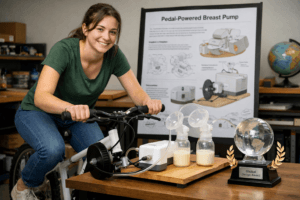
At the 2026 3DEXPERIENCE World event in Houston, Dassault Systèmes crowned Team UJ Wom+n in Tech from the University of Johannesburg as the winners of its expansive AAKRUTI student design competition for their project, “Latch”—a pedal-powered, electricity-independent breast pump with a universal bottle system, designed to offer mothers sustainable and accessible healthcare. The competition, which challenges students across the globe to devise solutions in sustainability, healthcare, and green energy using Dassault’s 3DEXPERIENCE platform, also showcased other pioneering finalists, including a child-friendly pain-reduction device for injections, a resonant ultrasound cancer treatment, a tactile communication kit for aphasia patients, and an eco-friendly brake-dust filtration system, collectively highlighting a significant shift in engineering education toward empathetic, human-centered innovation that prioritizes real-world impact and inclusive problem-solving alongside technical skill.
Pedal-Powered Ingenuity Triumphs: How a Student-Designed Breast Pump Captured a Global Design Prize
The air in Houston’s 3DEXPERIENCE Playground hummed with more than just the chatter of thousands of engineers and designers. It buzzed with the palpable energy of a paradigm shift. On February 4, 2026, amidst the gleaming showcases of advanced simulation software and virtual twin technology, the spotlight turned to a profoundly human, elegantly simple device: a pedal-powered breast pump named Latch.
Its creators, Team UJ Wom+n in Tech from the University of Johannesburg, South Africa, were just named the winners of Dassault Systèmes’ 2026 AAKRUTI International Student Design Competition. Their victory wasn’t merely about technical prowess; it was a resonant statement about the future of innovation—where sustainability, empathetic design, and universal accessibility converge.
Beyond the Press Release: The Soul of AAKRUTI
The word ‘Aakruti,’ as the press release notes, means ‘form’ or ‘shape.’ But to witness the competition is to understand it as the shaping of minds. Launched in India in 2011 and now encompassing over 37 countries and 55,000 students, AAKRUTI is less a contest and more a global incubator for conscience-driven engineering.
This year’s theme—sustainable solutions for healthcare, mobility, and green energy—forced participants to grapple with the 21st century’s most pressing dilemmas. The twelve finalist teams, hailing from nine countries, didn’t just use Dassault’s 3DEXPERIENCE platform and SOLIDWORKS as digital tools; they used them as canvases for their idealism. The “EDU Zone” became a microcosm of a better future, where technology is measured by its human impact.
Deconstructing the Winner: Why “Latch” Is More Than a Pump
At first glance, Latch’s premise is striking in its simplicity: a breast pump operated by a foot pedal, compatible with any standard bottle. But its genius lies in the layers of insight embedded within that simplicity.
- Energy Autonomy: By removing dependency on electricity or batteries, Latch addresses a critical barrier for millions. It empowers mothers in regions with unreliable power, in remote areas, or in situations of displacement. The kinetic energy of a mother’s own body becomes the sole resource required, a powerful metaphor for self-sufficiency.
- Economic and Environmental Sustainability: Eschewing proprietary parts and complex electronics, Latch is designed for repairability and longevity. Its universal fitting system rejects the wasteful, branded ecosystem of many baby products. This is circular economy thinking applied to intimate healthcare.
- Dignity and Ergonomics: Traditional pumping can be isolating and physically awkward. The pedal mechanism allows for a more natural, hands-free operation. It subtly shifts the experience from a clinical chore to an activity that can be integrated more comfortably into daily life. The team’s name, “Wom+n in Tech,” signals their intentional focus on designing for women, with women’s lived experiences at the core.
“This award validates our belief that innovation must be inclusive,” one could imagine a team member stating. “We weren’t just designing a product; we were designing for dignity, for resilience.”
The Runners-Up: A Spectrum of Sustainable Brilliance
The depth of the competition was underscored by the other finalists, each tackling a profound challenge:
- First Runner-Up, Team Bou (South Africa): Dr. Bou – This device tackles the universal childhood fear of needles with gentle cooling and vibration. It’s a masterclass in user-centered design, where the “user” is a frightened child and a stressed healthcare worker. It demonstrates that sustainability isn’t just about materials, but about sustaining emotional well-being.
- Second Runner-Up, Team BELGER (Turkey): Their project on selective cancer treatment via ultrasonic resonance is breathtaking in its ambition. Moving beyond the blunt force of many treatments, it seeks to exploit the unique biomechanical “signature” of cancer cells. This represents the pinnacle of bio-inspired engineering and precision medicine, conceived not in a corporate lab, but in a university.
- Best All-Girls Team, Shady Business (Singapore): TalkingTiles – For individuals with aphasia (loss of speech), communication barriers can be imprisoning. This smart tactile kit, using 3D-printed tiles, is a bridge back to human connection. It showcases how 3D design and rapid prototyping can deliver hyper-personalized, compassionate assistive technology.
- Encouragement Award, Team InnoForge (India): Filtron – Targeting a visible and deadly pollutant—brake dust—this smart braking system proves that sustainability in mobility goes beyond the powertrain. It addresses the often-invisible particulate matter that clouds our cities, showing a systems-thinking approach to “cleaner, safer mobility.”
The Real Story: Cultivating the Ecosystem of Future Innovators
The true headline from Houston isn’t just about a single winner. It’s about the successful cultivation of an innovation ecosystem. Dassault Systèmes, through AAKRUTI, its SOLIDWORKS SkillForce initiative, and 3DEXPERIENCE Edu, is doing something critical: it is de-risking creativity for students.
By providing professional-grade tools and a global stage, they allow students to think like founders, humanitarians, and visionaries before the pressures of commercial reality narrow their focus. Suchit Jain’s comment on “equipping students with in-demand workforce skills” is accurate, but the softer skill being honed is even more vital: the courage to solve meaningful problems.
These students are learning that engineering is not just about stress analysis and tolerances; it’s about understanding cultural contexts, economic disparities, and human vulnerability. They are practicing what might be called **”Empathetic CAD”**—where every sketch and simulation is interrogated not just for feasibility, but for its potential to improve a life.
The Takeaway for Industry and Education
For professionals and educators watching, AAKRUTI 2026 offers clear lessons:
- The Next Generation is Problem-Obsessed, Not Just Tech-Obsessed. They are applying world-class digital tools to granular, human-scale issues.
- Sustainability is a Holistic Brief. It encompasses energy, materials, economic access, and social dignity, as seen across Latch, Filtron, and TalkingTiles.
- Diversity Drives Depth. The winning team’s gender-focused perspective, the all-girls team from Singapore, and the global spread of finalists prove that heterogeneous teams identify and solve problems invisible to homogenous groups.
The 3DEXPERIENCE World event is where industry leaders come to see the future of technology. In the EDU Zone, they were shown the future of the heart and mind behind the technology. The students of AAKRUTI 2026 demonstrated that the most sustainable resource we have is not a mineral or an algorithm, but informed, compassionate, and empowered human ingenuity.
As the teams return to their home countries, their one-year SOLIDWORKS licenses in hand, they carry more than prize money. They carry the validation that their vision for a better-shaped world—their aakruti—has resonance. And in doing so, they reaffirm perhaps the most important human insight of all: that progress, ultimately, is not measured by the sophistication of our tools, but by the humanity of our solutions.
The 2026 AAKRUTI competition has closed, but the dialogue it opens is just beginning. What global challenge would you dare to reshape with the tools of design and engineering? The next generation of innovators has already started their sketches.
You must be logged in to post a comment.