
Orion, TJ and the media that never asked: The great Indian robodog rebranding
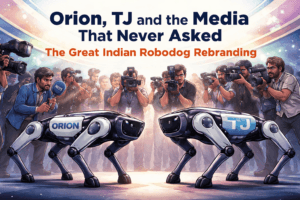
Orion, TJ and the media that never asked: The great Indian robodog rebranding
The recent ruckus at the India AI Impact Summit wasn’t just a case of a university getting caught with a counterfeit robot. It was a three-act play performed on a national stage, exposing a deep malaise within an ecosystem desperately trying to project an image of technological supremacy. When the curtain fell, we were left not with a vision of Viksit Bharat, but with the hollow shell of a Chinese robodog, rebranded first as “Orion” and then, in a plot twist nobody asked for, as “TJ.”
This wasn’t merely a story of misrepresentation; it was a masterclass in how Indian media, government enthusiasm, and institutional ambition can collectively fumble a simple fact-check, turning a summit on the future into a spectacle of the absurd .
Act I: The “Naughty” Marvel Called Orion
The stage was set at the Bharat Mandapam in New Delhi. The event was the flagship India AI Impact Summit 2026, billed as the largest AI conference in the Global South . Among the stalls was Galgotias University, a private institution from Greater Noida with over 40,000 students, there to showcase its alleged Rs 350+ crore investment in an AI ecosystem .
Enter Professor Neha Singh, the head of the university’s Communications Department. With the confidence of a proud parent, she introduced the world to “Orion” (Operational Robotic Intelligence Node) on camera. The robotic dog wagged its mechanical tail and performed tricks. It was, as a DD News reporter gushed, a “cute little robot” that was “quite naughty” . Professor Singh claimed this marvel was developed by the university’s Centre of Excellence .
The problem? “Orion” was about as “homegrown” as a plate of chop suey. The internet, doing what the media failed to do, quickly identified the robot as the Unitree Go2—a commercially available, off-the-shelf product made by China’s Unitree Robotics, available online in India for roughly ₹2.5 lakh . The “naughty” robot wasn’t an innovation; it was an import with a fresh coat of branding paint.
When the backlash hit like a ton of bricks, the university’s defense was a masterstroke of buck-passing. In a statement, they expressed being “deeply pained” by the “propaganda campaign” against them . They clarified that there was “no institutional intent” to misrepresent. The fall guy? Professor Singh herself. The university labeled her “ill-informed” and claimed she was not authorized to speak to the media, having given “factually incorrect information” in her “enthusiasm of being on camera” .
It was a stunning dismissal of a senior faculty member. Netizens were quick to fact-check this deflection, with community notes on social media pointing out that the university was trying to “deflect blame on innocent and tech illiterate faculty member” . The question remains: if the Head of the Communications Department isn’t authorized to communicate, who is? And if she was so ill-informed about the technical origins, why was she manning a technical stall at a national summit?
Act II: The Reincarnation—TJ Walks the Same Floor
Just when you thought the plot had reached its peak, it thickened. As Galgotias was being shown the door—reportedly asked to vacate the expo after power to their stall was cut —the same robotic dog seemingly reincarnated on the same expo floor.
This time, it was at the stall of Wipro, one of India’s IT giants. The dog had a new name: “TJ.” The “O2” marking on the side of its head, a dead ringer for the Unitree Go2’s design, remained intact . There was no “TJ” branding in sight.
News anchors who had missed the Galgotias story just 24 hours prior were now breathlessly covering “Wipro’s” robot. NDTV’s reporter Ravish Ranjan Shukla showcased “TJ” strutting its stuff. A PTI video caption confidently declared that Wipro had showcased “its” dog robot . The Ministry of Electronics and IT’s official handle and Union Minister Ashwini Vaishnaw had earlier shared posts celebrating the robot, lending governmental credibility to what was essentially the same Chinese machine . Those tweets have since been deleted, but the digital ink had already dried on the embarrassment.
Unlike Galgotias, the Wipro representative stopped short of explicitly claiming they built it from scratch . However, the staging, the lack of attribution, and the media’s willing suspension of disbelief achieved the same effect: a Chinese product was successfully passed off as Indian ingenuity.
This raises an alarming possibility. Was it just a massive coincidence that two different entities displayed the same niche robotic dog? Or does this point to a deeper, more unsettling trend where institutions believe that “innovation” is simply a matter of branding? As one observer noted, this wasn’t just a demo miscommunication; it was “white-labeling, academic dishonesty, and fraud” being paraded as achievement .
Act III: The Media Black Hole
If the universities and corporations were the performers, the Indian media was the enabler. The coverage of the summit reveals a news ecosystem suffering from a severe case of “press release journalism.”
At Galgotias’ stall, reporters failed to ask the most basic question: “Can we see the lab where this was made?” or “Who are the students on the core development team?” Instead, they lapped up the narrative. A PTI release glowingly described the university’s Rs 350 crore AI showcase without a shred of skepticism . It wasn’t just laziness; it was a systemic failure to distinguish between using technology and creating it.
The media’s reaction to the exposé was equally telling. When the robot was “Wipro’s TJ,” it was news. When it was Galgotias’ “Orion,” it was also news. But when it turned out to be the same Chinese product, the coverage shifted to blaming the university for lying, rather than introspecting on their own role as willing amplifiers of the lie. They were happy to project the image of a Viksit Bharat without verifying the bricks used to build that vision.
The Political Rorschach Test
Unsurprisingly, the robot became a political football. Opposition leader Rahul Gandhi posted that the summit had become a “chaotic PR spectacle” . Karnataka CM Siddaramaiah coined a memorable phrase, accusing the ruling party of not believing in “Make in India,” but rather in “Fake in India” . He alleged that a “BJP-linked institution” had caused “international embarrassment” .
On the other side, supporters argued that the antics of one university shouldn’t be used to tarnish the country’s broader AI ambitions . IT Secretary S. Krishnan weighed in with a dose of bureaucratic restraint, stating that while the summit isn’t a certification authority, “misinformation cannot be encouraged” .
But the political blame game misses the point. This wasn’t about left vs. right. It was about real vs. fake. It was about an ecosystem where claiming credit is prioritized over doing the work. As one report noted, the incident underscores the “thin line between sourcing global components and claiming original creation” .
The Real Innovation Deficit
The most damning evidence came not from the robot, but from the other exhibits. When reporters returned to the Galgotias stall after the controversy, they discovered that the university’s drone exhibit—meant to showcase cutting-edge aerospace innovation—was a thermocol model held together with tape and wire .
There it was. The perfect metaphor for India’s wannabe innovation economy. A thermocol drone and a Chinese robot. Style over substance. Hype over hardware.
This isn’t just about one bad actor. The university has a chequered past, including allegations of financial fraud against its founders and non-bailable warrants issued in the past . But it thrives because the system allows it to. As long as headlines can be generated, and as long as news channels need “cute” visuals to fill airtime, the ecosystem of fake innovation will persist.
The Galgotias-Wipro robot saga is a warning. It tells us that we are so desperate to declare ourselves a developed nation that we are willing to believe in magic—in robots that appear out of thin air, rebranded by a change of clothes. But innovation isn’t magic. It’s hard work. It’s messy labs, failed prototypes, and years of research. And until our media starts looking for that reality, instead of broadcasting the fairy tale, we will keep mistaking Chinese robodogs for Indian tigers.
You must be logged in to post a comment.