
Orange Skies and April Chills: Decoding India’s Unseasonal Rain Fury as IMD Issues Multi-State Alert
The India Meteorological Department has issued an orange alert for Bihar, Jharkhand, West Bengal, Sikkim, and Assam on March 27 due to an active Western Disturbance that will continue bringing heavy rain, thunderstorms, and gusty winds to the Eastern and Northeastern states through March 31, while also offering relief to Northwest India—including Delhi, Punjab, and Haryana—with unseasonably cool, drizzly weather and temperatures well below typical summer highs; however, the downpours pose risks of landslides in Himalayan foothills, waterlogging in cities like Patna and Guwahati, and crop damage for wheat farmers, prompting authorities to urge residents to stay alert, drive cautiously, avoid open fields during lightning, and monitor real-time nowcast warnings until the system weakens at month’s end.
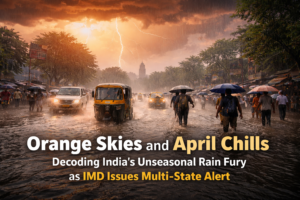
Orange Skies and April Chills: Decoding India’s Unseasonal Rain Fury as IMD Issues Multi-State Alert
As March draws to a close, India is witnessing a dramatic shift in its weather script. The usual transition towards the oppressive summer heat has been abruptly paused by the rumble of clouds and the splash of rain. On the morning of March 27, 2026, the India Meteorological Department (IMD) rolled out an ‘orange’ alert—a signal to “be prepared”—for five distinct states: Bihar, Jharkhand, West Bengal, Sikkim, and Assam.
For the millions living in the fertile plains of the Ganges or the tea gardens of the Northeast, the forecast isn’t just a statistic; it is a disruption, a relief, and a warning all rolled into one. While a sudden downpour might bring a smile to a farmer worried about rising temperatures, it also raises the specter of waterlogging, traffic chaos, and damaged crops.
But what is causing this meteorological surprise? The answer lies thousands of kilometers away, in the Mediterranean region, with a phenomenon known as the Active Western Disturbance.
The Mediterranean Connection: Understanding the Western Disturbance
To the uninitiated, a Western Disturbance sounds like a term reserved for geography textbooks. In reality, it is a low-pressure system that originates over the Mediterranean Sea and travels eastward, bringing moisture to the Indian subcontinent.
Typically, these systems are the lifeline of the Himalayan region, bringing winter snow to ski resorts in Gulmarg and Manali. However, when they remain “active” this late into March, they interact with the existing atmospheric moisture and heat, creating a volatile cocktail.
The IMD’s latest bulletin clarifies that this system isn’t a fleeting visitor. It is expected to linger, bringing isolated to scattered rainfall and snowfall over the Western Himalayan region until March 27, followed by scattered to fairly widespread precipitation from March 28 to 31.
But the ripple effects are being felt far beyond the mountains. The disturbance is pushing moisture-laden winds towards the eastern and northeastern plains, resulting in the heavy showers currently threatening states like West Bengal and Assam.
Region-Wise Breakdown: Where to Expect the Worst
The ‘orange’ alert is not a blanket warning for all of India. It targets specific “vulnerable zones” where the impact will be most severe. Here is what residents need to know, state by state:
- The Eastern Corridor: Bihar & Jharkhand
For the people of Patna, Gaya, or Ranchi, March 27 is likely to feel more like a humid July day. The IMD predicts isolated heavy rainfall accompanied by thunderstorms and gusty winds.
- Human Impact: For commuters in Patna, known for its traffic snarls, even 30 minutes of heavy rain can paralyze the city for hours. Authorities are advising residents to avoid unnecessary travel and secure loose objects on rooftops.
- Agricultural Note: Wheat farmers are on edge. While the rain saves irrigation costs, a sudden squall can flatten mature crops (lodging), leading to significant yield loss.
- The Himalayan Foothills: Sub-Himalayan West Bengal & Sikkim
This region, including tourist hotspots like Darjeeling and Gangtok, is on the highest alert. The IMD has specifically highlighted Sub-Himalayan West Bengal and Sikkim for isolated heavy rainfall on March 27.
- The Landslide Risk: The hilly terrain of Sikkim and the Darjeeling district is notoriously fragile. Heavy rain here often translates to landslides, blocking the crucial National Highway 10 that connects the Northeast to the rest of the country. Tourists are advised to check road status before heading out.
- The Northeast: Assam & Meghalaya
For the northeastern states, this is a prolonged affair. The weather office has forecast scattered to fairly widespread rainfall with thunderstorms and lightning over the region until March 31.
- Specific Alerts: Assam and Meghalaya will see heavy rainfall between March 27 and 29. Following that, Nagaland, Manipur, Mizoram, and Tripura (NMMT) will get their turn on March 28.
- The Guwahati Factor: Guwahati, the gateway to the Northeast, often struggles with drainage issues. A “yellow” or “orange” alert here usually means low-lying areas like Ganeshguri and Zoo Road become navigable only by boats.
The Silver Lining: Relief from the Heat
It isn’t all doom and gloom. For the rest of Northwest India, including Delhi, Punjab, Haryana, and West Uttar Pradesh, this weather pattern brings a welcome respite.
On March 27, the national capital is expected to witness a “generally cloudy sky” with spells of very light rain or drizzle. More importantly, the maximum temperature is likely to settle between 29°C and 31°C—significantly cooler than the 38-40°C levels usually seen in late March.
Residents of Delhi woke up to pleasant, drizzly mornings, with the IMD forecasting thunderstorms from morning to forenoon and again in the evening. For those planning outdoor evening events, carrying an umbrella is non-negotiable.
The “Yellow” Watch: Central and Southern States
While the East and North grab headlines, the IMD has also issued warnings for the central heartland.
- Madhya Pradesh & Chhattisgarh: Gusty winds reaching 30-50 kmph are likely between March 27 and March 31.
- Vidarbha: This region (including Nagpur) will experience similar gusty conditions for the next five days.
- Kerala: In a stark contrast to the rest of the country, the southern tip is battling humidity. Hot and humid conditions are likely to prevail in isolated pockets today, a reminder that summer hasn’t been canceled entirely—it has just been postponed.
Survival Guide: How to Navigate the Orange Alert
An ‘orange’ alert is the second-highest warning in the IMD’s color coding (Green -> Yellow -> Orange -> Red). It signifies that authorities need to be “prepared” and citizens need to be “alert.” Here is how you can stay safe:
- Shelter from Lightning: With thunderstorms predicted across most states, the risk of lightning strikes is high. Avoid standing under isolated trees or in open fields. If you are driving, pull over and stay inside the metal vehicle (a Faraday cage) until the lightning passes.
- Drive Slow: Gusty winds and slick roads are a recipe for highway accidents. If you are traveling on the Yamuna Expressway or the roads of Jharkhand, reduce your speed significantly.
- Digital Check: Before leaving home, check the “Nowcast” warnings issued by IMD. In the article linked, IMD issued a specific nowcast for Haryana (Yamunanagar, Kurukshetra, Karnal) and Western UP (Saharanpur, Meerut). These warnings are valid for only 2-3 hours but are highly accurate.
- Drainage Awareness: Residents in cities like Kolkata (under the West Bengal alert) and Patna should ensure their neighborhood drains are clear to prevent water from backing up into homes.
Looking Ahead: The Forecast Until March 31
The IMD’s latest press release suggests this pattern is not a one-day wonder. The Western Disturbance remains active, and the jet streams are favorable for precipitation.
- March 28-31: The Western Himalayan region (Jammu & Kashmir, Ladakh, Himachal Pradesh, Uttarakhand) will see a spike in activity, with fairly widespread rain and snow.
- Plains: Punjab, Haryana, Chandigarh, and Delhi will continue to see isolated showers until the month ends.
- East & Northeast: The rain intensity might decrease slightly after March 29 but will not stop entirely until the 31st.
Conclusion: The Unpredictable March
As climate patterns become more erratic, such “unseasonal” weather is becoming the new normal. The active Western Disturbance is a double-edged sword. For the water-scarce regions of the North, it is a blessing that recharges groundwater. For the residents of the orange-alert states, it is a call to resilience.
Whether you are a student in Ranchi praying for a rain holiday, a tea planter in Assam checking moisture levels, or a commuter stuck on a waterlogged street in Siliguri, the next 72 hours require patience.
Stay dry, stay safe, and keep an eye on the sky. The summer heat is waiting in the wings, but until March 31, the Western Disturbance is the star of the show.
You must be logged in to post a comment.