
Operation Twist: How Central Banks Reshape Economies by Reshuffling Their Bond Portfolios
Operation Twist is a monetary policy tool where a central bank, such as the U.S. Federal Reserve or the Reserve Bank of India, sells short-term government bonds and uses the proceeds to purchase long-term government bonds, with the primary goal of lowering long-term interest rates to stimulate borrowing and investment without expanding the overall money supply. First used by the U.S. in 1961 and revived after the 2008 financial crisis, the policy works by increasing demand for long-term bonds, which raises their prices and subsequently reduces their yields, effectively “twisting” or flattening the yield curve. While it directly influences domestic borrowing costs for businesses and individuals, its effects are global; for instance, when the U.S. implements Operation Twist, lower long-term yields there can drive foreign investors to seek higher returns in countries like India, leading to increased capital inflows, a stronger rupee, and improved liquidity, though it also requires careful management to avoid currency volatility and export impacts.
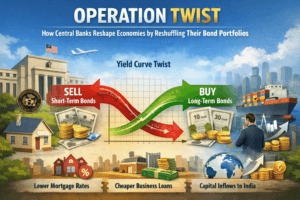
Operation Twist: How Central Banks Reshape Economies by Reshuffling Their Bond Portfolios
When the Federal Reserve or RBI decides to “twist” the yield curve, it’s not just Wall Street that feels the effects—your home loan, business borrowing costs, and even the rupee’s value can all shift.
The Policy That Sounds Like a Dance Move
Imagine you’re trying to warm up a cold room, but instead of turning up the thermostat (which would cost more energy), you simply rearrange the furniture to better distribute the existing heat. That’s Operation Twist in a nutshell—a monetary policy tool that reshuffles a central bank’s bond holdings to lower long-term borrowing costs without injecting new money into the economy.
The name itself tells a story. In 1961, when the U.S. Treasury first deployed this strategy, a newspaper columnist dubbed it “Operation Twist” because of how it literally twists the yield curve—the graphical representation of interest rates across different time periods. Normally, this curve slopes upward (short-term rates lower than long-term), but under Operation Twist, the central bank flattens it by pushing down long-term yields while keeping short-term rates stable or slightly higher.
The concept has recently gained attention again as both the U.S. Federal Reserve and the Reserve Bank of India have employed variations of this tool. But what makes it different from the more famous Quantitative Easing? And why should an ordinary borrower in Mumbai or a small business owner in Chennai care about what happens to U.S. Treasury bonds?
How Operation Twist Actually Works (No Economics Degree Required)
Let’s walk through the mechanics step by step, because understanding this helps demystify a lot of what you hear about central bank policy.
Step 1: The Central Bank Identifies Its Target
The goal is straightforward: lower long-term interest rates. Why long-term rates? Because these influence the loans that actually move the economy—corporate bonds, mortgages, infrastructure financing, and business expansion loans. When long-term rates fall, borrowing becomes cheaper for the kinds of investments that create jobs and growth.
Step 2: The Bond Swap Begins
Here’s where the “twist” happens. The central bank sells short-term government bonds from its portfolio. These might be Treasury bills maturing in a few months or a couple of years. Simultaneously, it takes the proceeds from those sales and buys long-term government bonds—typically 10-year or 30-year securities.
Step 3: Supply and Demand Does Its Magic
When the central bank starts buying long-term bonds in large quantities, demand for those bonds increases. Basic economics tells us that when demand rises, prices go up. And here’s the critical connection: bond prices and bond yields (interest rates) move in opposite directions. When bond prices rise, their yields fall.
So by aggressively purchasing long-term bonds, the central bank artificially depresses long-term interest rates. Meanwhile, selling short-term bonds slightly increases their supply in the market, which can put mild upward pressure on short-term rates—though central banks typically offset this through other tools to keep short-term rates at their target.
Step 4: The Money Supply Stays Neutral
This is Operation Twist’s signature feature. Unlike Quantitative Easing, which creates new money to purchase bonds, Operation Twist simply reallocates existing holdings. The central bank’s balance sheet doesn’t expand; it just changes composition. Think of it as trading water bottles of different sizes rather than adding more water to the pool.
A Brief History: From 1960s America to Modern India
The Original Twist (1961)
The Kennedy administration faced a dilemma in the early 1960s. The U.S. economy was sluggish, but the government worried that aggressively cutting rates might trigger inflation or weaken the dollar further. The Federal Reserve’s solution was elegant: push short-term rates up slightly to attract foreign capital and support the dollar, while pushing long-term rates down to stimulate domestic investment.
It worked moderately well, though the policy was smaller in scale than modern versions. The name stuck, and for decades “Operation Twist” remained a footnote in monetary policy textbooks.
The 2011 Revival
After the 2008 financial crisis, the Federal Reserve had already slashed short-term rates to near zero. With nowhere lower to go on those, the Fed needed new tools. Enter Operation Twist 2.0.
Between September 2011 and December 2012, the Fed sold $667 billion in short-term securities and bought long-term bonds. The impact was noticeable—the 10-year Treasury yield dropped from around 2% to about 1.5% during the program’s active phase. By June 2012, yields briefly touched 200-year lows, demonstrating the policy’s potency.
India’s Twist (2019-2020)
The Reserve Bank of India introduced its own version of Operation Twist in December 2019, and then significantly expanded it in April 2020 with a ₹10,000 crore operation. India’s context was different: the economy was slowing, but inflationary concerns limited how aggressively the RBI could cut traditional policy rates.
By buying long-term government securities (like the 10-year bond) while simultaneously selling short-term Treasury bills, the RBI successfully compressed the yield spread. The 10-year bond yield, which had been stubbornly high despite rate cuts, began moving downward, signaling cheaper long-term borrowing for corporations and the government alike.
Operation Twist vs. Quantitative Easing: Why the Distinction Matters
This comparison appears in every economics discussion, but the real-world implications deserve attention.
Quantitative Easing (QE) is like turning on the money printer. The central bank creates new reserves to purchase assets, expanding its balance sheet and increasing the money supply. It’s aggressive, unmistakable, and carries inflation risks if overdone.
Operation Twist is more surgical. The balance sheet size remains unchanged. No new money enters the system. Instead, the central bank simply extends the average maturity of its holdings.
For financial markets, this distinction matters. QE signals that the central bank is willing to go big, potentially devaluing the currency. Operation Twist signals a more measured approach—stimulus without the inflationary baggage. For investors, Twist tends to flatten the yield curve more directly than QE, which can have different implications for bank profitability (banks typically borrow short-term and lend long-term, so a flatter curve squeezes their margins).
How Operation Twist Affects India (Even When the Fed Does It)
Here’s where the story gets personal for Indian readers. You might think a U.S. Federal Reserve policy has little to do with your daily life, but global finance is deeply interconnected.
The Capital Flow Channel
When the Fed launches Operation Twist and U.S. long-term yields fall, American investors find themselves earning less on their domestic bond investments. Human nature being what it is, they start looking for better returns elsewhere. India, with its relatively higher interest rates, becomes an attractive destination.
This search for yield sends foreign capital into Indian markets. Foreign portfolio investors buy Indian government bonds and corporate debt. They invest in Indian equities. This capital inflow has immediate effects:
The Rupee Strengthens: More dollars coming into India means higher demand for rupees, pushing the currency upward. A stronger rupee sounds good, but it’s a double-edged sword—it helps curb inflation by making imports cheaper, but it hurts exporters who find their goods more expensive in global markets.
Liquidity Improves: Foreign money adds to the pool of capital available in Indian financial markets, potentially making it easier for Indian companies to raise funds.
The Borrowing Cost Channel
Lower global long-term rates create a reference point for Indian borrowers. While Indian interest rates aren’t directly tied to U.S. rates, global financial conditions do influence pricing. When the world’s benchmark long-term rate falls, it creates room for Indian rates to decline as well, or at least keeps them from rising as much as they might otherwise.
For an Indian company issuing corporate bonds, or for the government itself when it auctions debt, the global rate environment matters. International investors compare yields across countries. If U.S. bonds offer very little, they’re more willing to accept somewhat lower yields on Indian bonds than they otherwise would.
The Challenge of Managing Inflows
But here’s the complication the RBI must navigate: sudden surges of foreign capital create volatility. If dollars rush in too quickly, the rupee might appreciate sharply, damaging export competitiveness. The RBI often intervenes in currency markets to smooth these movements, buying dollars to prevent excessive rupee strength—which then adds to India’s foreign exchange reserves but also injects rupees into the system, complicating domestic monetary management.
This is why Operation Twist in the U.S. requires careful monitoring by Indian policymakers. It’s not that the policy directly targets India, but its spillover effects are real and consequential.
RBI’s Own Operation Twist: The Indian Experience
When the RBI implemented its version, the objectives were clear but the context was uniquely Indian.
Why India Needed Its Own Twist
By late 2019, the Indian economy was slowing. GDP growth had moderated, and investment demand was weak. The RBI had been cutting the repo rate—the rate at which it lends to banks—but these cuts weren’t fully transmitting to the long-term rates that matter for corporate borrowing.
Banks were reluctant to lower their lending rates, citing high deposit costs and the stickiness of their own funding. The yield on 10-year government bonds remained elevated, serving as a floor for corporate bond yields. Something needed to directly target that long-term rate.
The Transmission Mechanism
The RBI’s Operation Twist worked through a clear channel:
- The central bank announced simultaneous purchase of long-term bonds and sale of short-term bonds. In December 2019, the first operation involved purchasing ₹10,000 crore of long-term securities while selling an equivalent amount of short-term paper.
- Long-term bond prices rose, yields fell. The 10-year benchmark yield dropped by about 10-15 basis points in the immediate aftermath of the operation.
- Corporate bond markets took the cue. With the government bond yield—the risk-free benchmark—moving lower, corporate bonds could also price at lower levels. Companies found it cheaper to raise funds through debt.
- Banks reassessed their lending rates. While transmission is never instant, the signal from the yield curve encouraged banks to gradually reduce their marginal cost of funds-based lending rates.
The April 2020 Expansion
The pandemic added urgency. In April 2020, the RBI announced a larger ₹10,000 crore Operation Twist, part of a broader package to ease financial conditions. At a time when uncertainty was paralyzing markets, the central bank’s willingness to enter as a buyer of long-term bonds provided confidence. It signaled that the RBI would actively work to keep borrowing costs manageable during the crisis.
Who Benefits When the Yield Curve Twists?
Understanding Operation Twist means understanding who actually feels its effects.
Home Buyers: Long-term interest rates influence home loan rates. When the yield curve flattens through Operation Twist, housing finance companies and banks can potentially offer mortgages at more attractive rates. For someone taking a 20-year loan, even a 0.25% reduction in interest translates to significant savings over the loan’s lifetime.
Infrastructure Companies: These businesses borrow for decades at a time. Road builders, power companies, and port operators rely on long-term debt markets. Cheaper long-term borrowing makes large projects more viable.
The Government Itself: As the largest borrower in the economy, the government benefits when its borrowing costs fall. Lower interest payments on government debt mean more fiscal space for spending on health, education, and infrastructure.
Small Businesses: While small firms often borrow at shorter tenors, the overall easing of financial conditions tends to benefit them through improved credit availability and gradually lower rates.
The Limitations and Risks
Operation Twist isn’t magic, and it carries its own set of challenges.
Diminishing Returns: Each successive operation has less impact than the last. Markets eventually price in the central bank’s actions, and the marginal effect on yields shrinks.
Bank Profitability Concerns: Banks typically borrow at short-term rates and lend at long-term rates. A flatter yield curve compresses this spread, potentially hurting bank profits. If banks become less profitable, their ability and willingness to lend may suffer.
Market Distortions: Some critics argue that central bank intervention in bond markets masks true price discovery. When the largest buyer is always present, markets may not accurately reflect underlying risks.
Communication Challenges: Operation Twist requires clear communication. If markets misinterpret the central bank’s intentions, long-term rates might move in the wrong direction, or short-term volatility could increase.
The Global Context: Why Every Central Bank Watches the Yield Curve
Operation Twist belongs to a broader category of “yield curve management” that central banks increasingly employ. Japan has long practiced yield curve control, explicitly targeting the 10-year government bond yield. The Federal Reserve’s various programs during and after the 2008 crisis all aimed at shaping the curve.
For emerging economies like India, the yield curve matters for both domestic and external reasons. Domestically, it influences everything from corporate borrowing to household mortgages. Externally, the differential between Indian and global yields affects capital flows and currency stability.
When the RBI implements Operation Twist, it’s sending multiple signals: to domestic markets that it will act to keep long-term rates manageable; to global investors that India is actively managing its financial conditions; and to the government that monetary policy is working in coordination with fiscal needs.
What Operation Twist Teaches Us About Modern Central Banking
The evolution of Operation Twist from a 1960s experiment to a standard policy tool reflects how central banking has transformed. In an era of low inflation, modest growth, and high debt levels, traditional interest rate cuts have limits. Central banks must innovate, finding ways to influence borrowing costs without overstepping their inflation mandates.
Operation Twist represents a middle path—stimulus without monetization, intervention without expansion. It acknowledges that long-term rates matter enormously for economic activity, and that central banks have legitimate tools to influence those rates.
For the average person, the policy’s complexity shouldn’t obscure its practical effects. When you hear that the RBI or Fed is conducting an Operation Twist, think about what it means for borrowing costs, for investment decisions, and for the broader economic environment. Lower long-term rates today might mean more construction projects tomorrow, more business expansions next quarter, and more jobs next year.
The twist in the yield curve isn’t just an abstract financial concept—it’s a signal that policymakers are working to make the economy work better for everyone who borrows, lends, invests, and works within it.
The Bottom Line
Operation Twist has proven its utility across decades and continents. From Kennedy’s America to Modi’s India, central banks have reached for this tool when conventional policy hits limits. Its elegance lies in its simplicity: by simply changing the mix of bonds they hold, central banks can influence the borrowing costs that matter most for long-term investment and growth.
For India, the policy serves dual purposes—as a domestic tool when the RBI deploys it directly, and as an external factor when the Federal Reserve acts. Understanding Operation Twist means understanding one of the key ways modern monetary policy touches ordinary lives, from home loan EMIs to business expansion plans to the value of the rupee in your pocket.
In a world of complex financial instruments and opaque policy maneuvers, Operation Twist stands out as remarkably straightforward: buy long, sell short, and let the yield curve do the rest.
You must be logged in to post a comment.