
Operation in the Heart of Gaza: As Ground Assault Intensifies, a Doctor’s Testimony Reveals a Deepening Humanitarian Abyss
As the IDF launches a major ground offensive into the heart of Gaza City, prompting mass evacuations but leaving an estimated 600,000 civilians trapped, a devastating humanitarian crisis deepens, with frontline medical personnel like Dr. Michael Falk testifying that there is “no safe space” in Gaza, where hospitals are overwhelmed, disease and malnutrition are rampant, and a looming winter threatens to compound the suffering even further amid growing international legal and diplomatic repercussions.
Operation in the Heart of Gaza: As Ground Assault Intensifies, a Doctor’s Testimony Reveals a Deepening Humanitarian Abyss
Meta Description: As the IDF pushes into Gaza City, mass evacuations and a staggering humanitarian crisis unfold. A frontline doctor’s harrowing account reveals the human cost and the grim reality that there is “no safe space” left in Gaza.
The Military Push: A City Under Siege
Smoke rises in relentless, dark plumes over the skyline of Gaza City, visible even from across the border in Israel. The familiar soundscape of urban life has been replaced by the percussive thunder of airstrikes, the rumble of armored vehicles, and a pervasive silence where bustling markets once stood. On September 17, 2025, the Israel Defense Forces (IDF) announced its forces were operating “in the heart of Gaza City,” marking a pivotal and devastating escalation in a conflict that has already stretched for nearly a year.
This new phase, described as a “broad ground operation,” involves at least two full IDF divisions converging on the Strip’s largest urban center, with a third poised to join. The stated objective remains the dismantling of Hamas’s military infrastructure and the rescue of hostages. In the past 48 hours alone, the military reports striking over 150 targets. Israeli Defense Minister Israel Katz stated that 25 high-rise towers in the city were destroyed to eliminate sniper threats, vowing that without Hamas’s capitulation, “Gaza will be destroyed and become a monument to the atrocities and murderers of Hamas.”
The human tide fleeing this onslaught is staggering. The IDF estimates over 400,000 Palestinians have heeded evacuation orders and fled Gaza City. Yet, that leaves an estimated 600,000 people—a population larger than that of Boston or Lisbon—remaining in the path of a grinding urban offensive that officials warn could last for months. These are the elderly, the infirm, the desperately poor who have nowhere to go, and those who simply refuse to abandon their homes for a second or third time.
Beyond the Headlines: The View from a Khan Younis Hospital
While military briefings outline strategic advances and tactical strikes, the true measure of this offensive is taken not in kilometers gained but in human suffering endured. For that, we must turn away from the border and look inside Nasser Hospital in Khan Younis, a facility in southern Gaza that has become a grim refuge for the wounded and displaced.
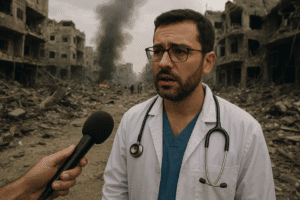
Here, Dr. Michael Falk, a trauma specialist from New York volunteering with the charity MedGlobal, provides a chilling, ground-level perspective that cuts through the political rhetoric. His testimony is not one of geopolitical strategy but of pure, unadulterated human crisis.
“If this ground offensive lasts months, it’s going to be horrible,” Falk states bluntly. He has witnessed a direct correlation between the intensified assault and the influx of casualties. “We’ve had two mass casualty incidents in the last three days alone,” he reports, a stark quantification of the operation’s human cost.
His description of Gaza’s reality is a portrait of a society on the brink of total systemic collapse:
- The Myth of Safe Zones: The concept of a “safe area” has evaporated. Falk recounts treating a patient blown up in an area previously designated as a humanitarian “green zone.” In a heartbreaking personal anecdote, he shares that one of his resident doctors lost his wife’s entire family, aside from his father, in an strike on a so-called safe zone. “There really is no safe space in Gaza,” he concludes, a statement that condemns the entire conflict’s architecture.
- A Health System in Agony: Nasser Hospital, designed for 300 patients, is now straining to care for over a thousand. The wounds of war are compounded by the complete breakdown of public health. Falk warns of a coming “horror” with the onset of winter: waterborne diseases, rampant respiratory illnesses, and a malnourished population too weak to heal. “Post-operative wound infections are horrendous, and mortality is far higher than in the U.S.,” he notes, highlighting a fatal disparity in care dictated not by medical knowledge but by circumstance.
- The Impossible Refugee Crisis: Where does one flee? Falk describes a landscape where “Mid-Gaza is a tent city from the Mediterranean to the eastern border.” For the hundreds of thousands escaping Gaza City, survival means procuring a tent for $400, renting a tiny plot of land, and somehow finding food—all while the war continues around them. There is no room, no infrastructure, and no reprieve.
A Doctor’s Haunting Comparison: Gaza as the “Worst”
Dr. Falk is not new to humanitarian disasters. His resume is a map of modern conflict zones: Iraq in 2017, Ukraine following the full-scale invasion in 2022, and now Gaza. This unique frame of reference makes his assessment all the more powerful and terrifying.
“Gaza is the worst I’ve ever seen,” he says. The distinguishing factor, in his view, is the totality of the violence and the utter lack of escape. “This feels indiscriminate. There is no reprieve, no calm place to go. It’s constant and everywhere.” This sense of inescapable, omnipresent danger, coupled with the total siege that has crippled life-support systems for a population, marks this conflict as uniquely catastrophic even among catastrophes.
The Wider Stage: Legal and Diplomatic Tremors
The conflict’s shockwaves are radiating far beyond Gaza’s borders. The IDF’s operation is unfolding against a backdrop of intensifying international legal and diplomatic pressure.
A United Nations commission has accused Israel of committing genocide in Gaza, a charge Israel vehemently denies as “fake.” Meanwhile, the European Commission’s proposed sanctions against Israel have been labeled “disproportionate” by Israeli officials.
Most strikingly, the war has drawn in a powerful, unexpected player: Qatar. Following a rare Israeli strike on its capital, Doha, earlier this month, a Qatari minister visited the International Criminal Court (ICC) in The Hague. The purpose, as stated on social media, was to explore “legal avenues to respond” and ensure “accountability for perpetrators of crimes under international law—including war crimes and acts of aggression.” This move signals a potential and significant escalation in the international legal battle surrounding the conflict, moving beyond statements and into the realm of potential prosecutions.
The Unfolding Future: A Long, Dark Winter
The trajectory is set for a profound and deepening tragedy. The IDF’s ground offensive in Gaza City is in its early stages, with a timeline measured in months. Each day of fighting will further pulverize the urban landscape, displace more people, and fill hospitals like Nasser beyond even their current breaking point.
Dr. Falk’s warning of a winter crisis looms large. The combination of cold rains, inadequate shelter, contaminated water, and collapsed sanitation is a breeding ground for epidemics. When compounded by severe malnutrition and a non-functional healthcare system, the result could be a secondary wave of death that claims far more lives than the bombs and bullets themselves.
The updates from the IDF sketch the outline of a military campaign. But the testimony from inside the hospitals and refugee tent cities paints the full, horrifying picture of a human catastrophe. The two narratives—the tactical advance and the humanitarian abyss—are inextricably linked. One is causing the other, and as the world watches the tanks roll into the heart of Gaza City, it must also listen to the doctors, the nurses, and the civilians who are living—and dying—in the heart of the crisis. The question is no longer just about when the fighting will stop, but what will be left of Gaza, and its people, when it finally does.
You must be logged in to post a comment.