
OnePlus’s Gamble: Exiting India’s Offline Market to Win the Online Price War
In a strategic pivot, OnePlus is exiting India’s offline retail market to adopt a direct-to-consumer (D2C) online-first model, aiming to lower prices by cutting distributor and store margins. Partner-run exclusive stores are being shut with a March 31 deadline, leaving only three company-owned outlets operational, while service centers will expand from 400 to over 600 by leveraging Oppo’s infrastructure—deepening integration with its parent. Although the move promises better after-sales reach in Tier 2/3 cities and potentially more competitive pricing, it eliminates the physical “touch and feel” buying experience, alienates distributors facing sudden credit recovery issues, and signals a retreat from premium retail dominance, positioning OnePlus as a value-focused online brand backed by Oppo’s service network.
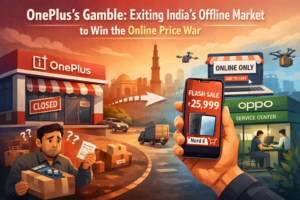
OnePlus’s Gamble: Exiting India’s Offline Market to Win the Online Price War
In a move that signals a dramatic recalibration of its India strategy, OnePlus has effectively decided to unplug from the country’s sprawling offline retail network. As reported by Moneycontrol on March 27, 2026, the company is pivoting aggressively to a Direct-to-Consumer (D2C) online-first model. While the headlines focus on the closure of exclusive stores and the severing of ties with distributors, the real story here is far more complex. It’s a story about the brutal economics of smartphone retail, the hidden costs of physical presence, and a high-stakes bet that deeper integration with parent company Oppo can salvage a brand that once thrived on hype but now must compete on value.
For the average OnePlus user walking into a mall, the immediate change will be the disappearance of those sleek, minimalist experience stores that once felt like Apple’s less pretentious cousin. However, for the industry, this is a seismic shift. OnePlus isn’t just shutting a few shops; it is dismantling the traditional retail supply chain that has been the backbone of smartphone sales in India for decades.
The Great Offline Retreat
According to sources cited in the report, OnePlus has asked all partner-run exclusive stores to shut down. Only three company-owned outlets—located in Hyderabad, Chennai, and Bengaluru—will remain operational. The message to the general trade channel is even more stark: distributors have been handed a March 31 deadline as their final billing date, with no transition period to clear existing inventory.
This isn’t just a logistical headache; it’s a financial gut punch for hundreds of small business owners and distributors. They are now left holding stock and, more critically, grappling with outstanding credit recovery with no clear path forward. The move raises a fundamental question: Why would a brand, which spent the better part of the last decade building a premium image through aspirational retail presence, suddenly pull the plug?
The answer lies in the numbers. Retail is expensive. Running an exclusive brand store involves high rents, staffing costs, and operational overheads. More importantly, selling through distributors and large-format retail (like Croma or Vijay Sales) eats into profit margins. A smartphone that sells for ₹30,000 in a store typically has a 10-15% margin built in for the retailer and distributor. By cutting out these middlemen, OnePlus can technically offer the same device for ₹25,500 to ₹27,000 and still retain the same revenue per unit.
In a market as price-sensitive as India, where specifications often trump brand loyalty, this margin flexibility is crucial. With rivals like Xiaomi, Realme, and even Samsung pushing aggressively in the mid-range and flagship-killer segments, OnePlus is essentially using the “D2C” playbook to win the price war. The upcoming Nord 6, reportedly set to be an Amazon exclusive, will be the first litmus test of this strategy.
The Oppo Safety Net
The most fascinating subtext of this development is the deepening umbilical cord between OnePlus and its parent company, Oppo. While OnePlus retreats from retail, it is simultaneously expanding its service network—from 400 to over 600 authorized centers—by leveraging Oppo’s vast existing infrastructure.
This is a masterstroke in cost-cutting. Building a service network from scratch is capital-intensive. By piggybacking on Oppo’s established footprint, OnePlus can scale its after-sales support to over 500 cities, including Tier 2 and 3 markets, without the associated investment. But it also marks a definitive end to the “independent plucky startup” persona that OnePlus has long cultivated.
For years, fans argued that OnePlus was distinct from its BBK Electronics (now a part of the larger entity) siblings. But with this move, the lines have completely blurred. The brand is now effectively functioning as a digital sub-brand of Oppo in India—handling the online sales and marketing, while leaning on Oppo for the heavy lifting of logistics and service.
This integration is also a regulatory necessity. Under Indian government regulations, smartphone makers are required to provide service support for up to five years, even if they cease operations. If OnePlus were to ever fully exit (a scenario this move makes unlikely, but not impossible), Oppo’s service centers would act as the default safety net, ensuring compliance without requiring OnePlus to maintain a costly independent infrastructure.
A Blow to Consumer Touchpoints
However, there is a risk in this strategy that goes beyond balance sheets: the loss of “touch and feel.”
For premium smartphones—devices costing upwards of ₹30,000—the offline buying experience remains critical. Consumers want to hold the device, feel the weight of the metal frame, test the camera in hand, and experience the “haptic feedback” before spending a month’s salary. Exclusive stores served as brand temples where that trust was built.
By shifting exclusively online, OnePlus is effectively ceding the premium “impulse buy” or “experience-led” purchase to Samsung and Apple. Samsung, with its massive retail footprint, and Apple, which has been aggressively expanding its own stores and franchise outlets in India, are likely to benefit from this retreat. If a customer walks into a mall undecided between an iPhone, a Galaxy S series, and a OnePlus, and the OnePlus store is dark, that’s a lost sale.
Moreover, the timing is interesting. While the report is dated March 2026, this trend has been building. The Indian smartphone market is currently saturated. Growth isn’t coming from first-time buyers in metros anymore; it’s coming from upgrade users in Tier 2/3 cities. By shutting offline stores, OnePlus is making a counterintuitive bet that it can reach those Tier 2 and 3 customers purely through e-commerce logistics and service centers, bypassing the physical retail experience entirely.
What This Means for Distributors and Partners
The human cost of this transition cannot be ignored. Distributors in the general trade channel are facing a sudden dead-end. The report mentions “concerns about recovering outstanding credit.” In the Indian retail ecosystem, credit cycles are the lifeblood of business. Distributors often stock inventory on credit, selling it to smaller retailers on a payment cycle. When a manufacturer pulls the plug without a transition period, it creates a domino effect of unpaid dues and potential defaults.
These distributors weren’t just vendors; they were the foot soldiers of the OnePlus army, responsible for merchandising, visibility, and localized marketing. Alienating them burns bridges not just for OnePlus, but potentially for Oppo as well, given the shared ecosystem. It sends a signal to the trade that partnerships with the BBK group come with expiration dates.
The Consumer Perspective: Pros and Cons
From a consumer standpoint, this restructuring is a double-edged sword.
The Good:
- Lower Prices: If OnePlus passes the savings from cutting retail margins to the consumer, we could see more aggressive pricing on flagship devices.
- Better Service Reach: Expanding service centers to 600 locations across 500+ cities is a massive win for after-sales support. For users in smaller cities who previously had to ship their phones to metros for repairs, having a local Oppo center handle the warranty is a significant upgrade.
The Bad:
- No Trial Before Purchase: You can’t test the phone before buying it. Return policies exist, but they are never as satisfying as walking out of a store with a device you’ve already vetted.
- Impersonal Support: While service centers are expanding, the removal of exclusive experience stores removes a physical anchor for the community. OnePlus built its brand on “community.” Community meetups often happened in these stores. That physical community hub is now gone.
The Verdict: A Pivot or a Surrender?
Is this a bold pivot to profitability, or a quiet surrender of the premium segment? It’s likely a bit of both.
OnePlus has realized that competing in the offline premium space requires a level of scale and capital that it can no longer justify as a “sub-brand” within the Oppo fold. By retreating to the online arena—where it was born—it can focus on what it does best: spec-heavy devices with competitive pricing, marketed through digital channels.
However, it is also a retreat from ambition. The dream of OnePlus becoming the “Apple of India” in terms of retail dominance is effectively over. Instead, it is settling into a new identity: a value-focused online brand supported by a robust service backbone provided by its parent.
For consumers, the hope is that the savings from this restructuring translate to better hardware at lower costs. For distributors, it’s a harsh lesson in the volatility of the smartphone industry. And for the Indian market, it’s a sign that the era of every brand trying to own a corner store is ending. In the race for profitability, sometimes the most strategic move is to stop trying to be everywhere, and simply focus on being the best deal—where the deals are made: online.
As March 31 approaches, the lights will go out in hundreds of OnePlus stores across the country. Whether this marks the beginning of a leaner, more profitable era for the brand, or the slow fade of a once-celebrated challenger, will depend entirely on whether the online-only model can sustain the premium aura that made OnePlus a household name in the first place.
You must be logged in to post a comment.