
One Year Later: The Story of Tarmeem, India’s First Gene-Edited Sheep
Born in December 2024 in Srinagar, India’s first gene-edited sheep, named Tarmeem, is thriving at one year old, showing a significant 10% increase in muscle mass compared to its non-edited twin due to the successful knockout of the myostatin gene using CRISPR technology. Developed over seven years by researchers at Sher-e-Kashmir Agricultural University, this breakthrough aims to address Kashmir’s mutton production deficit by enabling more efficient meat production with fewer animals. While the sheep remains under study in a secure enclosure, its success paves the way for potential regulatory approval and wider application in sustainable livestock farming, positioning India within a global movement adopting gene-editing for food security.
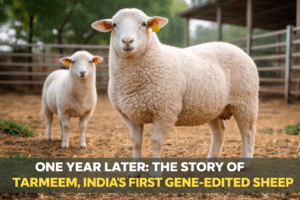
One Year Later: The Story of Tarmeem, India’s First Gene-Edited Sheep
Tarmeem, whose name translates to “modification” in Arabic, is more than just a scientific curiosity—it represents a quiet revolution in Indian biotechnology. As this pioneering sheep celebrates its first birthday in a secured enclosure at Sher-e-Kashmir Agricultural University, researchers are observing a living experiment that could reshape the future of sustainable meat production in the subcontinent.
A Scientific Breakthrough Seven Years in the Making
The journey to Tarmeem began long before her birth on December 16 last year. For seven years, an eight-member team led by Professor Riaz Shah navigated what he describes as “multiple false starts” and complex biological challenges. Their objective was specific: to deactivate the myostatin gene—a natural regulator that limits muscle growth in animals.
Using CRISPR-Cas9 technology (often described as “molecular scissors”), Dr. Suhail Magray and colleagues extracted embryos from pregnant sheep, precisely edited the target gene, and allowed the embryos to develop in controlled conditions before implanting them into surrogate mothers. Of seven in-vitro fertilization procedures, there were five live births, two abortions, and only one successful gene-editing outcome: Tarmeem.
“What began from zero has now become a standardized practice,” Professor Shah explains. “The learning curve was steep, but future success rates promise to be significantly higher.”
Tarmeem at One: Health, Growth, and the Twin Comparison
The most compelling evidence of the experiment’s success lies in the visible difference between Tarmeem and her non-edited twin sister. According to researchers, Tarmeem displays approximately 10% greater muscle mass—a gap they expect to widen as she matures. Crucially, she shows no adverse health effects, with normal physiological, biochemical, and behavioral parameters.
This controlled comparison offers a rare scientific opportunity. Because the twins share nearly identical genetics aside from the targeted edit, researchers can more accurately attribute differences to the myostatin modification rather than environmental or broader genetic factors. Tarmeem lives alongside her twin in a protected environment under continuous monitoring, allowing for ongoing assessment of longevity, health, and development.
Beyond the Lab: The Kashmir Context and Food Security Implications
The research transcends academic achievement when viewed through Kashmir’s specific agricultural challenges. The valley consumes approximately 60,000 tonnes of mutton annually but produces only half that amount. With shrinking agricultural land, water scarcity, and a growing population, traditional farming methods face mounting pressure.
Professor Nazir Ahmad Ganai, the university’s vice-chancellor, frames the research within this urgent context: “Gene-editing could raise a sheep’s body weight by 30%. This means fewer animals could provide more meat, transforming sustainable food production.”
If regulatory approval is granted, this technology could help address regional food deficits while potentially reducing the environmental footprint of livestock farming. The implications extend beyond mutton production—similar techniques could be applied to dairy yields, wool quality, or disease resistance in various species.
The Global Landscape: How Gene-Editing Is Reshaping Agriculture Worldwide
India’s entry into gene-edited livestock places it among a growing cohort of nations exploring this technology. Countries like Argentina, Australia, and Japan already regulate some gene-edited animals as conventional varieties, allowing them for consumption. The United States has approved genetically enhanced pigs, while the UK plans to permit gene-edited foods in the coming year.
The distinction between gene editing and genetic modification (GM) remains crucial in regulatory and public perception. Gene editing involves precise tweaks to an organism’s existing DNA—akin to correcting a typo in a sentence. Genetic modification typically introduces foreign DNA from another species. This fundamental difference has led many countries to adopt less restrictive policies toward gene-edited organisms.
In the medical realm, CRISPR-based therapies have already achieved remarkable successes, treating conditions like sickle cell anemia and rare genetic disorders. These medical advances are helping to build public understanding and acceptance of the technology’s precision and potential.
Ethical Considerations and the Road Ahead for India
Despite the promising science, Tarmeem’s future—and that of potential successors—depends on navigating complex ethical and regulatory landscapes. India’s agriculture ministry recently approved gene-edited rice varieties, suggesting a cautiously progressive stance. However, livestock regulation involves additional considerations regarding animal welfare, environmental impact, and traditional farming practices.
Public perception will play a significant role. The term “gene-edited” may evoke concerns among consumers unfamiliar with the science. Transparent communication about the safety, purpose, and benefits will be essential—as will demonstrating tangible advantages for farmers and consumers alike.
Professor Ganai draws a parallel to India’s Green Revolution: “Science gave us food security through high-yield crops in the 1960s. With responsible gene-editing, we can achieve similar breakthroughs in sustainable meat production.”
A Living Symbol of Scientific Ambition
As Tarmeem enters her second year, she represents both a technical achievement and a conversation starter about humanity’s relationship with the natural world. Her development demonstrates that Indian researchers can not only adopt cutting-edge biotechnology but adapt it to local needs and challenges.
The coming years will reveal whether Tarmeem remains a singular experiment or becomes the progenitor of a new approach to animal husbandry in India. Her health, fertility, and continued normal development will provide crucial data. Meanwhile, researchers await government decisions that could allow this technology to move from controlled experiment to agricultural application.
In a world grappling with climate change, resource limitations, and growing nutritional needs, Tarmeem’s story highlights a central dilemma: how to harness scientific innovation to meet human needs while respecting ethical boundaries and ecological balance. Her first birthday isn’t just a milestone for a sheep in Srinagar—it’s a moment to reflect on how we might responsibly nourish our future.
You must be logged in to post a comment.