
On a Knife’s Edge: How a Single Gaza Strike Reveals the Fragility of a Two-Year Ceasefire
A recent Israeli “targeted strike” in central Gaza, which Israel claimed neutralized a Islamic Jihad operative planning an attack, has severely tested the fragile U.S.-backed ceasefire in place for over two years, with the militant group dismissing the justification as “fallacious” and local witnesses reporting a drone strike that wounded four.
This incident exposes the deep-seated mistrust and precarious nature of the truce, where such actions are simultaneously framed by Israel as essential self-defense and by Palestinians as unprovoked aggression, all while the unresolved issue of repatriating the remains of hostages and the broader political stalemate continue to threaten the delicate calm with a return to wider conflict.
On a Knife’s Edge: How a Single Gaza Strike Reveals the Fragility of a Two-Year Ceasefire
The ruins of Gaza City have learned a new, unfamiliar sound in recent months: silence, punctuated not by airstrikes but by the tentative rhythms of recovery. Yet, that fragile quiet was shattered over the weekend by the unmistakable roar of a drone and the subsequent blast of a “targeted strike.” This single event, a microcosm of the larger conflict, has thrust the Israel-Gaza ceasefire into a glaring spotlight, testing whether a tense peace can survive the weight of a violent past.
On October 25, 2025, the Israeli military announced it had conducted a precise operation in central Gaza, alleging it had neutralized a member of the Palestinian Islamic Jihad (PIJ) who was in the “advanced stages” of planning an attack on Israeli troops. The following day, the militant group issued a swift and categorical denial, dismissing Israel’s justification as a “mere fallacious allegation.” This stark conflict of narratives, set against the backdrop of a U.S.-brokered truce, reveals more than just a disagreement over one incident; it exposes the deep-seated mistrust and unresolved grievances that continue to threaten the delicate peace.
The Incident: A Car in Flames and a War of Words
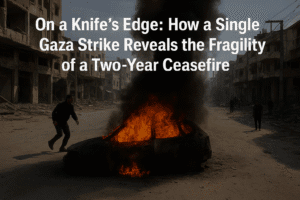
According to witnesses on the ground, the event was sudden and brutal. A drone, a ubiquitous symbol of the long conflict, locked onto a car moving through central Gaza. The strike was precise, leaving the vehicle a charred husk and, according to local medics, wounding four people. The absence of immediate reports of fatalities was perhaps the only sliver of relief in an otherwise volatile situation.
The Israeli military’s statement was characteristically succinct and framed within the context of self-defense. By identifying the target as a PIJ operative, Israel positioned the strike not as an offensive act, but as a necessary, preemptive measure to protect its forces. This doctrine of “targeted prevention” has been a cornerstone of Israeli military policy for years, justified by the government as essential to countering imminent threats.
However, the Palestinian Islamic Jihad’s response was equally strategic. By labeling the claim “fallacious,” they did more than just deny the allegation; they attempted to reframe the entire event. In their narrative, the strike was not a legitimate military action but an unprovoked act of aggression, a violation of the ceasefire designed to undermine Palestinian factions and maintain Israeli military dominance. They notably did not confirm or deny whether one of their members was killed, a rhetorical move that allows them to mourn a martyr without validating Israel’s casus belli.
The Broader Canvas: A Ceasefire Under Constant Strain
To understand the significance of this strike, one must look beyond the single column of smoke. The current ceasefire, in place just over two years after the devastating war that began with the Hamas-led attack on October 7, 2023, represents the most sustained period of calm in the region in years. Brokered with significant U.S. involvement, it is not a peace treaty, but a tense and conditional halt to major hostilities.
Both sides have repeatedly accused the other of violations. For Israel, any hint of militant activity—from rocket testing to the digging of tunnels—is a red line. For Hamas and other Palestinian groups, any Israeli incursion or strike, even those they deem “targeted,” is a breach of the understanding. This latest incident is a perfect case study in this cycle of accusation and justification. It demonstrates that a ceasefire does not mean an end to conflict, but merely its mutation into a lower-intensity, yet still dangerously volatile, state.
The Human Geography of a “Targeted” War
The term “targeted strike” conveys a sense of clinical precision, a surgical operation that minimizes collateral damage. But for the Palestinians in Gaza, there is no such thing as a isolated strike. The sound of the drone is a trigger for collective trauma, a reminder of the 11-month war that left over 35,000 dead and much of the territory in ruins.
The witnesses who saw the car erupt in flames are not just sources for a news report; they are people trying to rebuild their lives amid the rubble. Every such explosion shakes the foundations of their fragile sense of security and reopens psychological wounds. It reinforces the perception that despite the ceasefire, their lives remain subject to the unpredictable judgment of a distant operator.
Conversely, for many Israelis, particularly those in communities near the Gaza border, the constant threat of infiltration or rocket fire has defined their existence for decades. The military’s assertion that it thwarted an imminent attack resonates deeply with a populace that has lived through the horror of the October 7th attacks. For them, such strikes are not acts of aggression but of preservation—a necessary, if grim, toll for security.
The Unfinished Business: Hostages and the Shadow of the Past
Complicating the ceasefire further is the agonizing, unresolved issue of the hostages. The news report mentions a significant policy reversal: Israel has allegedly allowed Egyptian officials into Gaza to help locate the bodies of the remaining 13 hostages. This is a profound development. For two years, Israel has maintained a strict policy of barring foreign forces, and this shift signals the immense pressure on the government to bring closure to the families of the victims.
Hamas has agreed, as part of the ceasefire, to return all hostages, both living and deceased. Yet, the fact that remains are still in the enclave is a festering wound in Israeli society. The slow, painful process of repatriation is a constant reminder of the war’s brutality and a powerful political lever. Every delay or complication fuels public anger and hardens the stance of those who believe that military pressure, not diplomacy, is the only language militants understand.
A Path Forward on Shifting Sands?
The targeted strike in central Gaza is a symptom of a disease that has not been cured. The ceasefire is a bandage on a deep, infected wound. For a lasting peace to take root, several intractable issues must be addressed:
- The Demilitarization Dilemma: Israel demands the complete demilitarization of Gaza as a non-negotiable security requirement. For Hamas and PIJ, their arsenal is their primary leverage. Bridging this chasm seems nearly impossible without a third-party security arrangement.
- Reconstruction vs. Security: The massive reconstruction of Gaza is urgently needed, but Israel fears that resources will be diverted to rebuilding militant infrastructure. Establishing a transparent and effective mechanism for aid delivery is critical.
- The Political Horizon: Ultimately, a temporary ceasefire cannot hold indefinitely without a political process addressing the core issues of the conflict: borders, the status of Jerusalem, and the right of return for refugees.
The weekend’s events are a stark warning. The ruins of Gaza City are not just a landscape of past destruction but a potential preview of a future that remains all too possible. The drone strike, the charred car, the wounded, and the war of words—these are the tremors that precede an earthquake. The world watches to see if the architects of this fragile peace can reinforce its foundations before the next, inevitable shock brings it all tumbling down. The silence, it seems, was always destined to be broken; the question now is by what, and for how long.
You must be logged in to post a comment.