
Olmert’s Warning Exposes 7 Chilling Truths: Israel’s Former PM Drops Damning Bombshell on Gaza Crisis
Former Israeli Prime Minister Ehud Olmert has delivered a searing indictment of his country’s current handling of the Gaza crisis, describing proposed plans like the so-called “humanitarian city” as tantamount to a concentration camp and warning of actions bordering on ethnic cleansing. In a rare and powerful rebuke, Olmert accuses the Israeli government of systemic war crimes in both Gaza and the West Bank, enabled by negligence and political impunity.
He singles out settler violence as state-backed atrocities and brands extremist ministers as internal threats. Olmert rejects claims that international criticism is mere antisemitism, arguing global outrage is rooted in real-time witnessing of civilian suffering. Despite initially supporting military responses, he now condemns the abandonment of ceasefire talks and warns of Israel’s eroding moral standing and global legitimacy. His words carry unique weight given his former leadership role, signaling a profound fracture within the Israeli establishment. Olmert’s message is a wake-up call urging honest reckoning before irreversible damage is done.
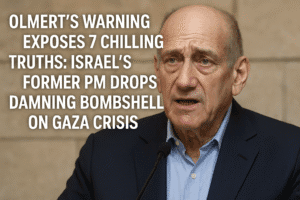
Olmert’s Warning Exposes 7 Chilling Truths: Israel’s Former PM Drops Damning Bombshell on Gaza Crisis
The stark condemnation from Ehud Olmert, Israel’s Prime Minister from 2006 to 2009, cuts through the noise of the Gaza conflict with chilling clarity. His interview with The Guardian isn’t merely criticism; it’s a profound alarm bell rung by an insider, accusing his own nation’s current government of actions that cross into the realm of international crimes. His words demand attention not just for their severity, but for the complex human and political tragedy they expose.
The “Humanitarian City”: A Euphemism Unmasked
At the heart of Olmert’s critique lies the Israeli government’s plan, championed by Defence Minister Israel Katz and backed by Prime Minister Netanyahu, to construct a massive “humanitarian city” in southern Gaza. Olmert strips away the bureaucratic veneer with brutal honesty:
- “It is a concentration camp. I am sorry.” Olmert directly invokes this historically loaded term, rejecting government claims of benevolent intent. His reasoning hinges on the reported condition: Palestinians forced into this zone would allegedly be prohibited from leaving except for deportation abroad.
- The Specter of Ethnic Cleansing: Olmert states unequivocally that forcibly transferring Gaza’s population into such a confined space “would be part of an ethnic cleansing.” While he distinguishes the current widespread evacuations (arguing they are legally permissible to protect civilians from combat zones), he insists that establishing a permanent, closed camp for hundreds of thousands constitutes a fundamental shift towards expulsion. “The inevitable understanding… is that it is not to save [Palestinians]. It is to deport them, to push them and to throw them away.”
This plan, as Olmert notes, isn’t theoretical; its implementation is reportedly a key obstacle in ceasefire negotiations, revealing its strategic importance to the current Israeli leadership.
Beyond Gaza: War Crimes and the “Hilltop Atrocities”
Olmert’s condemnation extends far beyond the proposed camp:
- War Crimes in Gaza & West Bank: He states plainly that Israel is “already committing war crimes” in both territories. He attributes this not necessarily to explicit orders for brutality, but to systemic “negligence” and a deliberate tolerance of actions known to cause massive civilian casualties. “I cannot refrain from accusing this government of being responsible for war crimes committed.”
- Settler Violence as State-Sanctioned Crime: Olmert reserves particular fury for the escalating violence by Israeli settlers in the occupied West Bank, calling the recent killings of Palestinians (including an American citizen) “unforgivable” and “unacceptable” war crimes. He rejects the label “hilltop youth,” calling them perpetrators of “hilltop atrocities.” Crucially, he asserts this violence operates with “near-total impunity” under a “framework of support and protection… provided by the authorities.” He identifies extremist cabinet ministers backing this violence and settlement expansion as “the enemy from within,” posing a greater long-term threat to Israel than any external foe.
The Erosion of Israel’s Standing: Beyond Antisemitism
Olmert offers a sobering analysis of Israel’s deteriorating global image, challenging a common Israeli narrative:
- He observes “more and more expanding expressions of hatred to Israel” internationally, particularly in the US.
- Crucially, he argues this cannot be dismissed wholesale as antisemitism: “I think many of them are anti-Israel because of what they watch on television, what they watch on social networks… This is a painful but normal reaction of people who say: ‘Hey, you guys have crossed every possible line.'”
- He laments the failure of Israeli media to adequately report on violence against Palestinians, contributing to a distorted domestic narrative.
A Voice for Change Amidst Despair?
Despite the devastating critique, Olmert, the last Israeli PM to engage in serious, high-level negotiations for a two-state solution, still clings to a thread of hope:
- He acknowledges initial support for the military response post-October 7th but condemns the government’s abandonment of meaningful ceasefire negotiations.
- He sees potential in a grand bargain: ending the Gaza war in exchange for Saudi normalization of relations. However, he expresses dismay at the current leadership’s actions, notably Netanyahu (under ICC arrest warrant) nominating Donald Trump for a Nobel Peace Prize.
- His decision to speak out stems from being “ashamed and heartbroken” that a war of self-defense morphed into something he views as criminal. He sees his role now as ensuring the world knows dissenting Israeli voices exist.
The Uncomfortable Truth: Why Olmert’s Words Matter
Olmert’s interview is more than just news; it’s a profound human and political reckoning:
- The Weight of Experience: Coming from a former head of government and someone who once commanded Israel’s military actions, his accusations carry unique gravity. He understands the mechanisms of power and security from the inside.
- Naming the Unnameable: Using terms like “concentration camp,” “ethnic cleansing,” and “war crimes” – applied to his own country’s actions by a former leader – breaks powerful taboos and forces an uncomfortable confrontation with the trajectory of current policy.
- Internal Fractures Laid Bare: His labeling of cabinet ministers as “the enemy from within” highlights the deep, dangerous fissures within Israeli society and governance, where extremist elements are seen as hijacking the state’s direction.
- A Warning Ignored at Peril: Olmert articulates the tangible consequences of current policies: not just immense Palestinian suffering, but the accelerating erosion of Israel’s international legitimacy and long-term security, driven by actions that much of the world perceives as unconscionable.
Olmert’s stark assessment is a cry from within the Israeli establishment, a plea to recognize a path leading to moral bankruptcy and strategic disaster. Whether it prompts reflection or is dismissed, it stands as a defining indictment of a moment where the line between defense and something far darker has, in the view of Israel’s own former leader, been catastrophically crossed. The value for readers lies not in easy answers, but in confronting the complex, painful human reality his words unveil.
You must be logged in to post a comment.