
Of Seasons Split: As North Shivers, The Southern Coast Braces for a Drenching
A stark climatic divide is gripping India, with the India Meteorological Department (IMD) forecasting persistent cold wave to severe cold wave conditions over parts of Madhya Pradesh and Chhattisgarh until November 16, even as the southern states brace for heavy rainfall. This weather split sees central India shivering with temperatures plunging as low as 7.4°C, while the southern peninsula, under the influence of cyclonic circulations over the Bay of Bengal, prepares for isolated heavy showers, thunderstorms, and lightning in Tamil Nadu, Kerala, and coastal Andhra Pradesh from November 13 through 19, highlighting the subcontinent’s simultaneous experience of two intense and contrasting seasonal patterns.
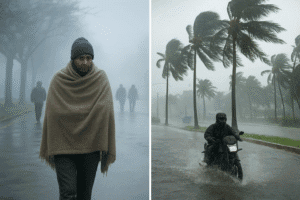
Of Seasons Split: As North Shivers, The Southern Coast Braces for a Drenching
The Unrelenting Grip of the Cold Wave in Central India
For residents of Madhya Pradesh and Chhattisgarh, the next few days offer little respite from the winter’s early onslaught. The IMD has issued a firm warning that cold wave to severe cold wave conditions are likely to persist, particularly in western Madhya Pradesh on November 13th and 14th, subsequently extending its chilly fingers into eastern Madhya Pradesh and Chhattisgarh until at least November 16th.
The numbers tell a stark tale. Rajgarh in Madhya Pradesh has already recorded a bone-chilling minimum temperature of 7.4°C, a figure that would be expected in the depths of December, not mid-November. This is not an isolated phenomenon. A significant swathe of central and northwestern India is experiencing below-normal temperatures. The chill has extended its reach into the northern plains, with parts of the Jammu region, Himachal Pradesh, Punjab, Haryana, and northern Uttar Pradesh also shivering through minimums between 7°C and 10°C.
But what constitutes a “cold wave”? For the plains, the IMD declares a cold wave when the minimum temperature dips to 10°C or below and is 4.5°C to 6.4°C below the normal. A “severe” cold wave is when the departure from normal exceeds 6.4°C. This current spell is significant because of its timing and intensity so early in the season, impacting agriculture, health, and daily life. Farmers in these regions are on high alert, as such cold can damage certain rabi crops, while health officials warn of a spike in respiratory illnesses.
The Southern Soaking: A Resurgence of the North-East Monsoon
Simultaneously, the southern states are under the influence of a very active North-East Monsoon (or retreating monsoon), which is the primary rain-bearing system for Tamil Nadu, Andhra Pradesh, and Kerala from October to December.
The IMD forecast spells out a period of intense rainfall activity:
- Tamil Nadu is on high alert, with isolated heavy rainfall predicted for November 13th and again in a more sustained spell from November 16th to 18th. Some isolated places have already received up to 11 cm of rain in the past 24 hours.
- Kerala and Mahe are expected to receive heavy rainfall on November 13th and then from November 17th to 19th.
- Coastal Andhra Pradesh, Yanam, and Rayalaseema will likely experience heavy showers between November 17th and 19th.
Adding to the drama, these rains will not be a quiet, constant drizzle. The forecast includes thunderstorms accompanied by lightning for Tamil Nadu, Kerala, and coastal Andhra on specific days, elevating the risk of localized flooding, power outages, and disruptions.
The Weather Systems Behind the Split Screen
This meteorological dichotomy is driven by a confluence of systems acting in tandem over the subcontinent.
- The Cold Wave Drivers: The primary reason for the cold conditions in the north and central India is the influx of dry, cold winds from the snow-clad Himalayas. The absence of significant cloud cover allows for maximum radiational cooling at night, where the earth’s heat escapes freely into the atmosphere, causing temperatures to plummet. Furthermore, a weak western disturbance over Kashmir has been too feeble to bring any appreciable rain or cloud cover that could trap heat. It has, instead, facilitated the flow of cold air.
- The Rainmakers in the South: The heavy rainfall is attributed to multiple systems brewing over the Bay of Bengal. A cyclonic circulation over the southwest and adjoining southeast Bay of Bengal is acting as a pivot, sucking in moisture from the sea. This is being supplemented by another cyclonic circulation over southeast Bangladesh and its neighbourhood. These systems are channeling a potent mix of moisture-laden winds towards the southern coast, which, upon interacting with the land, are rising, cooling, and condensing into widespread rain clouds and thunderstorms.
The Hazy North and The Foggy Mornings
Beyond the cold wave, northern India is also grappling with reduced visibility. On Thursday morning, shallow fog was reported at several places over Haryana, Chandigarh, Delhi, and isolated parts of Assam, Meghalaya, and other northeastern states. The IMD predicts that shallow to moderate fog is likely to persist over northeastern states and Uttar Pradesh for the next five days.
This fog, a mix of moisture and particulate pollution, is a common feature during the winter months, but its early arrival signals the settling in of stable, stagnant atmospheric conditions that can also lead to a buildup of pollutants.
Delhi-NCR: A Microcosm of the North’s Calm Chill
The national capital region serves as a perfect example of the prevailing northern conditions. The weather has been characterized by mainly clear skies with mist and haze during the night and morning hours. Maximum temperatures are hovering one to two degrees below normal at 25-27°C, while the minimums are a cool 10-12°C. The IMD’s forecast for Delhi from November 14th to 16th promises more of the same: mainly clear skies with shallow fog in the mornings. However, a key takeaway for Delhiites is the prediction of a further dip in the minimum temperature to 8°C-10°C by November 16th, marking a steady descent into winter.
Winds are expected to be northwesterly, with speeds of up to 15-20 kmph during the afternoon, providing some relief from the haze, but dropping to below 10 kmph in the evenings and nights, allowing the chill and fog to intensify.
A Tale of Two Forecasts: What It Means for You
This split weather scenario demands tailored preparedness.
If you are in Central India (MP, Chhattisgarh):
- Health: Take necessary precautions against the cold, especially the elderly, children, and those with respiratory issues. Layer up when going outdoors.
- Agriculture: Farmers should monitor crop health closely and seek advice from local agricultural departments on protective measures for sensitive crops.
- Travel: Early morning and late evening travel may be affected by cold and patchy fog. Ensure vehicles are winter-ready.
If you are in Southern India (Tamil Nadu, Kerala, Andhra Pradesh):
- Safety: Be prepared for heavy rain, thunderstorms, and lightning. Avoid traveling during intense spells and stay away from waterlogged areas and vulnerable structures.
- Urban Life: Expect possible disruptions to traffic, power, and daily commutes. Coastal areas should be vigilant about rough sea conditions.
- Water Management: While the rains are crucial for water reservoirs, the intensity could lead to flash floods. Authorities are likely to be on high alert.
In conclusion, India currently stands as a land of contrasting meteorological narratives. While the heart of the country bundles up against an early and assertive winter, the southern coasts are rolling up their trousers, ready to wade through the generous, and at times furious, bounty of the North-East Monsoon. This duality is a powerful reminder of the vast and varied climate tapestry that defines the Indian subcontinent.
You must be logged in to post a comment.