
Of Olives and Arson: How Settler Violence Chokes Hope in the West Bank’s Harvest Season
Amid a record surge in violence during the West Bank’s critical olive harvest, masked Israeli settlers attacked the villages of Beit Lid and Deir Sharaf, torching dairy trucks, farmland, and Bedouin structures, injuring several Palestinians in what officials describe as a coordinated campaign to drive them from their land. This escalation, enabled by the political influence of far-right settler leaders within Israel’s government and a perceived atmosphere of impunity, is coupled with an unprecedented expansion of illegal settlements, systematically fragmenting the territory and crushing the prospects for a viable Palestinian state as international attention remains focused elsewhere.
Of Olives and Arson: How Settler Violence Chokes Hope in the West Bank’s Harvest Season
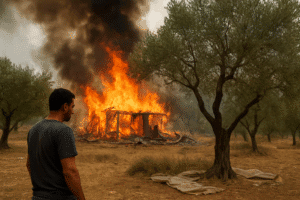
The acrid smell of smoke hangs heavy over the village of Beit Lid, a scent that has become tragically familiar. It’s not the smoke of a hearth or industry, but of dairy trucks deliberately torched, of ancient olive groves set ablaze, and of the simple tin shelters of Bedouin families reduced to ashes. This is the backdrop to the West Bank’s olive harvest, a time traditionally marked by family, festivity, and the year’s most crucial economic activity. But this year, as masked Israeli settlers hurl stones and firebombs, the season is defined by a different kind of yield: fear, loss, and a growing conviction that the land is being systematically taken, tree by tree.
This surge in violence is not an isolated spate of lawlessness; it is a symptom of a deeper, more calculated campaign. To understand the flames in Beit Lid and Deir Sharaf is to look beyond the headlines and into the intertwined forces of ideology, politics, and a bitter struggle over the very soil of the occupied West Bank.
The Olive Tree: More Than a Crop, A Culture Under Fire
For Palestinians, the olive tree is not merely agricultural. It is a living heirloom, a symbol of resilience, and a direct tether to their heritage. Some trees are centuries old, their gnarled trunks having witnessed generations of families who depend on their fruit for oil, for food, for income. The harvest is a communal ritual, a time when grandparents, parents, and children gather, blankets spread under the silvery-green leaves, to gather the year’s bounty.
This sacred season has now become a primary target. According to the UN OCHA, over 4,200 olive trees and saplings have been vandalized in recent weeks. For a farmer like Samir Shoman, inspecting the brutalized stumps of his livelihood in Khirbet Abu Falah, this is not just economic sabotage; it is a visceral attack on his identity and his children’s future. Each felled tree represents a year of lost income, a blow to a community’s food security, and a deliberate attempt to sever their connection to the land. The goal, as Palestinian Minister Muayyad Shaaban stated, appears clear: to make life so untenable that Palestinians are driven from their ancestral plots.
The Political Shield: When Ideology Enables Violence
The brazenness of the attacks points to a critical shift on the ground: a perceived atmosphere of impunity. The political landscape in Israel has fundamentally changed, with far-right settler leaders now holding key positions of power.
- National Security Minister Itamar Ben-Gvir, a hardline settler himself, oversees the national police force. He has a history of convictions for supporting a designated terror group and incitement to racism. His political base is built on a platform of Jewish supremacy and annexation.
- Finance Minister Bezalel Smotrich, who has openly advocated for Israel to annex most of the West Bank, wields significant control over the territory. This year, he approved a record 5,600 new settler housing units, ensuring the steady expansion of communities considered illegal under international law.
When the individuals tasked with upholding the law are ideologically aligned with the perpetrators, the result is often a tepid response. While Israeli police arrested four suspects in the Beit Lid attack, Palestinians and human rights groups consistently accuse the army and police of standing by or responding too slowly during settler assaults. The statement from the Israeli army—that soldiers “rushed to the scene” after “dozens of masked Israeli civilians” attacked—rings hollow to those who see a pattern of delayed intervention.
Annexation by Any Other Name: The E1 Plan and the Death of a Two-State Solution
Beyond the immediate violence lies a slower, more bureaucratic form of dispossession: settlement expansion. The Israeli government’s approval of the controversial E1 settlement plan is a game-changer. By building over 3,400 housing units in this strategic corridor east of Jerusalem, Israel would effectively cut the West Bank in two, severing Palestinian access to East Jerusalem—the envisioned capital of a future Palestinian state.
This is what French President Emmanuel Macron labeled a “red line,” warning of a strong European response. It is also why Canada, under the previous government, joined other nations in recognizing the state of Palestine, a move explicitly intended to preserve the fading prospect of a two-state solution.
The settler violence and the state-sanctioned settlement expansion are two sides of the same coin. One uses terror and intimidation to clear the land; the other uses bulldozers and bureaucracy to claim it. As opposition Israeli parliamentarian Gilad Kariv warned, the violence is not random; it is a deliberate strategy by extremists to “inflame the territories” and potentially spark a wider conflict, drawing the Israeli military into a larger West Bank operation.
A World Distracted, A People Abandoned?
The timing of this surge is crucial. It comes as a fragile ceasefire holds in Gaza, diverting international attention and diplomatic energy. The world breathes a sigh of relief over a paused war, while the slow-burning crisis in the West Bank accelerates. Mairav Zonszein of the International Crisis Group aptly noted that the West Bank “must not be disconnected from these efforts.” The fear is that the territory is becoming a forgotten front, where the absence of full-scale war masks a relentless, daily erosion of Palestinian rights and territory.
The charred trucks in Beit Lid will eventually be cleared away. But the scars on the land and its people will remain. The olive harvest, a testament to Palestinian steadfastness, has become a battleground. Each tree lost is a step back from peace, and each burning field illuminates a harsh truth: without urgent international pressure to hold perpetrators accountable and halt the settlement project, the dream of a viable Palestinian state is not just fading—it is being actively, systematically burned to the ground.
You must be logged in to post a comment.