
Of Crisp Mornings and Unseasonal Downpours: India’s Divided Winter Narrative
An early and pronounced winter chill has gripped north and central India, driven by a western disturbance and shifting wind patterns that have caused temperatures to plunge 4–7°C below normal, leading to cold wave conditions in areas like East Rajasthan. Meanwhile, southern India faces a contrasting weather pattern, with a trough and cyclonic circulation expected to bring widespread rain, thunderstorms, and potential isolated heavy showers to Tamil Nadu and Kerala, prompting agricultural advisories for crop protection and drainage management. This stark divide highlights the country’s climatic extremes, with the north settling into crisp, cold conditions while the south contends with unseasonal rainfall disruptions.
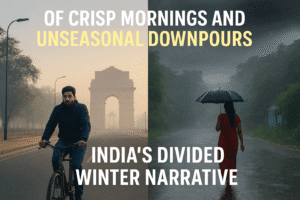
Of Crisp Mornings and Unseasonal Downpours: India’s Divided Winter Narrative
As the final remnants of Diwali’s festive echoes fade, a meteorological drama is unfolding across the Indian subcontinent, painting two strikingly different pictures. North of the Vindhyas, the air has shed its humid cloak, turning sharp and invigorating, while the peninsular south braces itself under the threat of darkened skies and thunderous applause. This isn’t just a weather report; it’s a tale of two winters, a narrative of how geography and atmospheric whimsy can dictate the rhythm of daily life for millions.
The North’s Early Embrace of Winter
For residents of Delhi, Punjab, and Haryana, the past week has brought a welcome and somewhat abrupt shift. The lingering, sticky humidity that often overstays its welcome well into November has been decisively swept away. In its place is a crispness that carries the unmistakable signature of winter. This isn’t a gradual descent but a noticeable step down, a sentiment echoed by the India Meteorological Department (IMD)’s data showing temperatures plunging 4 to 7 degrees Celsius below the seasonal average in places like East Rajasthan and West Madhya Pradesh.
The science behind this early chill is a fascinating interplay of global and regional patterns. A western disturbance, a storm system originating over the Mediterranean Sea, has acted as a key player. As it moves across north India, it typically brings precipitation. However, in its wake, it often ushers in cold, dry winds from the snow-clad Himalayas. This time, changing wind patterns have amplified this effect, creating a clear pathway for the cold air to cascade down over the plains.
The result is more than just a statistic on a thermometer. In isolated pockets of Rajasthan, night temperatures have flirted with single digits, dipping below 10°C and officially entering cold wave territory. For the agricultural heartlands of this region, this poses a silent threat. Farmers are being advised by the IMD to employ light irrigation and mulching—a technique where materials like straw are spread over the soil. This acts as an insulating blanket, protecting the delicate root systems of winter crops like wheat and mustard from cold stress, which can stunt growth and reduce yields. Vegetable nurseries, vulnerable to the frosty bite, are being covered with polythene sheets to retain precious soil warmth.
Urban life, too, is adapting. The early morning haze over Delhi is no longer just pollution; it’s a mix of shallow fog and smog, reducing visibility at airports like Safdarjung to 900 metres. The city’s rhythm changes—morning walks are pushed back by an hour, markets see a surge in sales of winter wear, and the iconic street food scene begins its seasonal transition from chilled golas to steaming cups of kadak chai. The forecast of northwest winds, whipping up to 20 kmph, only adds to the sensation of a proper northern winter setting in early, promising a week of chilly mornings and brilliantly sunny, pleasant afternoons.
The South’s Unwelcome Return of the Rains
Simultaneously, a completely different weather story is scripting itself down south. While the north zips up its jackets, Tamil Nadu and Kerala are battening down the hatches. The culprit here is a trough—an extended area of low pressure—extending from the southwest Bay of Bengal to central Kerala. Coupled with a cyclonic circulation over the Gulf of Mannar, this system is acting like a conveyor belt, pulling in moisture-laden winds from the ocean and dumping them as widespread rain over the region.
For these states, which have just emerged from the Northeast Monsoon’s initial phase, this is a disruptive encore. The IMD has predicted light to moderate rainfall in most places, with isolated heavy showers, particularly over Tamil Nadu and Kerala. The accompanying thunderstorms and lightning present risks of power outages, localised flooding, and damage to property.
The agricultural implications here are the inverse of the north’s concerns. For a paddy farmer in Tamil Nadu, seeing mature crops ready for harvest is a moment of anticipation. Now, that anticipation is laced with anxiety. The IMD’s specific advisory to farmers is a masterclass in practical meteorology:
- Harvest only during clear weather windows to prevent the spoilage of rice and groundnut.
- Ensure drainage in fields of water-intensive crops like sugarcane and cotton to prevent waterlogging, which can rot roots.
- Support banana plants with wooden poles to prevent them from being flattened (“lodging”) by strong winds.
- Protect harvested produce from rain at all costs.
For fishing communities and livestock owners, the warnings are equally direct. Fishermen are advised to heed weather warnings before venturing out, and livestock must be kept in sheltered areas with dry, safe fodder. This unseasonal weather pattern disrupts not just the present but also the planning for the upcoming agricultural cycle.
The Bigger Picture: A Nation of Climate Contrasts
This stark division in weather is a powerful reminder of India’s immense climatic diversity. The same season that brings a dry, cold winter to the Indo-Gangetic plains can simultaneously trigger rain-bearing systems in the peninsular south. It underscores the critical importance of hyperlocal weather forecasting and advisories.
The IMD’s role evolves from merely predicting temperatures to becoming an integral part of risk management for millions. Their forecasts empower a farmer in Rajasthan to save his tomato saplings and a fisherman in Kerala to safeguard his livelihood. This is where meteorological science translates directly into socio-economic resilience.
As we look ahead, the persistence of these conditions for the next week raises broader questions. While a single early winter or a spell of unseasonal rain cannot be directly attributed to climate change, it fits a observed pattern of increasing weather volatility. The boundaries between seasons are becoming more blurred, and extreme or uncharacteristic weather events are becoming more frequent.
For now, the people of north India are enjoying an early taste of their beloved winter, a season of festivals and food, of misty mornings and sunny days. Meanwhile, their compatriots in the south navigate the challenges of an unanticipated wet spell, a reminder of nature’s unpredictability. Two Indias, one November, two very different stories unfolding under the same vast sky. The only constant is change itself, and the enduring human capacity to adapt to the whims of the weather.
You must be logged in to post a comment.