
Of Course “Amaran” is Opening IFFI: The Invisible War Reshaping Indian Cinema
The selection of Sivakarthikeyan’s mainstream Tamil war drama “Amaran” to open the Indian Panorama at the 56th International Film Festival of India (IFFI) signals a significant convergence of commercial and artistic cinema, a theme reflected across a diverse lineup of 25 feature films, 20 non-feature films, and the newly introduced Best Web-Series nominees.
This year’s selection acts as a manifesto for a decentralized Indian cinema, highlighting a profound shift away from a Bollywood-centric narrative by showcasing stories in hyper-regional languages like Braj, Tulu, and Rajasthani, and formally recognizing the narrative power of streaming series. Ultimately, the panorama presents a cinematic identity that is proudly plural, where the traditional walls between mass entertainment and festival-curated art are being dismantled in favor of a more integrated and authentic ecosystem of storytelling.
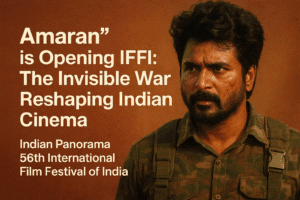
Of Course “Amaran” is Opening IFFI: The Invisible War Reshaping Indian Cinema
The announcement that Rajkumar Periyasamy’s Amaran, a Tamil war drama starring one of Kollywood’s biggest stars, Sivakarthikeyan, will open the Indian Panorama at the 56th International Film Festival of India (IFFI) is more than just a lineup detail. It is a declaration. A signal fire illuminating a profound and ongoing cultural shift in Indian cinema, where the rigid, centuries-old walls separating “mainstream” and “parallel” cinema are not just being scaled—they are being dismantled, brick by brick.
For decades, the Indian film landscape was a tale of two industries, often occupying the same geography but different artistic universes. On one side, the “commercial” film: star-driven, song-and-dance spectacles designed for mass consumption, where box office receipts were the ultimate measure of success. On the other, the “parallel” or “art” film: auteur-driven, narrative-focused, and festival-darling cinema that prided itself on its social realism and artistic integrity. The twain rarely met. A film festival like IFFI was traditionally the sanctum sanctorum of the latter, a space where the “serious” films were celebrated, far from the clamor of the single-screen theaters.
The selection of ‘Amaran’ as the opening film is a masterstroke that shatters this binary. Sivakarthikeyan is not just an actor; he is an institution. Rising from television comedy to become a bankable star known for his family-friendly entertainers and aspirational comedies, his filmography is a map of mainstream success. His pivot to a gritty war drama, based on the life of a real-life Indian Army officer, and its subsequent selection to lead the Indian Panorama, is emblematic of a new convergence. It signifies that a film can be both a star vehicle with widespread appeal and a piece of serious, festival-worthy cinema. The audience for substance and the audience for spectacle are, increasingly, the same.
The New Vanguard: A Tapestry of Voices Beyond the Mainstream
This year’s Indian Panorama lineup is not just defined by its high-profile opener but by its breathtaking linguistic and narrative diversity. The list of 25 feature films reads like a manifesto for a new, decentralized Indian cinema. Look beyond the headlines, and you’ll find a revolution in motion:
- The Rise of the Hyper-Regional: The inclusion of films in Braj (Vimukt), Tulu (Imbu), and Rajasthani (Whispers Of The Mountains) is a radical act. For too long, “Indian cinema” in the international consciousness was synonymous with Bollywood. This lineup actively challenges that hegemony, showcasing stories from the very heart of India’s cultural mosaic, told in languages that rarely see the national spotlight. It’s a move from a mono-culture to a polyculture of storytelling.
- Genre as a Vehicle for Discourse: The selection proves that potent social and political commentary isn’t confined to slow-burning dramas. Vivek Ranjan Agnihotri’s The Bengal Files and Tejas Prabha Vijay Deoskar’s Ground Zero suggest a growing space for political thrillers within the festival circuit. These films use the tools of tension, suspense, and narrative propulsion to engage with contentious historical and contemporary issues, making complex topics accessible and compelling to a wider audience.
- The Streaming Conundrum and the Web Series Award: The introduction of the Best Web-Series Award, with nominations for giants like Paatal Lok S2 and Suzhal – The Vortex S2, formalizes the festival’s recognition of the streaming revolution. This is a critical acknowledgment that some of the most ambitious, nuanced, and culturally resonant storytelling in India today is happening on the small screen. These series, with their long-form narratives and cinematic production values, have become the new “novels” of visual media, exploring societal fractures and character depths that a two-hour film often cannot.
The Debutante’s Ball: Nurturing the Next Wave
Perhaps the most hopeful section of the Panorama announcement is the nomination for the Best Debut Director award. By highlighting first-time filmmakers like Tribeny Rai (Shape Of Momo) and Jithin Laal (A. R. M), IFFI is not just celebrating finished products; it is investing in futures. This focus on nascent talent from across the country—working in Nepali, Bengali, Hindi, Malayalam, and Telugu—ensures that the pipeline of diverse stories will not run dry. It sends a powerful message to aspiring filmmakers everywhere: your voice, in your language, from your region, has a place on the national stage.
The Invisible War: A Quietly Transforming Cinematic Ecosystem
So, what forces are driving this seismic shift? The change is not accidental; it’s the result of a confluence of cultural, technological, and economic factors.
- The Audience Evolution: The modern Indian viewer is a hybrid creature. Weaned on global content from Netflix and YouTube, educated by the narrative complexities of world cinema, and still deeply connected to local cultures, today’s audience has a palate that is both sophisticated and demanding. They can, and do, enjoy a RRR with the same fervor as they discuss a Gully Boy or a Jallikattu. The artificial distinction between “high” and “low” art is collapsing under the weight of their eclectic consumption.
- The Democratization of Access: The streaming platforms, for all their corporate complexities, have acted as a great equalizer. A Tulu film or a Manipuri series no longer needs a prohibitively expensive national theatrical release to find its audience. It can be curated, subtitled, and presented to a pan-Indian, even global, viewership with the click of a button. This has emboldened creators to tell stories rooted in their specific soil, confident that there is a market for authenticity.
- The Star as Auteur: Stars like Sivakarthikeyan, Ayushmann Khurrana, and others are increasingly leveraging their commercial capital to back risky, content-driven projects. They are becoming curators in their own right, using their stardom as a gateway to introduce mass audiences to new kinds of narratives. When a star of Sivakarthikeyan’s stature chooses a Amaran, it legitimizes the project for his core fanbase while simultaneously attracting the attention of the critical establishment.
The Road Ahead: Beyond the Panorama
The 56th IFFI Indian Panorama, with Amaran at its helm, is a snapshot of Indian cinema at a critical juncture. It is a cinema that is more confident, more diverse, and more integrated than ever before. The old war between art and commerce is giving way to a new paradigm of “arthouse commercial” cinema—films that refuse to be pigeonholed.
The real challenge, and the next frontier, lies in ensuring that this curated diversity translates into sustainable economic models. Festival acclaim must be coupled with robust distribution strategies that allow these vibrant films to reach the audiences they deserve, both within India and abroad. The selection is the first battle; winning the war for viewership is the next.
But for now, we should celebrate this moment. The opening of the Indian Panorama is no longer just about unveiling a film; it’s about unveiling a new identity for Indian cinema itself—one that is proudly, authentically, and thrillingly plural. The message is clear: the future of Indian storytelling is not a single stream, but a magnificent, roaring delta.
You must be logged in to post a comment.