
‘Not Again’: Gaza Panic-Buying Sweeps Markets as Iran War Triggers Fears of New Famine
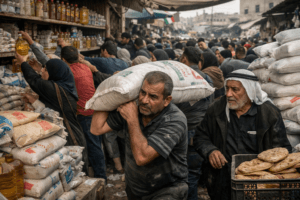
Following the outbreak of war between Iran and the US-led Israeli coalition and the subsequent closure of all crossings into Gaza “until further notice,” residents of the enclave—still traumatized by the famine and destruction of the recent 15-month genocidal war—have engaged in widespread panic-buying, emptying shelves of essential goods like flour and cooking oil amid fears of a repeat of the starvation crisis. While the conflict is not taking place on Gaza’s soil, the announcement triggered deep psychological trauma, leading to price hikes and shortages, with many residents unable to afford or store supplies and expressing despair that they are being punished again in a conflict they have no connection to.
‘Not Again’: Gaza Panic-Buying Sweeps Markets as Iran War Triggers Fears of New Famine
Deir el-Balah, Gaza Strip — The news spread through Gaza’s markets like wildfire on Saturday morning, turning a routine shopping trip for Ramadan iftar into a desperate scramble for survival.
Hani Abu Issa had arrived at the Deir el-Balah market with a short list — just ingredients for his family’s evening meal. Within minutes, he found himself joining crowds of Palestinians loading sacks of flour onto their shoulders, grabbing cooking oil, sugar, and yeast from rapidly emptying shelves.
“Someone told me Israel had struck Iran and war had broken out,” the 51-year-old father of five recalled, still standing near food stalls as shoppers jostled past him. “I watched everyone around me leave one after another, carrying whatever they could.”
The military confrontation between Iran and a US-Israeli coalition may be unfolding hundreds of miles away, but for Gaza’s 2.3 million residents — already shattered by 15 months of genocidal war that ended just two months ago — the psychological trigger proved immediate and devastating.
The Trauma That Drives Panic
What unfolded across Gaza’s markets wasn’t rational analysis of regional geopolitics. It was muscle memory. It was the instinct of people who have already starved once and will do almost anything to avoid starving again.
“I lived through famine like everyone else,” Hani said quietly. “The worst days were when I had to buy a sack of flour for more than 1,000 shekels. I don’t want to relive that experience.”
That experience remains painfully fresh. During Israel’s 15-month military campaign — which international courts are investigating as genocide — Gaza’s population endured systematic food deprivation. The United Nations and human rights organizations documented cases of severe malnutrition, with children dying from hunger-related causes while aid trucks waited at closed crossings.
Now, with the announcement that COGAT — the Israeli body managing Palestinian territories — had closed all crossings into Gaza and the West Bank “until further notice” due to security developments with Iran, those memories came flooding back.
Empty Shelves, Rising Prices
The scene in Deir el-Balah repeated itself across the Strip. In Nuseirat market, in Gaza City, in Rafah — wherever shops remained standing after months of bombardment — crowds gathered with urgent purpose.
Basic commodities vanished first. Flour, the foundation of every Gazan meal. Sugar, essential for the sweet drinks that break the Ramadan fast. Cooking oil. Yeast, without which families cannot bake bread when prepared loaves run out.
By Saturday evening, prices had begun climbing. Sellers who still had stock knew what scarcity meant. Buyers knew it too — and knew that waiting meant paying more later, if anything remained at all.
For 38-year-old Asmaa Abu Al-Khair, watching from the sidelines brought a different kind of agony. A mother of eight, she wandered through Gaza City market empty-handed, unable to join the rush.
“Where would we store it? And what would I even store?” she asked, frustration and fear tangling in her voice. “We need everything, and we can barely provide our daily food during Ramadan.”
Her family, like so many others, remains displaced — living in tents with no space for stockpiling, no money for bulk purchases, no margin for error. For them, the crossing closures aren’t an inconvenience. They’re a death sentence delayed.
“I feel great anxiety,” Asmaa said. “Everyone is talking about it — about Iran’s strike and the closure of the crossings — and I cannot afford to buy what I need, while at the same time, I am afraid of famine returning. I have young children.”
The Ceasefire That Wasn’t Enough
Just two months ago, a ceasefire brought tentative hope to Gaza’s battered population. After 15 months of what many here simply call “the war” — as if no other war could compare — the guns fell silent. Families began emerging from shelters. Markets slowly restocked. Children returned to what passes for normal life in a place where normal has been systematically destroyed.
Ramadan this year offered something precious: the first holy month in two years without bombs falling, without counting the dead before iftar, without wondering whether tomorrow would come.
“I found myself lost again,” said Mohammed Daher, 46, who fled his home in Jabalia and now lives displaced in Deir el-Balah. He decided not to join the panic-buying, not because fear didn’t touch him, but because exhaustion had gone deeper.
“We are exhausted. I reached a point where I have grown used to all scenarios,” he said, despair evident in his voice. “Israel is looking for any pretext to starve Gaza’s residents again and deepen their humanitarian crisis.”
Daher spent most of his savings during the previous famine, paying inflated prices for basic goods — if he could find them at all. The experience stripped him of more than money. It stripped him of the energy to keep running.
“Today, I have no energy left to endure that torment again. Let whatever happen, happen.”
Confusion and Mistrust
Adding to the anxiety, conflicting reports emerged about why crossings had closed. Local sources suggested the closure might coincide with the Jewish holiday of Purim, creating confusion about duration and intent.
But for Palestinians who have lived through 15 months of what human rights groups call a campaign of collective punishment, parsing Israel’s motivations feels almost irrelevant.
“We cannot be certain or confirm anything,” Hani said with visible frustration. “Israel’s word cannot be relied upon, and no specific duration was given.”
The lack of clarity feeds the fear. If crossings close for days, existing stocks might hold. If they close for weeks — as happened during the worst phases of the war — famine conditions return. No one knows. No one can know. And no one trusts official statements from any side.
A Warning from Economic Reality
Behind the scenes, Gaza’s already shattered economy faces collapse if closures continue. Ali al-Hayek, a member of the Palestinian Businessmen Association in Gaza, offered stark numbers:
- Gaza’s economy has contracted by more than 85 percent
- Unemployment approaches 80 percent
- Over 97 percent of industrial facilities have ceased operations
- Most of the population now lives below the poverty line
Closing crossings doesn’t just stop food imports. It halts aid distribution to struggling families, pauses charitable kitchens that feed thousands during Ramadan, and blocks urgent medical travel for wounded patients, cancer victims, and those with chronic diseases requiring treatment unavailable in Gaza’s destroyed health system.
Al-Hayek called on the international community to intervene immediately, pressing Israel to reopen crossings and restore normal movement of goods and people. But he also urged Gaza’s traders not to exploit the shortage with price gouging — a plea that echoes through Ramadan’s emphasis on solidarity and mutual support.
‘Why Play with People’s Nerves?’
Perhaps the most painful question came from Asmaa, standing empty-handed in Gaza City market as others rushed past.
“We endured so much hardship during the war, and it barely ended with the announcement of a ceasefire. So why close the crossing now? What do we have to do with what is happening? Is what we witnessed not enough? Why play with people’s nerves?”
The question has no answer — or rather, too many answers, none of them comforting. For decades, Gaza has been treated as a pressure valve, a bargaining chip, a place where larger conflicts find local expression. The war with Iran may be about regional power, nuclear ambitions, and global alliances. But in Gaza, it translates immediately into something simpler: Will there be bread tomorrow?
When COGAT announced crossing closures Saturday evening, Asmaa felt it “like a stab in my heart.” She went to sleep with what she called “deep frustration.”
Solidarity Amid Scarcity
In Nuseirat market, 28-year-old seller Omar Al-Ghazali watched the panic unfold with understanding born of shared experience. A father of four, he saw customers grabbing supplies with desperate urgency and didn’t blame them.
“People’s fear is completely justified,” he said. “They were shocked and frightened and want to secure themselves. They learned from the previous famine experience and from fears of trader hoarding.”
Omar recognized the paradox: People know, rationally, that a war in Iran shouldn’t directly affect Gaza’s food supply. But rationality has little to do with trauma.
“Today, although the war is not taking place on Gaza’s land, the fear of repeating the famine scenario appears stronger than any logical analysis of the regional situation,” he observed. “We cannot tell people not to buy. What they went through was extremely difficult. We try to convince ourselves that things are fine and that no one will be affected, but fear is stronger.”
What Comes Next
As night fell over Gaza on Sunday, markets began emptying — not of shoppers, but of goods. Those who could afford to stockpile had done so. Those who couldn’t faced another night of uncertainty.
For Hani Abu Issa, standing in Deir el-Balah market with five children at home, the situation crystallized something he’d been considering for months.
“All I think about now is traveling and leaving with my two daughters to live in another country,” he said quietly. “That is enough.”
But leaving Gaza is nearly impossible. The same crossings that now close to food and aid also control exit permits. The same war that triggers regional conflict also traps civilians in place.
For now, Gaza waits — not for peace, not for justice, not for the normal life that seems permanently out of reach. Just for news. Just for crossings to reopen. Just for bread tomorrow.
You must be logged in to post a comment.