
Northern India’s Deep Freeze: Science, Struggle, and Silent Beauty in a Historic Cold Wave
A severe cold wave, intensified by a strong La Niña event and southward-shifting jet streams, has gripped northern India with near-zero temperatures, causing Delhi’s coldest winter morning, freezing parts of Kashmir’s Dal Lake, and creating widespread travel chaos due to dense, polluting fog. The persistent freeze, occurring during Kashmir’s traditional ‘Chilla-i-Kalan’ winter period, highlights the strain on infrastructure and public health, especially for vulnerable populations in homes without central heating, while also presenting scenes of stark beauty in the region’s frozen landscapes and underscoring the broader pattern of increasingly volatile extreme weather events.
Northern India’s Deep Freeze: Science, Struggle, and Silent Beauty in a Historic Cold Wave
A dense, bone-chilling fog has settled over northern India, not as a transient mist but as a heavy, persistent blanket. Beneath it, a historic cold wave has transformed familiar landscapes: iconic lakes in Kashmir have become sheets of white ice, frost etches intricate patterns on car windshields in Delhi, and the normally bustling morning streets fall silent, shrouded in near-zero visibility. This is not merely a few cold days; it is a severe meteorological event tightening its grip from the Himalayan valleys down to the northern plains, disrupting millions of lives and revealing the profound interplay between climate, culture, and human resilience.
The Icy Grip: A Regional Snapshot
The cold wave’s severity is starkly visible in the temperature readings across the region. The following table summarizes the harsh conditions recorded in key locations:
| Location/Region | Minimum Temperature (°C) | Key Observations & Impacts |
| Delhi (Plains) | 2.9°C (Recorded low) | Coldest morning of the winter; dense fog disrupting flights and trains. |
| Haryana (Plains) | Below 1°C (e.g., Narnaul) | Frost-covered vehicles; temps 3-6°C below normal. |
| Srinagar, Kashmir | -5.2°C to -6.0°C | Parts of Dal Lake frozen; within the ‘Chilla-i-Kalan’ period. |
| Shopian, Kashmir | -7.5°C to -8.6°C | Consistently the coldest place in the Valley. |
| Punjab & Uttar Pradesh | Widespread 1-5°C | “Zero visibility” fog in Amritsar, Varanasi; major travel chaos. |
| Rajasthan (Fatehpur) | -3.5°C | Sub-zero temperatures in the plains, which is uncommon. |
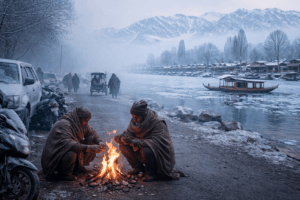
Beyond the plains, the cold is even more extreme. In the Kashmir Valley, residents are enduring ‘Chilla-i-Kalan’, the traditional 40-day period of harsh winter that began on December 21. During this time, temperatures routinely plunge several degrees below freezing. The famous Dal Lake in Srinagar has partially frozen, a visually striking testament to the persistent sub-zero cold. Other water bodies across the Valley have succumbed to ice as well, with temperatures in towns like Shopian reaching as low as -8.6°C.
The “Why” Behind the Freeze: A Perfect Atmospheric Storm
This exceptional cold is not a random occurrence but the result of specific climatic phenomena converging. Meteorologists point to a primary driver: a strong La Niña event. La Niña, the cool phase of the El Niño-Southern Oscillation (ENSO), alters global weather patterns. For the Indian subcontinent, it typically correlates with colder-than-normal winters due to changes in high-altitude wind patterns like the subtropical westerly jet stream.
This year, the jet stream has intensified and shifted southward, acting as a conduit for copious cold air advection from the higher latitudes straight into North India. Furthermore, a persistent high-pressure system over Siberia is predicted to strengthen, potentially funneling an even more intense “polar vortex” extension toward the region in late January. While forecasts that far out carry uncertainty, the pattern indicates the potential for the cold to intensify.
Adding to the misery is the dense fog, which forms under clear, calm, and cold conditions when moisture near the ground condenses. This fog mixes with pollutants to become a toxic smog, trapping the cold air at the surface and creating a vicious cycle of poor visibility and hazardous air quality. In Delhi, this has turned the city into a “giant freezer,” where cold air is trapped under a warmer layer, preventing any relief.
Life in the Cold: Disruption and Daily Grind
The human and economic impact of this weather is severe and multifaceted:
- Transportation Chaos: The most immediate effect has been on travel. Dense to very dense fog with visibility often below 50 meters—and at times zero—has brought road, rail, and air traffic to a crawl. Delhi’s Indira Gandhi International Airport has repeatedly warned of delays and cancellations. Major highways and trains connecting Punjab, Haryana, and Uttar Pradesh have seen massive disruptions, stranding passengers for hours.
- Public Health Crisis: The cold wave poses a direct threat to health, especially for vulnerable populations like the homeless, elderly, and those with pre-existing conditions. The IMD has warned of increased risks of illnesses like flu due to prolonged exposure. Concurrently, the stagnant, foggy air has worsened pollution, with Delhi’s AQI often soaring into the “severe” category (400+), leading to breathing difficulties and prompting the re-imposition of strict pollution control measures.
- Infrastructure and Habitation Strain: Most homes in India’s northern plains lack central heating, designed for heat rather than extreme cold. This makes the indoors almost as chilly as the outside, forcing families to rely on makeshift methods to stay warm. In Kashmir, reports of frozen water pipes are common, adding to the daily challenges.
Beyond the Shiver: Cultural Context and Unexpected Beauty
Within the hardship, there exists a cultural and natural narrative. In Kashmir, the Chilla-i-Kalan is an accepted, albeit difficult, part of the annual calendar—a period to be endured with preparation and resilience. The frozen landscapes also create scenes of breathtaking, if austere, beauty. While Dal Lake’s partial freeze is news, other high-altitude lakes in India are famous for their winter transformations.
For instance, Gurudongmar Lake in Sikkim (one of India’s highest) freezes completely in winter, save for a small patch of water believed to be blessed. Similarly, the crescent-shaped Chandratal (Moon Lake) in Himachal Pradesh and the mysterious Roopkund (Skeleton Lake) in Uttarakhand become frozen, silent, and spectacular destinations for the most intrepid travelers. These frozen lakes are a reminder of nature’s dual capacity to challenge and awe. However, this beauty can be treacherous, as suggested by an unverified report of tourists falling through ice on a frozen lake, highlighting the dangers of venturing onto unstable frozen surfaces.
Looking Ahead: Forecast and Implications
The India Meteorological Department (IMD) forecasts that the cold wave and dense fog conditions will persist over northwest India for the next several days. There is some hope for change with a western disturbance expected to approach the Himalayan region around January 16-18, which could bring light snowfall to the mountains and potentially alter the wind patterns over the plains. However, any significant relief from the intense cold in the plains is likely to be gradual.
This cold wave, particularly its intensity and spread to regions like central and east India which are also experiencing “uncharacteristic cold,” invites reflection on larger patterns. While a single event cannot be simplistically attributed to climate change, the increasing frequency and intensity of extreme weather events—be it heatwaves, floods, or cold spells—align with the predictions of a warming, more volatile global climate.
For now, the people of northern India continue to navigate the freeze. They wrap themselves in shawls and blankets, huddle around small fires on icy sidewalks, and patiently wait for delayed trains in the opaque whiteness of the fog. Their daily endurance is a powerful human story set against the backdrop of a formidable natural phenomenon—a story of adaptation and resilience in the face of a deep and persistent freeze.
You must be logged in to post a comment.