
North India’s Winter Siege: The Perfect Storm of Fog, Frost and Western Disturbances
A biting winter chill is set to return to North India, driven by a fresh Western Disturbance, bringing a dual threat of sharply plummeting temperatures and widespread dense fog. The India Meteorological Department (IMD) warns that isolated pockets of Punjab, Haryana, Chandigarh, and Uttar Pradesh will face very dense fog, significantly reducing visibility, with cold wave conditions expected in some areas. This system will also trigger a spell of rain and snow in Jammu, Kashmir, Ladakh, and Himachal Pradesh, while Uttarakhand may experience ground frost. Despite double-digit temperatures in places like Delhi, a combination of high humidity, calm winds, and persistent fog will make conditions feel intensely colder, severely disrupting daily life, transportation, and posing health risks to residents.
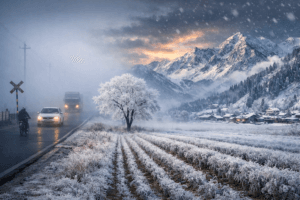
North India’s Winter Siege: The Perfect Storm of Fog, Frost and Western Disturbances
As North India braces for a dramatic shift in weather, residents are facing a multi-pronged assault from plummeting temperatures, dense fog, and a series of incoming Western Disturbances. This isn’t just a typical cold spell—it’s a complex meteorological event that has made plains colder than Himalayan hill stations and created hazardous conditions affecting millions of lives, agriculture, and transportation systems.
The Immediate Forecast: A Return to Biting Cold
According to the India Meteorological Department (IMD), a biting winter chill is returning to North India with temperatures set to drop sharply. The weather office has issued warnings about a “twin challenge” of falling mercury and blinding fog conditions.
Several states are bracing for dense to very dense fog engulfing isolated pockets during the early morning and night hours. The most affected regions include Punjab, Haryana, Chandigarh, and Uttar Pradesh. This atmospheric veil will also extend to Himachal Pradesh, Uttarakhand, Rajasthan, and Bihar, where visibility is expected to be significantly reduced.
Regional Impact Breakdown
| Region | Primary Threats | Expected Conditions | Timeline |
| Punjab, Haryana, Chandigarh | Cold wave, very dense fog | Temperatures plummeting, visibility severely reduced | Jan 30-31, continuing through early February |
| Uttar Pradesh, Bihar | Dense fog, thunderstorms | Low visibility, possible thunderstorms with lightning | Until Feb 1, with possible extension |
| Jammu, Kashmir, Ladakh | Heavy snowfall, thunderstorms | Widespread snow with thunderstorms, gusty winds (40 km/h) | Jan 31 – Feb 2, with intermittent systems for 10 days |
| Himachal Pradesh, Uttarakhand | Snow, ground frost, fog | Snowfall in higher reaches, fog in valleys, ground frost in Uttarakhand | Jan 31 onward, with multiple systems approaching |
| Rajasthan | Dense fog, hailstorms | Fog in east, isolated hailstorms in west | Jan 31 – Feb 1 |
| Delhi-NCR | Dense fog, “cold day” conditions | Visibility drops, temperatures 6-13°C, feels colder than actual | Until Feb 1, with change to cloudy skies and possible light rain |
The Science Behind the Chill: Why Delhi Feels Colder Than the Hills
One of the most perplexing aspects of this winter has been the phenomenon where plains experience colder conditions than Himalayan hill stations. Residents of Delhi-NCR have been waking up to bone-chilling mornings even when thermometers show temperatures in double digits.
The explanation lies in a combination of factors. First, dense fog traps moisture and pollutants close to the surface, preventing sunlight from warming the air during the day. This creates a self-perpetuating cycle where cold air lingers longer, making mornings and evenings feel much colder than actual temperatures suggest.
Additionally, calm winds and high humidity reduce the body’s ability to retain heat, intensifying the sensation of cold. With limited daytime sunshine, the ground fails to warm up, allowing cold conditions to persist through the day.
The contrast with hill stations is equally scientific. IMD Director General M Mohapatra explains that “cloud cover over the hills, triggered by an active western disturbance, prevented heat from escaping at night”. Over the plains, however, clear skies and persistent cold northwesterly winds led to strong radiative cooling, allowing temperatures to drop sharply.
The Western Disturbance Factor: A Triple Threat Approach
The weather patterns for the coming week are being shaped by an unusual sequence of systems. Meteorologists have identified three Western Disturbances in succession that will affect the region from January 31 through February 7.
The first two systems (January 31-February 3) will bring light to moderate rain and snowfall to the Western Himalayan region, along with scattered rain in the plains of Northwest and Central India. The third system (February 5-7) will move across Northwestern India soon after, prolonging the period of active weather into early February.
For Jammu and Kashmir specifically, the situation is even more intense with four back-to-back weather systems expected to bring intermittent rain and snow over the next 10 days. This comes as the region transitions from Chillai Kalan (the harshest 40-day winter period) to Chilai Khurd (the second harshest 20-day period).
Human Impact: Life in the Cold Wave
The human toll of this weather pattern is substantial and multifaceted. Transportation networks have been severely disrupted, with dense fog causing cancellation of 118 flights at Delhi airport on December 30 alone due to zero visibility. Road travel has become hazardous, with reduced visibility leading to increased accident risks.
Educational institutions have borne significant impact, with schools in Delhi remaining closed until January 15 to protect students from the biting chill and poor air quality. Similar measures were extended to Uttar Pradesh, Punjab, and other states amid record low temperatures.
The personal experiences of residents highlight the severity of conditions. Jeeva Thavasiraj, a 22-year-old site engineer from Tamil Nadu working in Gurugram’s Sector 66, expressed shock at the unprecedented chill: “I come from Tamil Nadu and have never experienced this kind of cold. Even with heavy safety shoes, our feet become numb”.
Health concerns are escalating, with advisories warning that prolonged exposure could lead to frostbite, flu and aggravated respiratory problems such as asthma and bronchitis, especially among the elderly and children.
Agricultural Implications and Precautions
The agricultural sector faces particular challenges from this weather pattern. The IMD has issued specific guidance for farmers, urging them to “ensure proper drainage for wheat and mustard crops, pause irrigation, and keep your harvest covered”.
The threat of ground frost in Uttarakhand and other regions poses risks to crops. In Rajasthan, where isolated hailstorms are predicted, farmers need to take protective measures for their fields.
Devendra Tripathi, founder of Mausam Tak and a weather vlogger for Kisan Tak, has been monitoring these atmospheric changes closely. He notes that “a new Western Disturbance has reached the mountains of India and, due to its impact, clouds are already visible in the western Himalayan region”. This moisture could be beneficial for the region’s snowpack but brings challenges for agriculture in the plains.
Historical Context and Climate Patterns
This severe winter follows an exceptionally dry period in northwest India, which recorded an 84.8% rainfall deficit in December and 84% deficit in the first ten days of January. This lack of precipitation left the hills largely without snow until recently.
Gurugram’s recent recording of 0.6°C matched the city’s January 22, 1977 low. Historical data shows the city has gone lower than this only three times on record: -0.4°C on December 5, 1966, 0°C on January 11, 1970, and 0.3°C on January 22, 1979.
Delhi experienced its coldest December day since 2020 on December 31, 2025, with maximum temperatures dipping to 14.2°C—a staggering 6.2 degrees below normal—accompanied by dense fog.
Looking Ahead: The Forecast Trajectory
While the immediate outlook remains challenging, meteorologists predict some gradual changes. Although northwest India may not see significant change in minimum temperatures over the next two days, a gradual rise of 3-5°C is forecast thereafter as new weather systems approach.
Central India can expect a slight reprieve with a gradual rise in minimum temperatures by 2-3°C over the next 24 hours. For Delhi specifically, the capital will transition from “Mist” to “Generally Cloudy Sky” with a chance of light rain and strong winds starting Saturday night.
The IMD has issued a yellow alert for North India and continues to urge residents, travelers, and authorities to remain vigilant. They recommend following advisories closely and taking necessary precautions during periods of dense fog, cold wave, and storm activity as winter weather continues to assert its grip over large parts of the country.
As North India navigates this complex weather scenario, the interplay between Western Disturbances, local atmospheric conditions, and human adaptation continues to write a compelling chapter in the region’s meteorological history. The coming days will test preparedness and resilience as nature demonstrates its formidable winter power.
You must be logged in to post a comment.