
North India’s Weather Crisis: A Perfect Storm of Fog, Pollution, and Systemic Challenges
North India’s Weather Crisis: A Perfect Storm of Fog, Pollution, and Systemic Challenges
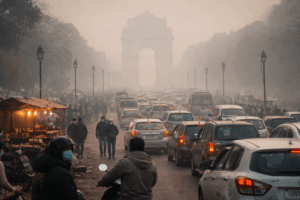
Winter in North India is often a season of contrasts—of warm blankets and chilly mornings. However, the dawn of December 20, 2025, brought no such coziness. Instead, a dense, toxic blanket smothered the region, grounding hundreds of flights, closing schools, and forcing millions indoors. This was not a simple foggy day; it was a stark manifestation of a recurring environmental crisis where adverse weather collided headlong with severe, human-made pollution.
A Region Grinds to a Halt
The crisis unfolded in the pre-dawn hours, as visibility in the capital plunged dramatically. At Delhi’s Safdarjung, the day’s lowest visibility was recorded at a mere 200 meters, with Palam faring only slightly better at 350 meters. This severe drop triggered a cascade of disruptions across India’s busiest travel hub.
At the Indira Gandhi International Airport (IGIA), which typically handles around 1,300 flights daily, operations were thrown into disarray. Airport authorities implemented Low Visibility Procedures (LVP) and CAT-III conditions—a specialized instrument landing system that allows operations only with trained pilots and compliant aircraft in extremely poor visibility. Despite these measures, the scale of disruption was immense. Reports indicate at least 129 flights were cancelled (including 66 arrivals and 63 departures), with delays affecting hundreds more. On the previous day, the disruptions were even more severe, with 177 flights cancelled and over 500 delayed.
Airlines scrambled to respond. IndiGo warned of “slower operations” due to fluctuating visibility, while Air India Express proactively cancelled multiple routes from Delhi to cities like Pune, Ranchi, and Varanasi. The ripple effect disrupted travel plans for tens of thousands of passengers during a peak travel period.
The Choking Grip of “Severe” Air Pollution
Compounding the travel nightmare was an invisible, yet far more dangerous, threat: toxic air. The fog was laced with pollutants, creating a smog that turned the atmosphere hazardous. According to the Central Pollution Control Board (CPCB), Delhi’s overall Air Quality Index (AQI) at 7 a.m. was 376, solidly in the “Very Poor” category.
However, this average masked alarming local extremes. Multiple monitoring stations across the city recorded AQI levels deep in the “Severe” category (401-500), posing serious health risks to the entire population. ITO recorded a staggering AQI of 429, while Anand Vihar and Sarai Kale Khan both hit 428. Other hotspots included Akshardham (420), Jahangirpuri (420), and Punjabi Bagh (413).
To understand the health implications of these levels, the following table outlines the risks associated with different AQI categories:
| AQI Category | AQI Range | Health Implications | Advisory for the Public |
| Good | 0-50 | Minimal impact | No precautions needed |
| Moderate | 51-100 | Possible discomfort for sensitive individuals | Unusually sensitive people should consider reducing activity |
| Unhealthy for Sensitive Groups | 101-150 | Increased aggravation for people with heart/lung disease; discomfort for elderly & children | Sensitive groups should reduce prolonged/heavy exertion |
| Unhealthy | 151-200 | Widespread effects for sensitive groups; discomfort for general public | Sensitive groups should avoid heavy exertion; everyone should limit prolonged exertion |
| Very Unhealthy | 201-300 | Significant aggravation for all; serious health effects for sensitive groups | Sensitive groups should avoid all outdoor exertion; everyone should limit outdoor activity |
| Hazardous | 301+ | Emergency conditions: Serious risk of respiratory effects for the entire population | Everyone should avoid all outdoor physical activity |
The “Severe” levels recorded in Delhi are classified as “Hazardous” on some international scales, meaning the air was dangerous for everyone to breathe. Independent air quality monitoring service IQAir recorded levels over 25 times the World Health Organization’s recommended limit for fine particulate matter (PM2.5).
Anatomy of a Recurring Crisis: Why This Happens Every Winter
This disruptive event is not a freak occurrence but a predictable, annual phenomenon with deep-rooted causes. It represents a “perfect storm” of meteorological and human factors unique to North India’s winter.
- The Meteorological Trap: During winter, calm winds and lower temperatures create a phenomenon called a temperature inversion. A layer of warm air acts like a lid, trapping cooler air—and all the pollutants in it—close to the ground. This prevents the normal vertical dispersion of smoke, dust, and emissions.
- The Human-Made Pollutants: Trapped within this atmospheric lid is a toxic cocktail from multiple sources:
- Vehicular Emissions: Delhi has over 11 million registered vehicles. Experts estimate that traffic contributes approximately 41% of the capital’s PM2.5 pollution.
- Industrial Emissions: Factories and power plants in and around the National Capital Region (NCR) contribute an estimated 18.6% of the pollution load.
- Construction and Road Dust: Ongoing development projects and dust from unpaved areas are perennial contributors.
- Agricultural Burning: A critical seasonal factor. Each autumn, after the rice harvest, farmers in the neighbouring states of Punjab and Haryana burn crop stubble to clear their fields for the next crop. This practice, though increasingly regulated, releases massive plumes of smoke that drift over Delhi and get trapped by the winter inversion.
- Local Weather Patterns: The region’s topography and shifting wind patterns can also bring in dust and pollution from the Thar Desert and other regions, accounting for a significant portion of particulate matter.
Government Response: From Advisories to Emergency Measures
Faced with the escalating crisis, authorities activated a multi-layered response:
- Pollution Control: The Commission for Air Quality Management (CAQM) invoked Stage-IV of the Graded Response Action Plan (GRAP), the most severe emergency measures. These included a ban on most construction and demolition work, restrictions on the entry of diesel trucks into the city, and a mandate for 50% of public and private office staff to work from home.
- Transport Enforcement: Delhi’s government strictly enforced the “No PUC, No Fuel” rule, barring vehicles without a valid Pollution Under Control certificate from refueling. On a single day, this push led to over 60,000 new PUC certificates being issued.
- Traveler Facilitation: The Ministry of Civil Aviation issued directives to airlines, mandating timely passenger communication, provision of refreshments for long delays, and free rescheduling or refunds. The Directorate General of Civil Aviation (DGCA) was instructed to ensure strict compliance.
- Weather Warnings: The India Meteorological Department (IMD) issued color-coded alerts across North India. An Orange alert (meaning “be prepared”) was in effect for Delhi on December 20, while a more severe Red alert (meaning “take action”) was issued for parts of Uttar Pradesh and Haryana.
Looking Ahead: A Foggy and Hazardous Forecast
The immediate future offers little respite. The IMD forecast predicts that dense to very dense fog conditions are likely to persist across Punjab, Haryana, Delhi, Uttar Pradesh, and Uttarakhand for several days, potentially lasting through the Christmas holiday period. The Air Quality Early Warning System has also forecast that pollution levels may remain in the “Severe” category in the coming days.
This recurring crisis forces a difficult question: How does a major global capital adapt to becoming partially non-functional for weeks each year? The immediate measures—flight cancellations, work-from-home orders, and vehicle restrictions—are necessary bandaids. However, they come with a significant economic cost in lost productivity, disrupted supply chains, and health-related expenses.
Long-term solutions require sustained, multi-state cooperation to address the root causes: transitioning farmers away from stubble burning, accelerating the adoption of electric vehicles, enforcing stricter industrial emissions standards, and expanding green cover. Until these systemic changes take hold, the people of North India will continue to brace themselves each winter, waiting for the winds to change and lift the oppressive, toxic blanket that descends upon their cities.
You must be logged in to post a comment.