
North India Shivers, South India Drenched: Decoding India’s Bifurcated Winter Weather Pattern
As India transitions into late November, a stark climatic divide emerges, with North India, including Delhi-NCR, Punjab, and Haryana, under a cold-wave alert characterized by steadily plunging temperatures—expected to drop as low as 9-10°C—accompanied by dense morning fog and severely hazardous air quality that traps pollutants, while simultaneously, the southern peninsula braces for vigorous northeast monsoon activity, triggered by a forming low-pressure system in the Bay of Bengal, promising widespread heavy to extremely heavy rainfall, thunderstorms, and potential flooding in Kerala, Tamil Nadu, and the Mahe region.
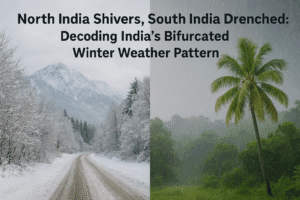
North India Shivers, South India Drenched: Decoding India’s Bifurcated Winter Weather Pattern
As the final week of November unfolds, India presents a dramatic tale of two weather systems. While the northern plains brace for a penetrating cold wave and hazardous air, the southern peninsula is reactivating under the vigorous return of the northeast monsoon, promising heavy rains and a different set of challenges. This isn’t just a simple weather report; it’s a deep dive into the atmospheric forces shaping the lives of millions across the subcontinent.
The North’s Deep Freeze: More Than Just a Chill
A cold-wave alert has been officially issued for Delhi-NCR, Rajasthan, Punjab, and Haryana. But what does a “cold wave” truly mean beyond the headline? The India Meteorological Department (IMD) defines it specifically: a drop in the minimum temperature to at least 10 degrees Celsius and a departure from the normal by 4.5 degrees or more. We’re not just talking about a crisp morning; this is a significant, health-impacting meteorological event.
The Mechanics of the Chill:
The current conditions are a perfect recipe for a sharp temperature drop. The skies over North India are predominantly clear, a critical factor. During the day, the sun provides modest warmth, but as night falls, this heat escapes rapidly back into the atmosphere unimpeded by cloud cover. Furthermore, the presence of light winds prevents the mixing of air, allowing a layer of cold, dense air to settle close to the ground, particularly in low-lying areas like the Indo-Gangetic plain.
The Fog Factor and Air Quality Crisis:
The forecast of early morning fog is intrinsically linked to this cooling. As the ground cools overnight, moisture in the air condenses into tiny water droplets, forming radiation fog. This fog, however, is not the pristine mist of postcards. In Delhi-NCR, it acts as a lid, trapping not just moisture but a toxic cocktail of pollutants.
As of the latest readings, the Air Quality Index (AQI) in the capital remains entrenched in the “very poor” to “severe” category (374 AQI is a stark figure). This cold-wave setup exacerbates the problem. The phenomenon of a temperature inversion—where a layer of warm air sits atop the cold, dense air near the surface—creates a lid that prevents the vertical dispersion of pollutants. Vehicle emissions, industrial smoke, and particulate matter from other sources are trapped, creating a hazardous breathing environment that poses serious risks to respiratory and cardiovascular health.
What to Expect on the Ground (Nov 22-25):
Residents of North India should prepare for a consistent, intensifying cold. The IMD predicts that the minimum temperatures in Delhi-NCR could plunge to a biting 9-10 degrees Celsius, while daytime highs will struggle to cross the 24-26 degree mark. The key takeaway is the narrowing gap between day and night temperatures, a classic indicator of peak winter conditions. This means the cold will be a persistent presence, not just a nighttime affair.
The South’s Soaking: The Northeast Monsoon Roars Back
In stark contrast, the IMD has issued advisories for “heavy to extremely heavy rainfall” across Kerala, Tamil Nadu, and the Mahe region. This is the hallmark of the northeast monsoon (or retreating monsoon), the primary rainfall season for these regions from October to December.
The Engine of the Rain: A Brewing Low-Pressure System
The catalyst for this intensified activity is the expected formation of a low-pressure area over the southeast Bay of Bengal. Such systems act as engines, sucking in moist winds from the surrounding ocean. As these north-easterly winds hit the coastal mountains of Tamil Nadu and Kerala, they are forced to rise, cool, and condense, resulting in widespread rainfall, thunderstorms, and the potential for localized flooding.
Cities like Thiruvananthapuram are forecast for a mostly cloudy sky with frequent bouts of rain or thunderstorms. This is vital, life-sustaining rain for the region’s agriculture, particularly for the samba crop in Tamil Nadu, and for replenishing reservoirs and groundwater levels. However, the “extremely heavy” rainfall warning signals potential disruption—waterlogging in urban areas, traffic snarls, and the risk of landslides in hilly terrain.
Regional Snapshots: A Nation of Contrasts
Western Madhya Pradesh: Moving away from the headlines, central India, specifically western Madhya Pradesh, is already in the grip of a significant cold-wave. Here, the temperatures have fallen “significantly below average,” indicating one of the core cold zones of the country. The dry, continental climate of this region allows for rapid radiative cooling, often making it colder than some parts of North India at night.
Kolkata and East India: Kolkata presents a more temperate picture, embodying a gentle transition into winter. The city experiences fairly cool mornings but feels noticeably warm during the day, with temperatures ranging from a pleasant 18 degrees to a warm 29 degrees Celsius. However, it shares a grim commonality with Delhi: a severe air quality problem. Despite the sunny skies, the AQI remains in the “very unhealthy” range, a persistent public health issue driven by local pollution, dust, and meteorological conditions that hinder dispersal.
Hyderabad: The Deccan plateau city of Hyderabad finds itself in a middle ground. The forecast of a partly cloudy sky with haze suggests it’s on the fringes of both the northern dry spell and the southern moisture, resulting in hazy conditions without the intense cold or the prolific rain.
Staying Safe and Prepared: A Citizen’s Guide
For North India:
- Layer Up: The key to combating the cold is layering clothing. Thermal innerwear, a warm mid-layer like a sweater, and a windproof jacket are more effective than one heavy garment.
- Protect Your Health: The cold air and poor AQI are a dangerous mix. Limit strenuous outdoor activities, especially in the early morning and late evening. Wear a high-quality N95 mask to protect against pollutants.
- Home Readiness: Check weather-stripping on doors and windows to keep the cold air out. Ensure vulnerable populations—the elderly and the homeless—have access to warmth and shelter.
- Travel Advisory: Be prepared for early morning fog that can severely impact road and air travel. Check flight and train schedules before heading out.
For South India:
- Rain Ready: Carry an umbrella or raincoat at all times. Be cautious of waterlogged streets and avoid walking or driving through flooded areas.
- Stay Informed: Keep track of IMD updates and local warnings for heavy rain, thunderstorms, and potential flooding.
- Check Your Surroundings: Those in hilly areas should be aware of the landslide risk and have an emergency plan in place.
This bifurcated weather pattern is a powerful reminder of India’s diverse climatic identity. As the north hunkers down under a blanket of cold, dense air, the south is being rejuvenated by the life-giving, yet sometimes furious, northeast monsoon. Understanding these patterns is the first step in navigating them safely and responsibly.
You must be logged in to post a comment.