
North India Gripped by Winter’s Fury: Kashmir Snowfall Meets Widespread Fog and Travel Chaos
From December 21, a severe winter system has engulfed Northern India, bringing heavy snowfall to Jammu & Kashmir and Himachal Pradesh—heralding the harsh ‘Chillai-Kalan’ period—while dense fog and toxic smog have blanketed the plains. The IMD forecasts these conditions, including intense cold and blizzard-like winds in higher reaches, will persist until at least December 28. This has caused major travel chaos, with over 500 flights delayed and dozens cancelled at Delhi’s airport alone, while low visibility has also disrupted rail networks. In Delhi, the fog has combined with pollutants to create a severe air quality health hazard. Authorities advise extreme caution for road travel, recommend masks outdoors, and urge air travelers to check directly with airlines for real-time updates amid ongoing disruptions.
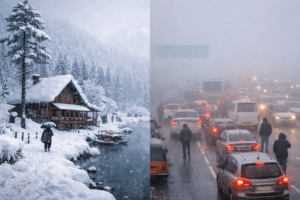
North India Gripped by Winter’s Fury: Kashmir Snowfall Meets Widespread Fog and Travel Chaos
A severe winter weather system has descended upon northern India, bringing a dramatic mix of heavy snowfall to the Himalayas and persistent, dense fog across the plains. This dual phenomenon is causing significant disruption, from the celebratory first snow of ‘Chillai-Kalan’ in Kashmir to grounded flights and hazardous roads in Delhi, Punjab, Haryana, and Uttar Pradesh.
The India Meteorological Department (IMD) forecasts no immediate relief, predicting that intense cold and foggy conditions will grip most of North India until at least December 28, with warnings for blizzard-like conditions in the higher reaches. The impact is a stark reminder of winter’s power, affecting millions of lives, crippling transportation networks, and marking the region’s annual battle with plummeting temperatures and reduced visibility.
The Himalayan Embrace: Snowfall and the Start of Chillai-Kalan
In Jammu & Kashmir, the weather marks a significant seasonal and cultural turning point. Snowfall has blanketed the upper reaches, officially heralding the start of **’Chillai-Kalan’**—the 40-day harshest winter period that lasts from December 21 to January 30.
- Widespread Precipitation: The IMD predicted heavy snowfall and rainfall, accompanied by snowstorms at isolated places over the higher reaches of Jammu, Kashmir, Ladakh, and northeast Himachal Pradesh. Key tourist destinations like Gulmarg and Sonamarg have received fresh snow, with accumulations of up to two inches reported. The strategic Sadhna Top pass has seen moderate snowfall, with six inches accumulating since Saturday night.
- A Welcome Respite: This precipitation ended a prolonged dry spell in the Valley, which local residents and tourism players had feared. A dry winter last year caused severe problems, making this season’s early snow a positive omen for water resources and tourism.
- Temperature Paradox: Interestingly, while the landscapes turned white, night temperatures in the Valley, including in Srinagar, rose significantly above normal—by as much as six notches—due to the cloud cover. Gulmarg recorded a low of -2.4°C, which, while sub-zero, was still several degrees above the seasonal average.
Table: Temperature Snapshot in Jammu & Kashmir and Hills
| Location | Minimum Temp (°C) | Note |
| Gulmarg, J&K | -1.5 to -2.4 | Above normal for this season |
| Srinagar, J&K | 4.0 | 6.4°C above normal |
| Lahaul-Spiti, HP | – | Received light snowfall |
A Transportation Standstill: Flight and Train Disruptions
The dense fog shrouding the Indo-Gangetic plains has triggered a cascading crisis in air and rail travel, with Delhi’s Indira Gandhi International Airport (IGI) at the epicenter.
- CAT-III Operations Activated: Due to visibility dropping as low as 100 meters on some runways, Delhi Airport has been conducting flight operations under CAT-III conditions. This instrument landing system allows specially equipped aircraft and trained pilots to land in very low visibility, but it drastically reduces the flow of air traffic.
- Massive Cancellations and Delays: The disruptions have been severe. On a single day, Delhi’s IGI airport witnessed over 500 flights delayed and at least 14 cancellations. The ripple effects were felt nationwide, with major airlines like IndiGo and SpiceJet cancelling dozens of flights to and from other affected cities like Srinagar, Amritsar, Varanasi, Bagdogra, and Ayodhya.
- Advisories and Passenger Guidance: Authorities have issued continuous advisories. Delhi International Airport Limited (DIAL) and the Airports Authority of India (AAI) have urged passengers to check directly with their airlines for real-time updates before heading to the airport. Airlines have set up support teams and offered flexible rebooking or refund options for affected travellers.
- Rail Network Also Hit: The low visibility has not spared the railways. Reports indicate that at least 30 trains were delayed in Delhi due to the thick fog, compounding the travel woes for thousands.
The Plains in a Chilly Haze: Widespread Fog and Dropping Mercury
Beyond the travel hubs, a vast swath of North India is experiencing intense cold and foggy conditions, with visibility severely hampered during the morning and night hours.
- Regional Forecast: The IMD has stated that Uttar Pradesh, Bihar, Punjab, Haryana, Chandigarh, Delhi, Rajasthan, Jharkhand, and parts of Madhya Pradesh are likely to witness these conditions until December 28. Dense to very dense fog is specifically predicted for Punjab until December 27 and over Haryana, Chandigarh, and Delhi from December 24-27.
- Temperature Extremes: While the hills see snow, the plains are shivering. Barabanki in Uttar Pradesh recorded the lowest minimum temperature among the plains at 4.5°C. Other areas like Narnaul in Haryana and Gurdaspur in Punjab saw minimums of 5.2°C and 6.8°C, respectively. The IMD has also issued a cold day warning for several states, including Bihar and Odisha, where maximum daytime temperatures are expected to fall significantly.
- The Smog Factor in Delhi: In the national capital, the problem is compounded by toxic smog. On Tuesday morning, Delhi’s overall Air Quality Index (AQI) was in the ‘severe’ category at 408, with some areas like Dwarka recording readings as high as 435. The combination of calm winds, cold temperatures, and high pollution levels has trapped pollutants close to the ground, creating a hazardous mix of fog and smog that reduces visibility and harms health.
Guidance for Residents and Travelers
Navigating this severe weather period requires caution and preparedness.
- For All Residents:
- Limit early morning outdoor exposure when fog and pollution are at their peak.
- Use masks (N95/KN95 recommended) when outside to protect against polluted fog.
- Ensure vulnerable groups (elderly, children, those with respiratory conditions) take extra precautions.
- Drive with extreme caution: use fog lights, maintain large following distances, and avoid high speeds.
- For Air Travelers:
- Always check your flight status with the airline (website/app) before leaving for the airport. Do not rely solely on third-party booking sites.
- Allow substantial extra time for your journey to the airport, as road travel will also be slow.
- Understand that if your flight is cancelled, you are entitled to rebooking on the next available flight or a full refund, as per airline policies and DGCA guidelines.
- Stay patient and cooperate with airport and airline staff, who are managing a difficult, safety-critical situation.
Looking Ahead: The Forecast Timeline
The IMD’s outlook suggests a prolonged period of challenging weather:
- Until December 27-28: Dense fog and cold conditions are expected to persist across the northern plains.
- December 25: A brief period of near-normal temperatures and clearer skies is possible in Delhi, but shallow fog may linger in the mornings.
- Hill Regions: Isolated heavy rain and snowfall are likely over Jammu-Kashmir-Ladakh and Himachal Pradesh, with potential for strong winds and blizzard-like conditions.
This widespread weather event underscores the powerful seasonal shift underway. While the snow brings joy and vital moisture to the mountains, the dense, often polluted fog on the plains presents a serious challenge to public health, safety, and the economy. Residents and authorities alike must remain vigilant as North India endures this extended spell of winter’s grip.
You must be logged in to post a comment.