
North Chills, South Soaks: India’s Extreme Weather Divide Intensifies
India is currently experiencing a stark weather divide, with northern regions including Delhi-NCR gripped by a severe winter chill and dense fog that has reduced visibility, disrupted transportation, and compounded a public health crisis as temperatures plunge to 8-9°C and air quality deteriorates further, worsened unexpectedly by volcanic ash from Ethiopia’s eruption, while simultaneously southern states including Tamil Nadu, Kerala, and the Andaman & Nicobar Islands are under IMD alerts for heavy to very heavy rainfall and potential cyclonic activity, triggering school closures and fisher warnings, showcasing the nation’s dual challenges of extreme weather.
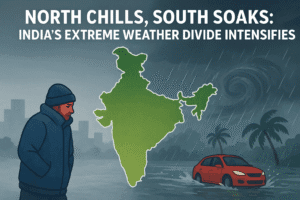
North Chills, South Soaks: India’s Extreme Weather Divide Intensifies
Meteorological contrasts are gripping India as the nation experiences a dramatic weather bifurcation. Northern regions, including Delhi-NCR, are shivering under dense fog and plunging temperatures, while Southern India braces for torrential rainfall and potential cyclonic activity. This striking divergence showcases how different weather systems can simultaneously affect various parts of the subcontinent, creating distinct challenges for millions of Indians.
Delhi’s Winter Onslaught: Fog, Chill, and Volcanic Complications
Dense Fog and Temperature Plunge
Delhi-NCR residents are waking up to increasingly frigid mornings as winter tightens its grip on the capital region. The India Meteorological Department (IMD) has reported minimum temperatures dropping to around 9 degrees Celsius, with maximum temperatures hovering near 24 degrees Celsius . The mercury is expected to dip even further in the coming days, with forecasts suggesting temperatures could fall to 8-9 degrees Celsius .
The IMD has issued a yellow alert for dense fog conditions across Delhi and surrounding areas . This dense blanket of fog has significantly reduced visibility, creating hazardous travel conditions and disrupting daily life. The foggy conditions are expected to persist, with the weather office predicting moderate fog coverage until at least November 26 .
Transportation Disruptions
The reduced visibility has already begun impacting transportation networks:
- Flight operations at Delhi airport have experienced delays, with authorities advising passengers to check with their airlines for updated flight information .
- Rail services have been similarly affected, with multiple trains including the Purushottam Express, Poorva Express, Shramjeevi Express, and JBP NZM SF Express running behind schedule .
- Road transportation has also been impacted, particularly in isolated areas of western Uttar Pradesh where heavy fog during night and early morning hours has reduced visibility .
Air Quality Crisis Compounded by Volcanic Ash
Delhi’s already problematic air quality has slipped further into the “very poor” category, with the Air Quality Index (AQI) recording readings around 360 . One monitoring station in Rohini even registered a “severe” air quality reading of 416 .
Complicating this situation is the unexpected arrival of volcanic ash from Ethiopia’s Hayli Gubbi volcano, which erupted on November 23, lofting substantial ash approximately 10-15 kilometers into the atmosphere . This ash plume has traveled across Yemen and Oman before drifting toward India, reaching Delhi and other northern states including Gujarat, Rajasthan, Maharashtra, Punjab, and Haryana .
Health experts have raised serious concerns about the compounding effect of this volcanic ash on Delhi’s already critical pollution situation. Dr. Abhishek Shankar, Assistant Professor in Radiation Oncology at AIIMS, Delhi, warned: “Volcanic ash drifting from Ethiopia may further degrade Delhi’s air quality by adding fine particles and toxic metals. These ultrafine particles can penetrate deep into the lungs, aggravating respiratory issues, triggering asthma, and increasing vulnerability among children, older adults, and cancer patients” .
The IMD has indicated that these ash clouds are drifting toward China and were expected to move away from India by the evening of November 25 .
Health Impacts and Expert Warnings
Medical experts are emphasizing the severe health implications of Delhi’s deteriorating air quality. Dr. Anant Mohan, Professor & Head of Pulmonary Medicine and Sleep Disorders at AIIMS Delhi, stated: “Air pollution does not leave any part of the body unaffected. Our respiratory system is the most commonly affected – nose, ears, throat, and lungs – because they are in direct contact with the air. All other organs, from the brain to any part of the body, heart, vessels, it is possible for everyone to have a heart attack or stroke” .
The health effects are already visible among Delhi residents, who are reporting watery eyes, asthma symptoms, itchy skin, and throat irritation. Prolonged exposure can lead to more severe conditions including persistent coughing, chest tightness, wheezing, and shortness of breath .
Southern India’s Deluge: Cyclonic System Triggers Rainfall Alerts
Developing Cyclone Senyar
While North India battles fog and pollution, Southern India is preparing for a significant rainfall event triggered by a developing weather system over the Bay of Bengal. The IMD has identified a low-pressure area that is likely to intensify into a cyclonic storm named Senyar (meaning “lion,” a name suggested by the United Arab Emirates) .
This system represents one of the season’s stronger rainfall events linked to evolving systems over the Bay of Bengal . According to IMD scientist Dr. Sanjeev Dwivedi, “A low-pressure area over the Strait of Malacca and the adjoining Andaman region is expected to move west to northwest, with the possibility of depression formation over the South Andaman Sea” .
Regional Rainfall Distribution and Alerts
The IMD has issued comprehensive weather alerts across multiple southern states:
- Tamil Nadu: Experiencing the longest and most intense rainfall phase, with heavy rainfall predicted from November 25-27, followed by very heavy rainfall from November 28-30 . Several districts have already experienced 20-26 centimeters of rainfall in 24-hour periods, causing significant waterlogging and traffic disruptions .
- Kerala and Mahe: Heavy rainfall is expected on November 25-26, with the intensity reducing thereafter . A yellow alert has been issued specifically for Thiruvananthapuram, Kollam, and Pathanamthitta districts on November 25 .
- Andaman & Nicobar Islands: Bracing for a prolonged rainy phase with heavy rainfall on November 25, followed by heavy to very heavy rainfall from November 26-28, and another round of heavy rain expected on November 29 .
- Coastal Andhra Pradesh and Yanam: Heavy rainfall is expected toward the end of the forecast period – on November 29, followed by heavy to very heavy rainfall on November 30 .
Safety Protocols and Precautionary Measures
Authorities have implemented several safety measures in response to these weather developments:
- Fishermen warnings: The IMD has strongly advised fishermen against venturing into several maritime areas, including the South Andaman Sea until November 27, Southeast Bay of Bengal from November 25-28, and Southwest Bay of Bengal, Gulf of Mannar, Comorin area, and the Tamil Nadu-Sri Lanka coasts until November 29 .
- School closures: Several educational institutions across vulnerable districts have been instructed to remain closed, particularly in Tamil Nadu and Kerala .
- Travel advisories: Residents have been advised to limit non-essential travel, with particular cautions about waterlogged roads and potential traffic disruptions .
Broader Weather Patterns Across India
Temperature Trends in Northwest and Central India
The IMD has predicted a gradual temperature drop of 2-3 degrees Celsius over the plains of northwest India until November 27 . Maharashtra is also expected to experience a similar temperature dip within the same timeframe . Central India will remain relatively stable until November 26, after which night temperatures are expected to fall by 2-3 degrees Celsius from November 27-29 .
Fog Conditions in Other Regions
Beyond Delhi, isolated pockets of west Uttar Pradesh, Assam, Meghalaya, Nagaland, Manipur, Mizoram, and Tripura may experience dense fog during night and early morning hours . The reduced visibility in these regions may lead to delays in flight operations, slower road traffic, and disruption of morning commutes .
Implications and Outlook
Cascading Effects of Extreme Weather
These contrasting weather patterns are creating significant challenges across affected regions:
- Urban infrastructure stress: Southern cities, particularly Chennai, are facing urban waterlogging and drainage overloads, especially in coastal and low-lying areas like Anna Nagar, Kilpauk, T. Nagar, and Mylapore .
- Transportation network disruptions: Key transportation corridors including ECR, GST Road/NH32, and NH16 feeder sections may experience ponding, slow-moving traffic, and temporary closures . Suburban rail services in Chennai risk delays and cancellations .
- Health emergency: Delhi’s compounding air quality issues, worsened by volcanic ash, are creating a public health emergency that particularly affects vulnerable populations including children, the elderly, and those with pre-existing respiratory conditions .
- Economic impact: Business operations face disruption through increased absenteeism, supply chain interruptions, and reduced mobility of workforce and goods .
Adaptive Measures and Response
Risk analysis experts recommend several immediate actions for residents and businesses in affected regions:
- Immediate responses: Activate incident response teams, implement work-from-home arrangements for staff crossing flood-prone routes, secure ground-floor assets, and pre-stage emergency kits at critical facilities .
- Operational adjustments: Reroute time-sensitive freight away from vulnerable corridors, maintain liaison with local authorities for convoy permissions, and enable remote access for critical systems .
- Strategic planning: Update business continuity plans with specific flood thresholds, conduct post-event lessons-learned sessions, and invest in drainage and site hardening for vulnerable locations .
Conclusion: A Nation Weathering Dual Challenges
India finds itself grappling with two significant weather challenges simultaneously – the North immobilized by fog and cold, the South bracing for torrential rains and potential cyclonic activity. This meteorological dichotomy showcases the vast climatic diversity of the subcontinent and the different adaptation strategies required across regions.
As Delhi residents bundle up against the chill and deteriorating air quality, southern coastal communities are preparing for potential flooding and infrastructure disruptions. These parallel weather events underscore the importance of region-specific disaster preparedness and the need for responsive governance systems capable of addressing multiple weather emergencies concurrently.
With the IMD maintaining vigilant monitoring of both situations, the coming days will test the resilience of India’s infrastructure, emergency response systems, and the adaptive capacity of its citizens facing these contrasting extreme weather conditions.
You must be logged in to post a comment.