
No Safe Place: The Systematic Assault on Palestinian Childhood in 2025
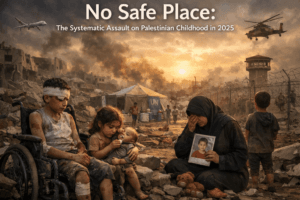
No Safe Place: The Systematic Assault on Palestinian Childhood in 2025
The year 2025 has etched itself into the history of the Palestinian people not as a marker of time, but as a chronicle of profound loss. For Palestinian children, it was another year defined by a relentless assault on their most fundamental rights—to life, safety, health, and a childhood free from terror. While a ceasefire agreement brought a fragile pause to some hostilities, the violence, deprivation, and systemic oppression never truly ceased. The evidence compiled by human rights organizations and UN agencies paints a devastating picture: a generation is being scarred, starved, and disappeared under what experts describe as a deliberate and systematic campaign.
The Unrelenting Scale of Violence
The statistics from Gaza are catastrophic, transcending the bounds of typical conflict. Over 23 months of war, at least 20,000 Palestinian children have been killed by Israeli forces—an average of more than one child every single hour. This figure represents about 2% of Gaza’s entire child population. Among the dead are at least 1,009 infants under the age of one, nearly half of whom were born and killed during the war itself. The injury count is equally staggering, with over 42,000 children wounded and an estimated 21,000 left with permanent disabilities.
The violence did not subside with ceasefires. In the weeks following the October 2025 pause in hostilities, UNICEF reported that at least 67 children were killed in conflict-related incidents—a rate of two children per day during a period ostensibly dedicated to peace. These ongoing attacks highlight a grim reality: for Palestinian children, there is no safe period and no secure location.
A Comparative View: Gaza and the West Bank
The crisis manifests differently across the occupied territories, but the threat to children is a constant. The table below outlines the distinct yet interconnected patterns of violence.
| Aspect of Crisis | Gaza Strip | Occupied West Bank |
| Primary Driver of Violence | Large-scale military bombardment, airstrikes, and siege conditions. | Military raids, settler violence with state complicity, and law enforcement operations. |
| Scale of Child Fatalities | Catastrophic; over 20,000 killed since Oct. 2023. | Significant; child killings are regular occurrences during raids. |
| Key Tactic | Starvation as a weapon of war, destruction of life-sustaining infrastructure. | Forcible displacement through violence and intimidation, targeting of livelihoods (e.g., olive harvest). |
| Systemic Context | Total siege, widespread destruction (80%+ buildings damaged), collapsed health system. | Institutional capitulation to settler interests, blurring of lines between military and violent settlers. |
The Many Faces of Suffering
Beyond the headlines of airstrikes and death tolls, children endure a spectrum of calculated horrors designed to break both body and spirit.
- Starvation by Design: In Gaza, Israel’s comprehensive siege has been weaponized to create famine conditions. Over one million people, half of them children, face catastrophic hunger. The UN reports that two-thirds of children under five are surviving on just two or fewer food groups, placing the entire under-five population at risk of acute malnutrition. This is not a byproduct of war but a documented policy, with human rights groups and legal scholars arguing it constitutes a deliberate act to destroy conditions for life.
- The Crisis of Detention and Torture: In the West Bank and for those abducted from Gaza, Israel’s military detention system represents a pipeline of abuse. Palestinian children are routinely arrested—often violently, frequently at night—and subjected to interrogation without a parent or lawyer present. Testimonies detail systematic physical violence, solitary confinement, and coercion. In 2025, a record 48% of all Palestinian child detainees were held under administrative detention, a practice of imprisonment without charge or trial based on secret evidence. The system’s goal, as analyzed by the UN Special Rapporteur, appears to be the “unchilding” of a generation—stripping them of innocence and burdening them with trauma no child should bear.
- Settler Violence and Institutional Complicity: In the West Bank, 2025 saw an unprecedented surge in settler violence, with October marked as the worst month since UN record-keeping began. Attacks have evolved from property destruction to kidnappings, prolonged beatings, and lethal assaults, often with the passive presence or active support of Israeli soldiers. Scholars note this is not a failure of law enforcement but a deliberate institutional transformation, where state bodies have aligned with settler ambitions. The distribution of thousands of army rifles to settler militias and the placement of pro-settler ideologues in key government ministries have created a climate of absolute impunity.
- The Agony of the Disappeared: A particularly chilling development in 2025 has been the enforced disappearance of children from Gaza. Families report sons being taken by Israeli forces while seeking aid, only to vanish into a black hole of detention. With Israel refusing to disclose identities or locations, parents are trapped in a nightmare of uncertainty, searching morgues and hospitals for children who are simply gone.
A Collapsed World: Health, Home, and Future
The infrastructure of childhood has been systematically dismantled. In Gaza, 97% of schools and 94% of hospitals have been damaged. The health system is on the brink of collapse, with 61% of health service points non-functional. Thousands of children, including those with severe war injuries, cancer, or congenital heart conditions, await medical evacuations that may never come.
The physical destruction is so vast that UN estimates suggest debris clearance alone could take seven years. For children, this means no schools to return to, no hospitals to heal in, and no safe homes to rebuild. Their environment is one of rubble, overcrowded tents, and the constant fear of renewed bombardment or displacement.
The Legal and Diplomatic Vacuum
This crisis persists within a framework of profound international inaction and impunity. While the UN General Assembly has overwhelmingly passed resolutions demanding Israel comply with international law and allow humanitarian access, enforcement mechanisms are stymied. Key states have shielded Israel from meaningful consequences.
Legally, the landscape is damning. The International Court of Justice (ICJ) is actively considering the case of genocide, and an Independent International Commission of Inquiry found in 2025 that genocide is being committed by Israel in Gaza. The Commission cited evidence of acts intended to destroy the Palestinian group in part, alongside statements from senior Israeli officials demonstrating intent. This places every state party to the Genocide Convention under a legal obligation to act, yet political will remains scarce.
The Path Forward: Beyond Awareness to Accountability
Awareness of these crimes is no longer the primary challenge. The data is documented, the legal opinions are clear, and the children’s testimonies are recorded. The deficit is one of courage and enforcement.
- Upholding Legal Obligations: All states, particularly those with close ties to Israel, must fulfill their duty under the Genocide Convention to prevent the crime. This includes halting all transfers of weapons used against civilians and children.
- Enforcing International Law: The findings of the ICJ and UN commissions must trigger tangible sanctions and measures to end the siege of Gaza, stop the expansion of illegal settlements, and dismantle the system of military detention for children.
- Prioritizing Child-Centric Aid and Protection: Humanitarian response must place children’s unique needs—nutritional, medical, psychological, and educational—at its absolute core. This requires unfettered access for aid agencies and a massive scaling up of mental health support for a traumatized generation.
- Demanding Accountability: There can be no lasting peace without justice. The work of the International Criminal Court must be supported, and domestic legal avenues under principles of universal jurisdiction should be pursued to end the cycle of impunity.
The story of 2025 is not just one of Palestinian children as victims. It is, fundamentally, a story about the failure of the international system erected after World War II to protect the most vulnerable. The conventions and laws exist, but they ring hollow for the child searching for food in Gaza, the teenager beaten in an Israeli prison, or the family mourning a son killed harvesting olives. Their safety, and the integrity of international law itself, now depends on whether the world can move from expressions of concern to acts of consequence. The childhood of a generation, and the viability of a just future for all in the region, hangs in the balance.
You must be logged in to post a comment.