
“No Room For ₹14.20 Crore Man”: Kris Srikkanth’s Ideal CSK XI Sparks Heated Debate
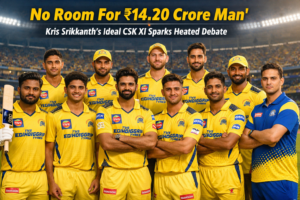
“No Room For ₹14.20 Crore Man”: Kris Srikkanth’s Ideal CSK XI Sparks Heated Debate
As the countdown to IPL 2026 ticks into its final days, the air in Chennai is thick with the familiar scent of jasmine and anticipation. For the Chennai Super Kings (CSK), a franchise built on loyalty and a near-mythical understanding of team culture, the selection of the playing XI is never just about numbers on a spreadsheet. It’s about chemistry, about the “CSK DNA”—a concept that has often baffled analysts but delivered trophies.
However, when former India opener and ex-BCCI chief selector Krishnamachari Srikkanth unveiled his preferred playing XI for the Super Kings this week, he lit a fuse under the cricketing world. Known for his unapologetic opinions and deep-rooted connection to Chennai (he was a key part of the franchise’s early leadership), Srikkanth delivered a lineup that was less about validating the auction room’s big spends and more about a return to a tactical philosophy that made CSK the kings of consistency.
In a move that can only be described as audacious, Srikkanth completely omitted Kartik Sharma—the 26-year-old all-rounder for whom CSK splurged a staggering ₹14.20 crore in the recent mini-auction—from his ideal XI. He also left out batter Sarfaraz Khan and pacer Anshul Kamboj, opting instead for a structure that prioritizes experience, explosive batting at the top, and a spin-heavy attack that mirrors the franchise’s glory days.
The Openers: A Blend of Proven Royalty and Raw Youth
Srikkanth’s opening combination is a statement of intent. By picking Sanju Samson alongside Ayush Mhatre, he signals a shift away from the more conservative starts CSK has sometimes been criticized for.
Samson, fresh off India’s T20 World Cup 2026 triumph, brings a captain’s poise and a range of strokes that can dismantle powerplays. But the real intrigue lies in Mhatre. The 19-year-old, who captained India to victory in the U19 World Cup earlier this year, is the prototype of the modern aggressive opener. Including him over a ₹14.20 crore all-rounder suggests that Srikkanth believes in the “horses for courses” philosophy: a specialist batter who can utilize the field restrictions is worth more than a versatile floater who might not fit the specific opening slot.
At No. 3, Ruturaj Gaikwad is a non-negotiable. As captain and the anchor of the lineup, Gaikwad’s role remains sacrosanct.
The Middle Order Gamble: Urvil Patel Over the Marquee Signing
The most contentious call in Srikkanth’s XI comes at No. 4. While many expected the big-money signing Kartik Sharma to slot in as a finisher or middle-order stabilizer, Srikkanth handed the reins to Urvil Patel.
Patel is a name that evokes raw power. Known in domestic circuits for his ability to hit sixes at will—including a record-breaking 50 off just 14 balls in the Syed Mushtaq Ali Trophy a few years ago—Patel represents the “X-factor” that CSK has often imported via overseas players. By choosing Urvil, Srikkanth is prioritizing a specialist explosive batter over a multi-skilled all-rounder. It’s a classic old-school CSK move: pick a player who excels in a specific role rather than forcing a utility player into a position they aren’t naturally suited for.
This decision effectively relegates Kartik Sharma to the bench, a staggering prospect given the price tag. Sharma’s strength lies in his medium-pace bowling and lower-order hitting. In Srikkanth’s view, with the bowling attack already featuring three pacers (Henry, Khaleel, and the impact player option) and a deep batting lineup, Sharma’s hybrid skillset becomes a luxury rather than a necessity.
Following Urvil, Srikkanth slots Dewald Brevis (the “Baby AB”) at No. 5, followed by Shivam Dube at No. 6 and the talismanic MS Dhoni at No. 7. This configuration is terrifying for opposition bowlers. If Gaikwad provides the stability, Brevis, Dube, and Dhoni form a trio of power-hitters who can exploit the death overs. Dube’s ability to crush spin and Dhoni’s masterclass in finishing remain the team’s trump card.
The All-Rounder Conundrum: Prashant Veer Gets the Nod
Srikkanth’s selection of Prashant Veer at No. 8 is fascinating. Like Kartik Sharma, Veer was also a ₹14.20 crore acquisition by CSK. The 20-year-old all-rounder from Uttar Pradesh is viewed as a long-term project—a fast-bowling all-rounder in the mold of a young Hardik Pandya.
By picking Veer over Sharma, Srikkanth is making a call on the type of all-rounder required. Veer offers genuine pace (140+ km/h), whereas Sharma is more of a medium-pace accumulator. In a Chepauk stadium that traditionally favors spin, having a pacer who can extract bounce and bowl enforcers in the middle overs might be more valuable than a sixth or seventh bowling option. This selection indicates that Srikkanth values Veer’s wicket-taking ability with the new ball or in the middle overs over Sharma’s batting depth.
The Bowling Attack: A Spin Fortress and Kiwi Precision
The bowling lineup reveals Srikkanth’s tactical blueprint for IPL 2026: win the game in the middle overs with wrist spin.
Noor Ahmad, the Afghan prodigy who was CSK’s breakout star in IPL 2025 with 24 wickets, is the centerpiece. Srikkanth pairs him with Rahul Chahar as the Impact Player, creating a dual wrist-spin threat. On the typically slow and low Chepauk surface, this combination could be lethal. By naming Chahar as the Impact Player, Srikkanth essentially confirms a strategy where CSK can bat deep with 7 batters and then bring in a world-class spinner to replace a batter while fielding.
The pace attack is lean but precise. Matt Henry, the New Zealand veteran, brings relentless accuracy and seam movement, a skill set that has historically troubled batters in the powerplay. Alongside him, Khaleel Ahmed offers the left-arm variety that CSK has craved since the days of Ashish Nehra. Notably, Srikkanth left out Anshul Kamboj, a talented pacer, indicating that in a three-pacer setup (Henry, Khaleel, and Veer), there is simply no room for another seamer unless they drop a spinner, which they are unlikely to do in Chennai.
The Overseas Player Strategy: Breaking the Norm
One of the most striking aspects of Srikkanth’s XI is that it features only three overseas players: Dewald Brevis (South Africa), Noor Ahmad (Afghanistan), and Matt Henry (New Zealand).
This leaves the fourth overseas slot open on the bench, with players like Akeal Hosein, Zakary Foulkes, and Matt Short waiting in the wings. In the modern IPL, where franchises often scramble to fit four overseas superstars into the XI, Srikkanth’s approach is a throwback. It suggests flexibility. By playing only three foreigners, CSK allows itself to adapt to conditions. On a turning track, they could bring in Hosein for a pacer; on a flat deck, they could unleash Foulkes. But the primary message is one of confidence: the Indian domestic core (Samson, Mhatre, Gaikwad, Urvil, Dube, Veer, Khaleel, Chahar) is strong enough to beat the best.
The Human Element: What Does This Mean for the Snubbed Stars?
While Srikkanth’s XI is a theoretical exercise, the real-world implications for players like Kartik Sharma and Sarfaraz Khan are significant.
For Kartik Sharma, carrying a price tag of over ₹14 crore, being left out of a “dream XI” by a franchise legend is a mental hurdle. In the high-pressure environment of CSK, where players are often told to “do their job” without worrying about external noise, such public omissions can either fuel a fire or create pressure. Srikkanth’s snub may serve as a wake-up call: the price tag guarantees nothing. To break into this lineup, Sharma must either prove he can be a more dynamic hitter than Urvil Patel or a more potent bowler than Prashant Veer.
Similarly, Sarfaraz Khan’s omission highlights the intense competition for middle-order spots. Despite his domestic dominance and improved fitness, Sarfaraz finds himself behind the power-hitting of Urvil and the experience of Dube.
Conclusion: A Blueprint for the Yellow Jersey
Kris Srikkanth’s selection is more than just a list of 12 names; it is a philosophical statement. It prioritizes specific skills over versatility, wrist spin over pace in the middle overs, and explosive intent at the top of the order. By leaving out a ₹14.20 crore star, he reminds everyone that in the CSK ecosystem, legacy and role clarity often outweigh auction price tags.
Whether the actual CSK think tank—led by Ruturaj Gaikwad and the coaching staff—agrees with Srikkanth remains to be seen. But if the former India great’s vision holds true, IPL 2026 will see a CSK that is aggressive from ball one, reliant on a lethal spin duo, and confident enough to bench a multi-millionaire if the team balance demands it.
One thing is certain: when the first ball is bowled at Chepauk, all eyes will be on who walks out at No. 4. If it’s Urvil Patel and not the ₹14.20 crore man, the Srikkanth school of thought will have won the day.
Srikkanth’s Ideal CSK XI (IPL 2026):
- Sanju Samson
- Ayush Mhatre
- Ruturaj Gaikwad (C)
- Urvil Patel
- Dewald Brevis
- Shivam Dube
- MS Dhoni (WK)
- Prashant Veer
- Noor Ahmad
- Matt Henry
- Khaleel Ahmed
Impact Player: Rahul Chahar
You must be logged in to post a comment.