
“No Permission Needed”: India’s Bold Message to the U.S. as It Doubles Down on Russian Oil
Amid escalating U.S.-Israel conflict with Iran that has disrupted Middle Eastern supply chains and spiked global oil prices, India has firmly declared it will continue importing Russian crude without seeking or requiring Washington’s permission, despite a temporary U.S. waiver intended to facilitate stranded Russian oil sales. While the waiver offers short-term relief, New Delhi emphasizes its energy sovereignty, noting Russia remained its top supplier even as the discount on Russian crude has vanished due to heightened demand. The geopolitical turmoil has immediate domestic consequences, forcing a 7% hike in LPG cylinder prices—India’s first such increase in nearly a year—as the nation relies on Gulf imports for over 90% of its cooking gas. With strategic crude reserves offering a buffer, India’s urgent pivot back to Russian oil underscores a stark reality: energy security now trumps diplomatic alignment, as the government scrambles to keep both industries running and kitchens lit.
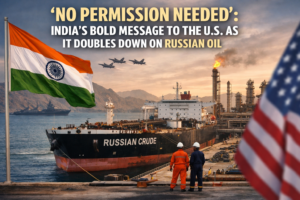
“No Permission Needed”: India’s Bold Message to the U.S. as It Doubles Down on Russian Oil
The geopolitical chessboard of global energy has been violently upended. As the Middle East teeters on the brink of a regional war, with the Strait of Hormuz effectively closed, the world’s energy security is hanging by a thread. In the midst of this chaos, India has drawn a line in the sand. On March 7, 2026, New Delhi issued a stark reminder to the international community: when it comes to feeding the energy appetite of 1.4 billion people, India answers to no one .
This isn’t just a news brief about oil imports; it is a story of strategic autonomy, the fragility of global supply chains, and the immediate human cost of distant geopolitical conflicts. By weaving together the latest official statements, market data, and on-the-ground realities, we can uncover the high-stakes game India is playing to keep its lights on and its kitchens running.
The Washington Tango: A Waiver or a Formality?
To understand the current moment, we have to rewind just a few weeks. For much of early 2026, it appeared that India was slowly but steadily yielding to intense pressure from the Trump administration. Reports from February suggested that Indian state-run refiners had slammed the brakes on new spot purchases of Russian crude. This came on the heels of a U.S. trade deal that saw Washington roll back a punishing 25% tariff on Indian exports, with American officials claiming New Delhi had made a “commitment” to stop buying Russian oil .
However, that “commitment” was notably absent from any official joint statement. The Indian government played a masterclass in strategic ambiguity, neither confirming nor denying the deal, simply stating that national interest guides its procurement . This careful dance seemed to pay off.
Fast forward to March 5, 2026. With the U.S.-Israel campaign against Iran sparking retaliatory attacks and shutting down the world’s most critical oil choke point, Washington blinked first. The U.S. Treasury issued a temporary 30-day waiver, specifically allowing Indian refiners to purchase Russian crude that was already “stranded at sea” . U.S. Treasury Secretary Scott Bessent framed it as a move to “stabilise global oil markets,” insisting it wouldn’t provide significant financial benefit to Moscow since it only applied to oil already in transit .
But for New Delhi, this waiver was a political prop, not a necessity. The government’s Press Information Bureau (PIB) issued a sharp rebuke dressed as a clarification. “India has never depended on permission from any country to buy Russian oil,” the statement read, making it clear that the suggestion a U.S. waiver “enables” these purchases fundamentally misunderstands India’s sovereign decision-making .
Russian Oil: From Discount Darling to Premium Lifeline
The economics of this relationship have flipped. For years, Russian oil was the “discount darling” of Indian refiners, often trading at $10 to $13 below the international Brent benchmark . It was a no-brainer for a price-sensitive market. By February 2026, despite the political headwinds, Russia remained India’s largest crude supplier. Data from Kpler shows India imported approximately 1.042 million barrels per day (mb/d) of Russian crude in February, with state-owned IOC leading the pack .
But the war has changed the math. With Middle Eastern supplies trapped behind the blocked Strait of Hormuz, demand for Russian barrels has skyrocketed. The discount has vanished. Traders are now selling Russian Urals to India at a premium of $4 to $5 per barrel over Brent for deliveries in March and early April .
Yet, for Indian refiners, price is no longer the primary issue—availability is. “Nowadays more than prices, availability of molecules is the issue,” one trader involved in Russian oil sales told Reuters . This scarcity has sparked a frantic scramble. Sources indicate that Indian state refiners have already snapped up about 20 million barrels of Russian oil from traders . The physical evidence is floating in the Arabian Sea.
Tankers that were once destination-bound for East Asia have done a U-turn. The Suezmax tanker Odune arrived at Paradip port on March 4, carrying 730,000 barrels of Urals crude. The Aframax tanker Matari is headed for Vadinar, while the Indri, another Suezmax, sharply turned north towards India after initially signaling Singapore as its destination . These ships, all previously sanctioned by the EU and UK, are now India’s floating insurance policy against a regional meltdown .
The Human Equation: When Geopolitics Hits the Kitchen
While diplomats discuss waivers and traders track tankers, the real weight of this crisis is being felt in the kitchens of ordinary Indians. The conflict’s most immediate and painful consequence landed on March 7: a sharp hike in the price of LPG (liquefied petroleum gas) cylinders.
India is the world’s second-largest LPG buyer, and it is dangerously exposed. Over 90% of its LPG imports come from the Gulf, transiting through the very Strait of Hormuz that is now a war zone . Unlike crude oil, India does not have massive strategic reserves of cooking gas, making this its “bigger vulnerability,” according to Kpler analyst Sumit Ritolia .
The math is simple but brutal. A 14.2 kg domestic LPG cylinder now costs ₹913 in Delhi, up from ₹853—a 7% increase. In Mumbai, the price rose to ₹912.50, in Kolkata to ₹930, and in Chennai to ₹928.50 . For commercial establishments, the hike was even steeper, with 19 kg cylinders jumping by over ₹115 . This marks the first increase for household users since April 2025, breaking a year of relative price stability .
For the over 10 crore families under the Ujjwala Yojana, a ₹300 per cylinder subsidy remains, insulating them slightly. But for the vast middle class and urban poor who fall outside this net, this is a direct hit to the monthly budget . The government was left with no choice. With the Hormuz corridor shut, the supply chain risk became too high, forcing the Petroleum Ministry to order refiners to ramp up LPG output by diverting propane and butane streams from industrial use to household cylinders .
Strategic Reserves and the “Plan B”
Despite the LPG pain, the government is projecting calm regarding crude supplies. The PIB note emphasized that India is “well stocked” with over 250 million barrels of crude and petroleum products, enough to “handle short term disruptions” . This confidence is backed by data suggesting that while the crisis is severe, it is not yet a catastrophe.
Kpler data indicates that India’s refiners have more than ten days of crude in storage and about a week’s worth of fuel stocks . This buffer, combined with the floating storage of Russian crude in Asian waters (estimated at around 10 million barrels), gives New Delhi a short-term breathing room .
However, the long-term strategy is shifting. The February import data shows a fascinating trend: while Russia remained the top supplier, Saudi Arabia surged to second place with 1.009 mb/d—its highest monthly export to India in nearly six years—and Iraq followed closely with 0.981 mb/d . This was part of a deliberate strategy to diversify sources.
But the war has forced a rapid pivot back to Moscow. As one source put it, “Should Middle Eastern inflows tighten, Indian refiners could pivot back toward Russian grades relatively quickly” . That pivot is now complete. The irony is thick: India spent months reducing dependence on Russia to appease the U.S., only to have a U.S.-led war force it back into Russia’s arms for survival.
The Road Ahead: A Fragile Equilibrium
As of March 7, 2026, India stands at a unique crossroads. It has effectively received Washington’s blessing (via the temporary waiver) to buy Russian oil, even as it denies needing it. It has secured physical cargoes to replace lost Middle Eastern supply, albeit at a higher price. And it has passed on some of that cost to consumers, hoping the political fallout is manageable.
But the situation remains volatile. President Donald Trump’s demand for the “unconditional surrender” of Iran suggests the conflict is far from over . Global crude prices soared 8.5% on March 6 alone, capping a nearly 30% weekly gain .
For India, the message is clear: energy security is national security. Whether it is buying Russian oil without permission, tankers doing emergency U-turns in the Arabian Sea, or a household budget strained by a ₹60 hike on a gas cylinder, the nation is navigating one of its most severe energy tests. The world may see India’s oil strategy as geopolitical maneuvering. For the Indian government, it is simply the business of keeping a nation running.
You must be logged in to post a comment.