
Nine American Lives, Zero Justice: The West Bank Killings That Washington Won’t Solve
More than 30 US senators have demanded the Trump administration open an independent investigation into the February killing of 19-year-old Palestinian American Nasrallah Abu Siyam in the West Bank—the ninth American citizen killed by Israeli soldiers or settlers since 2022—citing a “consistent pattern” in which these deaths occur without any criminal convictions or accountability, as a new letter led by Senator Chris Van Hollen calls for a full accounting of all nine cases and a congressional briefing by April 5, highlighting that none of the killings have resulted in justice despite promises from US officials, with victims including journalist Shireen Abu Akleh, 78-year-old Omar Assad who was bound and left to die, activist Aysenur Ezgi Eygi, and three minors, while noting that settler violence has sharply increased since the Trump administration revoked Biden-era sanctions on violent settlers.
Nine American Lives, Zero Justice: The West Bank Killings That Washington Won’t Solve
As the death toll of US citizens reaches nine since 2022, families grapple with grief while perpetrators remain free—and a new Senate letter demands answers
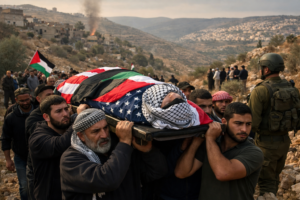
The body wrapped in a Palestinian flag and a keffiyeh moves through the rocky hills of Mukhmas, carried on the shoulders of men whose faces betray a mixture of grief and rage. Nasrallah Abu Siyam was 19 years old. He was born in Philadelphia. And on February 18, 2026, he became the ninth American citizen killed in the occupied West Bank since 2022—the latest name added to a list that keeps growing while accountability remains utterly absent.
This week, more than 30 US senators signed a letter demanding that the Trump administration open an independent investigation into Abu Siyam’s death. But for the families of the eight Americans killed before him, the letter arrives as yet another promise in a long line of promises—each one fading into the dry West Bank air like smoke from burning olive groves.
The Day the Farming Stopped
The village of Mukhmas sits northeast of Jerusalem, a place of terraced hills and ancient olive trees that have anchored families to this land for generations. On February 18, Palestinian farmers were working those terraces when masked Israeli settlers descended upon them.
Witnesses describe a scene of calculated violence. The settlers moved through the groves with purpose, attacking the farmers who were simply tending trees older than the occupation itself. And there, in the chaos, stood Israeli soldiers. They watched. They did not intervene. They provided no medical assistance when Abu Siyam was shot. They made no arrests.
The 19-year-old American bled to death on Palestinian soil while uniformed representatives of a government that receives billions in US military aid annually declined to lift a finger.
“The soldiers were there,” one witness later told local reporters, his voice carrying the exhaustion of someone who has seen this scene before, in too many variations. “They saw everything. They did nothing.”
The Israel Defense Forces did not respond to requests for comment on this story. They rarely do when the victims are Palestinian, even when those victims hold American passports.
A Pattern Written in Blood
Senator Chris Van Hollen of Maryland, who led the letter alongside 30 Democratic and independent colleagues, chose his words carefully. “This has now become a consistent pattern,” the lawmakers wrote to Secretary of State Marco Rubio, Attorney General Pam Bondi, and Ambassador to Israel Mike Huckabee. The pattern: “Americans are being killed in the West Bank by settlers or the [Israel Defense Forces] without justice or accountability, despite promises from US officials.”
Nine dead Americans. Zero criminal convictions. The math is not complicated, but the implications are devastating.
The letter demands a US-led investigation into Abu Siyam’s killing, a full accounting of where all nine cases currently stand, and a briefing to Congress by April 5. Whether those demands will yield anything different from the previous letters, the previous statements, the previous expressions of “deepest condolences” remains an open question—one that eight sets of grieving family members have already learned to answer with bitter skepticism.
The Ninth Name on a List of Ghosts
Before Nasrallah Abu Siyam, there were eight others. Their names deserve to be spoken, their stories deserve to be told, not as statistics in a political argument but as human beings whose lives were cut short while the world looked elsewhere.
Shireen Abu Akleh was 51 when she died, a journalist of such renown that her name traveled far beyond the territories she covered. Palestinian American, a reporter for Al Jazeera, she was known for her courage and her clarity—for telling the stories of her people with a dignity that transcended the violence surrounding her. In May 2022, while covering an Israeli military raid in Jenin, she wore a blue flak jacket clearly marked “PRESS.” She was in an open area. She was identifiable as a journalist by any standard. And an Israeli soldier shot her in the head.
The bullet that killed Shireen Abu Akleh did not just end one life. It was a message to every journalist covering the occupation, every truth-teller who might imagine that being American, being press, being visible would offer protection. The message: nothing protects you here. Nothing at all.
Omar Assad was 78 years old. He was a Palestinian American businessman who had returned to the West Bank in his retirement, perhaps imagining that his American citizenship and his years carried some weight. In January 2022, IDF soldiers stopped him at a checkpoint. They gagged him. They blindfolded him. They bound his hands and feet and left him on the ground in the cold. He died of a stress-induced heart attack, his body discovered later, still bound.
A 78-year-old man. Gagged. Blindfolded. Bound. Left on the ground to die. The IDF eventually acknowledged “moral failure” in the incident but announced no criminal charges. Omar Assad’s family received condolences and promises. They received no justice.
Aysenur Ezgi Eygi was 26, a Seattle native and recent graduate of the University of Washington. She was an activist with the International Solidarity Movement, part of a long tradition of young Americans who travel to the West Bank to witness, to document, to stand in nonviolent solidarity with Palestinians. In September 2024, she attended a protest against settlement expansion. An Israeli soldier shot her in the head.
The soldier who killed Aysenur was not a settler extremist acting outside the law. He was a uniformed member of the IDF, carrying out military operations in occupied territory. The bullet that entered her skull was government-issued. The hand that pulled the trigger was government-trained. The system that declined to prosecute him was government-run.
Khamis al-Ayyada, 40, died in August 2025 not from a bullet but from smoke. Israeli settlers set fire to his village. The flames spread. Al-Ayyada inhaled the smoke until his lungs could no longer function. He left behind family, friends, a community that must now rebuild while knowing that the people who killed him are probably still out there, still living in settlements, still receiving government protection.
And then there were the minors. Three of them.
A 14-year-old from New Jersey. Two 17-year-olds, killed in separate incidents. Children. American children. Their ages alone should stop anyone reading this list cold. Fourteen years old and shot dead in the West Bank. Seventeen years old, twice, in different places, different circumstances, same outcome: young bodies lowered into graves while the killers remain free.
The Families Nobody Wanted to Join
When the families of Americans killed in the West Bank began speaking to each other, they discovered they had formed what one described as “a club nobody wanted to be a part of.” They share grief, yes, but they also share frustration—the endless cycle of statements from US officials, the expressions of concern that never translate into action, the promises of investigations that vanish like morning mist.
“There is a consistent pattern in which Americans are being killed in the West Bank by settlers or the IDF without justice or accountability, despite promises from US officials,” the senators’ letter states. The families could have written those words themselves. They have been living them for years.
The State Department’s response to Abu Siyam’s death followed the familiar template: confirmation of the death, expression of condolences, statement that the US “expects a full, thorough and transparent investigation.” The department spokesperson added that the US “condemns criminal violence by any party in the West Bank” and takes “particular interest in this case due to our duty to protect American citizens.”
Notice the phrasing: “expects” an investigation. Not “will conduct.” Not “demands.” Not “insists upon as a condition of continued military aid.” The language of diplomacy, carefully calibrated to express concern without requiring accountability.
The US embassy in Jerusalem has been in direct contact with Abu Siyam’s family, the spokesperson added. Contact. Communication. Words. All the things that grieving families receive in abundance while the people who killed their loved ones receive nothing at all.
The Sanctions That Vanished
Understanding the current situation requires understanding what changed when Donald Trump returned to the White House in January 2025. One of his first acts was to revoke a Biden-era executive order that had placed sanctions on settlers implicated in violence. Thirty-three individuals and organizations lost their designations overnight—a signal from the new administration that the consequences imposed by the previous government would no longer apply.
The senators’ letter notes that the number of settler violence incidents subsequently “shot up.” The cause and effect are not difficult to trace. When violence carries consequences, some people choose not to be violent. When those consequences disappear, the inhibitions disappear with them.
Dozens of Palestinian villages have been emptied of their residents since the sanctions were lifted. Not gradually, not through economic pressure or “natural growth” of settlements, but through direct violence supported or even participated in by Israeli government forces. Ethnic cleansing is a strong term, but it is the term that human rights organizations and UN experts have used to describe what is happening in the West Bank. Empty villages. Displaced families. Burning olive groves. And now, nine dead Americans.
The Missing Senators
Notable by their absence from the senators’ letter are both of Pennsylvania’s senators—Democrat John Fetterman and Republican Dave McCormick. Abu Siyam was a Philadelphia native. His American identity was rooted in Pennsylvania soil. And yet the senators who represent that state did not sign onto a letter demanding justice for his killing.
Fetterman has been one of Israel’s most vocal supporters in the Senate over the last several years. He has not commented publicly on Abu Siyam’s death. The silence is conspicuous, a reminder that for all the talk of bipartisanship on Israel, there are lines that some politicians will not cross—including demanding accountability when American citizens are killed by US allies.
McCormick’s absence is perhaps less surprising given his party affiliation and the Trump administration’s approach to the region, but it carries its own weight. A constituent, a young man from his state, was killed. The people who killed him remain free. And McCormick has chosen not to join 31 of his colleagues in asking why.
What Justice Would Look Like
The Department of Justice, which would be involved in any US investigation into American citizens killed abroad, declined a request for comment on this story. That silence is itself telling. The DOJ has jurisdiction to investigate killings of US nationals overseas under certain circumstances. It has the authority to pursue charges, to demand cooperation from foreign governments, to use the full weight of American law to seek accountability.
It has not done so in any of these nine cases.
What would justice look like for the families of the nine? It would begin with investigations that are actually conducted, not merely “expected.” It would mean arrests, prosecutions, convictions. It would mean the Israeli government treating Palestinian American victims the way it would treat Jewish American victims—with urgency, with seriousness, with the understanding that American citizenship confers certain rights regardless of ethnicity or national origin.
It would mean the US government using its leverage, including the $3.8 billion in annual military aid to Israel, to demand accountability as a condition of continued support. It would mean the DOJ opening cases, issuing indictments, seeking extradition if necessary. It would mean treating the killing of an American citizen anywhere in the world as an attack on the United States itself.
That is what justice would look like. That is not what has happened.
The Larger Context
The killings of these nine Americans did not occur in isolation. They are part of a broader surge in settler violence that human rights organizations have documented extensively. Since October 7, 2023, and the subsequent Gaza war, the situation in the West Bank has deteriorated dramatically. Settlers, emboldened by political support and military protection, have accelerated their attacks on Palestinian communities. The Israeli military, ostensibly present to maintain order, has frequently stood aside or participated.
The senators’ letter references the “consistent pattern” of Americans killed without accountability. But the pattern extends beyond Americans. Thousands of Palestinians have been killed or displaced in the West Bank since the Gaza war began. The difference is that American victims attract congressional letters, State Department statements, expressions of concern. Palestinian victims without US passports receive far less attention from Washington.
This is not an argument against caring about American victims. It is an argument for understanding that the system that fails Americans is the same system that fails Palestinians—a system of impunity in which some lives are treated as worthy of protection and others as acceptable losses.
What Comes Next
The senators have demanded a briefing by April 5. Whether that deadline will be met, and whether the briefing will produce anything beyond more statements and expressions, remains to be seen. The families of the nine have learned not to expect too much.
In the West Bank village of Mukhmas, the farmers have returned to their terraces. The olive trees remain, ancient and patient, waiting for peace that does not come. Nasrallah Abu Siyam was 19 years old, born in Philadelphia, buried in the land of his ancestors. The masked settlers who killed him are probably still out there, still living in their settlements, still receiving protection from soldiers who watched an American die and did nothing.
Nine dead Americans. Zero convictions. A consistent pattern, as the senators wrote, of killings without justice or accountability. The question now is whether this letter will be different from the others—whether this time, words will translate into action. The families are watching. The world should be watching too.
But then, the world has been watching for a long time. And the killings continue.
You must be logged in to post a comment.