
Navigating Trump’s World: How India Is Redefining Its Role Through Strategic Multi-Alignment
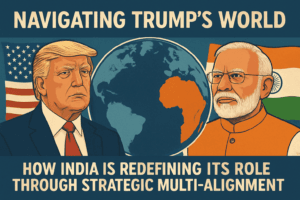
Navigating Trump’s World: How India Is Redefining Its Role Through Strategic Multi-Alignment
When U.S. President Donald Trump returned to the White House in 2025, many in New Delhi anticipated a continuation of the warming partnership between the world’s two largest democracies. Instead, they were met with a diplomatic paradigm shift. The sudden imposition of steep tariffs on Indian exports, coupled with claims of unwanted mediation in South Asia, has not merely caused a bilateral rift; it has triggered a fundamental reevaluation of India’s foreign policy playbook for the 21st century.
Far from bending to American pressure, India is executing a masterclass in strategic hedging. This is not a simple pivot away from the United States, but a deliberate and calculated move toward what analysts call “multi-alignment”—diversifying partnerships across global power centers to enhance sovereignty and mitigate risk. The era of betting everything on a single, unpredictable ally is over. India, under Prime Minister Narendra Modi, is navigating a turbulent world by rewriting the rules of engagement, proving that in an age of great power competition, the real power may lie with those who refuse to choose sides.
The Crisis Point: Tariffs and Sovereignty
The catalyst for India’s strategic shift was a one-two punch from Washington that challenged core national interests. In the summer of 2025, the Trump administration announced a baseline tariff of 25% on Indian exports, later signing an executive order that added an “additional ad valorem rate of duty of 25 percent”. The official justification—to penalize India for continuing to purchase Russian oil—was perceived in New Delhi as blatant economic coercion aimed at dictating foreign policy. The reaction was severe, with India’s Ministry of External Affairs condemning the measures as “unfair, unjustified, and unreasonable”.
Simultaneously, Trump publicly claimed credit for brokering a ceasefire between India and Pakistan, a move that directly undermined India’s sovereign position. New Delhi has long opposed any third-party mediation in its bilateral disputes with Islamabad. While Modi’s government firmly denied the U.S. role, the Pakistani government’s contradictory praise for Trump’s intervention created an embarrassing diplomatic scenario, exposing India to perceptions of weak leadership.
These actions shattered the previously held assumption in New Delhi that Washington inherently valued the strategic partnership. As noted by analysts, the tariff announcement led to the “repoliticization” of the relationship, threatening a “slow-motion catastrophe” for ties that had been carefully built over 25 years.
The F-35 “Poison Pill”: A Symbolic Breaking Point
Perhaps the clearest illustration of the growing divergence in strategic outlook came not in public statements, but in failed defense negotiations. For months, U.S. and Indian officials worked on a mega trade-and-defense compact. However, the deal hit an insurmountable wall over the F-35 stealth fighter jet.
Washington’s offer to include the F-35 in a broader package came with a critical condition: India would not receive the source code or have meaningful freedom to integrate its own indigenous weapons and sensors. For the U.S., the F-35 represents more than an aircraft; it is a strategic ecosystem designed to lock partners into decades of American logistics, software, and upgrades.
For India, this was unacceptable. Having risen to become the world’s second-largest arms importer, India is no longer content to be a “captive end-user”. The demand for full technology transfer and operational sovereignty is non-negotiable. As one report characterized it, the U.S. message was, “We can review policy and ease processes, but don’t ask for the keys to the vault.” India’s response was equally blunt: “Without those keys, there is no deal”.
This impasse turned the F-35 from a procurement opportunity into a symbolic poison pill. It crystallized a fundamental question: would India be a subordinate security partner or an independent pole in the international system? Choosing sovereignty, New Delhi walked away, effectively putting the grand trade deal “in the freezer”.
India’s Pragmatic Pivot: The Multi-Alignment Strategy in Action
In response to American pressure, India is not retreating but expanding its horizons. Its strategy is one of multi-alignment, actively deepening ties with other major powers to create a balanced and resilient diplomatic portfolio. This approach is evident across three key relationships.
- Re-engaging Europe as a Strategic HedgeWith trust in Washington weakened, Europe has emerged as a compelling alternative. A 2025 policy brief from the European Council on Foreign Relations argues that Europe offerscapital, technology, and supply chain diversification without the heavy geopolitical strings attached to American or Russian alternatives. India sees clear opportunities in restarting long-stalled free trade agreement talks with the European Union, strengthening the EU-India Trade and Technology Council, and expanding cooperation on defense, critical minerals, and clean energy. For Europe, which is pursuing its own “strategic autonomy,” a closer partnership with a major Indo-Pacific power like India is equally attractive.
- The Enduring Russian LifelineDespite Western pressure, the pragmatic relationship with Russia remains vital. Trade has ballooned to nearly $70 billion, driven largely by India’s import of discounted Russian crude. As the U.S. trade deal stalled, Russian President Vladimir Putin arrived in New Delhi with a contrasting offer: discussions on theSu-57E fifth-generation fighter with extensive technology transfer and local assembly in India. Where the U.S. guarded its source code, Russia signaled a willingness to make India a co-designer—a necessity for Moscow’s sanctioned defense industry and a major opportunity for India’s technological ambitions.
- A Cautious, Calculated Recalibration with ChinaThe most delicate balancing act is with Beijing. The Trump tariffs have prompted a notable, if cautious, warming in tone from New Delhi. After months of American pressure, Indian officials began openly discussing the relaxation of investment rules for China in sectors like manufacturing and renewable energy. This is not an embrace but a coldly pragmatic recalibration. As one former Indian official warned, China “should not make the mistake of assuming that India has become vulnerable”. The underlying security competition and border disputes remain, but economic logic is compelling a more nuanced approach, especially as China remains India’s largest goods trading partner.
India’s Multi-Alignment Strategy in Practice
| Strategic Partner | Primary Indian Interest | Key Initiative/Offer | Sovereignty Consideration |
| United States | Advanced tech, defense, balancing China | F-35 offer (rejected), Quad cooperation | Perceived as conditional, with high risk of external control |
| Europe | Trade, technology, secure diversification | EU FTA talks, Tech Council, green/defense coop | Viewed as having “fewer geopolitical strings” |
| Russia | Energy security, defense tech, strategic autonomy | Discounted oil, Su-57 fighter tech transfer | Offers high level of operational independence |
| China | Economic necessity, regional stability | Relaxing investment rules, managing trade deficit | Proceeded with extreme caution due to security rivalry |
The Deeper Shift: From Partnership to Self-Reliance
Beyond these tactical maneuvers lies a deeper philosophical transformation in India’s foreign policy worldview. The events of 2025 have vindicated the long-held doctrine of “strategic autonomy,” reinforcing the belief that India’s interests are best secured by maintaining freedom of action.
Prime Minister Modi distilled this sentiment, stating that the only real enemy is “dependence on other countries”. This ethos of atmanirbharta (self-reliance) is moving from a political slogan into a guiding strategic principle. The experience has shown that even the most cultivated partnerships can become instruments of pressure, making diversification and self-sufficiency not just idealistic goals but strategic imperatives.
Furthermore, India is discovering and leveraging its own market power as a diplomatic tool. Its massive defense imports (accounting for 8.3% of the global total) mean that its decisions directly impact defense industries from Bordeaux to Fort Worth. Its large, skilled workforce makes punitive measures like H-1B visa hikes a double-edged sword that can hamper U.S. innovation. This reality grants India a form of asymmetric influence it is now learning to wield.
Conclusion: The Making of a Pivotal Power
The India taking shape in the shadow of Trump’s “America First” policies is not the pliant partner Washington may have expected. It is a more confident, pragmatic, and sovereign power. The confrontational tactics have accelerated India’s journey toward a mature multi-alignment strategy, where loyalty is conditional and leverage is carefully balanced.
This shift has profound implications for the global order. It suggests that in an increasingly fragmented world, middle powers like India may hold the balance. They can navigate between competing blocs, extracting concessions and avoiding over-dependence. The challenge for the United States is to recognize that a partnership of equals cannot be built on coercion. For India, the path forward is clear: to build a foreign policy that reflects its civilizational weight and contemporary ambitions, ensuring that its voice, interests, and sovereignty remain its own in an unpredictable world. The story of “The India Trump Made” is ultimately the story of a nation rediscovering the strategic imperative of walking alone when necessary, while being wise enough to cultivate many friends for the journey.
You must be logged in to post a comment.