
Navigating the Minefield: When Workplace Political Discourse Becomes Harassment
A New Brunswick arbitrator’s decision to reinstate a paper mill worker fired for making offensive comments about Israel and Judaism to a Jewish colleague establishes a critical precedent for Canadian workplaces navigating the Israel-Palestine debate, ruling that while the employee’s aggressive and targeted statements—including telling the colleague to “shut your mouth and fuck off”—constituted workplace harassment under the employer’s policy, the termination was overturned due to a procedurally flawed investigation and the disproportionate penalty.
The arbitrator instead imposed a four-month unpaid suspension and mandatory sensitivity training, emphasizing the worker’s clean record and remorse, and highlighting the legal distinction between politically charged discourse and harassment, which focuses on unwelcome conduct that threatens an employee’s emotional health rather than the extreme threshold of criminal hate speech. This case underscores the necessity for employers to implement fair investigative procedures and proportional, progressive discipline while balancing the protection of employees from harassment with the complex realities of political expression in increasingly polarized work environments.
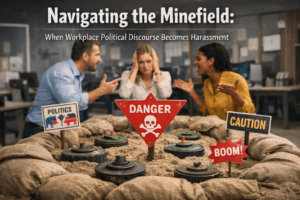
Navigating the Minefield: When Workplace Political Discourse Becomes Harassment
The line between political opinion and workplace harassment has become dangerously thin in Canadian workplaces. In a landmark decision that speaks directly to our polarized times, a New Brunswick arbitrator ordered the reinstatement of a paper mill worker fired for making offensive comments about Israel and Judaism to a Jewish colleague. While finding that the comments constituted harassment, the arbitrator ruled the employer’s flawed investigation and excessive penalty required a dramatic reversal: a four-month unpaid suspension and mandatory sensitivity training instead of termination.
This case is not an isolated incident but part of a growing trend of workplace conflicts stemming from the Israel-Palestine debate. From paramedics to teachers to medical residents, employees across Canada are facing discipline, suspension, and termination for expressing views on this conflict, creating a climate of fear and uncertainty about free expression. The ruling offers a critical roadmap for employers and employees alike on navigating one of today’s most combustible workplace challenges.
The Conversation That Crossed the Line: A Case Study in Escalation
The incident at the heart of the case began, like many workplace conflicts, with casual conversation. On April 28, 2025, Ethan Chamberlain, a shipper at Lake Utopia Paper, was at his desk when truck driver Igor Marichev arrived to pick up a load. The two had a cordial relationship spanning years. Their discussion started with the federal election but quickly turned to the Middle East.
What followed was a rapid descent from discourse to harassment. Chamberlain made several statements Marichev found deeply offensive, including the ancient antisemitic trope that Jews were responsible for the killing of Jesus and a conspiracy theory alleging Israeli foreknowledge of the 9/11 attacks. The conversation grew increasingly heated, particularly when Chamberlain reportedly compared Zionists to Nazis.
The critical turning point came when Chamberlain told Marichev, in effect, **”If you don’t want to hear other people’s opinions, you can shut your mouth and fuck off”**—a statement Marichev testified was repeated multiple times. This aggressive, targeted profanity, not the political debate itself, formed the core of the harassment finding. Marichev stated clearly, “What hurt me [is] when someone tells me to fuck off from here, a few times”.
Why Termination Failed: The Investigation’s Critical Flaws
Arbitrator Guy G. Couturier’s decision to reinstate hinged on two key findings: that harassment did occur, but that the employer’s response was procedurally unsound and disproportionate.
The company had retained “MM,” a former police officer with decades of experience. Yet the investigation was found to lack basic fairness. Chamberlain was never provided with a copy of the complaint, a transcript of Marichev’s interview, or an opportunity to listen to the recording before being questioned. Perhaps more damagingly, the arbitrator noted the investigator used leading questions and suggested words when the complainant struggled to recall events.
These procedural failures undermined the employer’s position, demonstrating that even when harassment occurs, employers must follow their own policies committing to investigate complaints “in a timely and fair manner”.
The Legal Landscape: Hate Speech vs. Workplace Harassment
A crucial distinction emerges from this case and broader legal analysis: hate speech and workplace harassment are governed by different legal standards with different thresholds for employer intervention.
Hate speech in Canada is narrowly and strictly defined. Under the Criminal Code, it requires the “wilful promotion of hatred” targeting identifiable groups and extends “only to very extreme forms of expression”. Criticism of a state’s actions, even when heated, generally does not meet this high threshold. The International Holocaust Remembrance Alliance (IHRA) definition, endorsed by Canada, specifically clarifies that “criticism of Israel similar to that leveled against any other country cannot be regarded as antisemitic”.
Workplace harassment, however, operates under a different, broader standard. As defined in the Lake Utopia Paper case, it includes “any objectionable or offensive behaviour that is known or ought reasonably to be known to be unwelcome”. This standard focuses on the effect on the recipient and the workplace environment rather than the absolute extremity required for hate speech charges.
| Aspect | Hate Speech (Criminal Code) | Workplace Harassment |
| Legal Standard | Beyond reasonable doubt (criminal) | Balance of probabilities (civil/employment) |
| Definition | Wilful promotion of hatred against identifiable group | Unwelcome conduct that detrimentally affects work environment |
| Focus | Extreme content and intent to promote hatred | Effect on recipient and workplace environment |
| Examples from Case | Not met in this case | Repeated profanity, targeted hostile comments, creating intimidating atmosphere |
| Employer’s Duty | Report potential crimes | Proactively prevent and address through policies and training |
This distinction explains why the arbitrator could find harassment occurred without making a definitive ruling on whether the comments constituted antisemitism. The legal test was whether the behaviour threatened Marichev’s emotional health and created an offensive work environment—a test Chamberlain’s aggressive, targeted comments clearly failed.
The Proportionality Principle: Why Reinstatement Prevailed
A cornerstone of Canadian employment law is progressive discipline—the principle that penalties should correspond to the severity of misconduct and an employee’s record. The arbitrator determined the employer “bypassed the corrective phase” and “went directly to the punitive level” in terminating Chamberlain.
Several mitigating factors supported reinstatement:
- Chamberlain’s clean disciplinary record over four years of service
- His apparent genuine remorse and offer to apologize and undergo training
- The fact the employer had never previously warned him about aggressive language
Bernie Farber, an expert on antisemitism who testified in the case, emphasized that “voice, tone, context” are fundamental in assessment. The arbitrator acknowledged this while focusing on the workplace policy violation. The ruling effectively stated: serious misconduct occurred, but not the “most extreme” violation warranting termination.
Beyond the Mill: A National Pattern of Workplace Conflict
This New Brunswick case reflects a nationwide challenge. Since the October 2023 Hamas attacks on Israel and subsequent military operations in Gaza, Canadian workplaces have become battlegrounds over political expression.
Consider these parallel cases:
- A York Region paramedic was terminated after commenting on a union Facebook post calling for a demonstration against Israel
- A University of Ottawa medical resident was suspended for social media posts describing Israel as a “settler colonial and apartheid state” but was reinstated after investigation
- A Toronto teacher was investigated and suspended for social media posts critical of Israel, telling reporters the experience made teachers “afraid to speak about anything that we could see as unjust”
Employment law experts are deeply divided. Nancy Shapiro, volunteering for the Centre for Israeli and Jewish Affairs, emphasizes that “employers must tolerate a range of political views, but they also have a legal duty to maintain harassment-free, safe workplaces”. Meanwhile, Toronto labour lawyer Jackie Esmonde argues employers are “weaponizing professionalism to silence people,” noting she’s contacted weekly “by somebody who is facing discipline, termination for pro-Palestinian speech”.
A Practical Action Plan for Canadian Employers
The Lake Utopia Paper decision offers crucial guidance for employers navigating this minefield. Here is a practical action plan distilled from the ruling and expert commentary:
- Develop Clear, Comprehensive Policies Before Crises Occur Workplace policies must explicitly address political discourse, harassment, and discrimination, including specific reference to antisemitism and other forms of religious and ethnic bias. Policies should adopt robust definitions, such as the IHRA definition of antisemitism which Canada has endorsed. Crucially, these policies must be communicated regularly to all employees.
- Implement Fair, Transparent Investigation Protocols The fatal flaw in the Lake Utopia case was procedural unfairness. Investigations must:
- Provide the respondent with the complaint and relevant materials
- Avoid leading questions that suggest answers
- Maintain impartiality throughout the process Employers should train internal investigators or carefully vet external ones to ensure they understand these procedural requirements.
- Apply Proportional, Progressive Discipline Except in the most extreme cases, termination should not be the first response. Consider:
- The employee’s disciplinary history and length of service
- The severity and context of the misconduct
- Whether the employee shows remorse and willingness to change
- Options like suspension, training, and monitored reinstatement
- Provide Regular, Specific Training Generalized diversity training is insufficient. Employers need to provide specific education on identifying antisemitism, Islamophobia, and other forms of bias that may arise in political discourse. Training should help employees understand the difference between legitimate political criticism and statements that harass colleagues based on protected characteristics.
- Foster Psychological Safety for Difficult Conversations Research indicates 64% of employees feel comfortable sharing thoughts at work when psychological safety exists. Employers should create guidelines for respectful dialogue on contentious issues while making clear that harassment will not be tolerated under any circumstances.
Conclusion: Balancing Rights in Polarized Times
The reinstatement of the New Brunswick mill worker represents more than a single employment dispute—it’s a defining precedent for Canadian workplaces in an era of intense political polarization. The ruling affirms that while employees cannot use political debate as cover for harassment, employers cannot use harassment policies as tools to suppress all uncomfortable political expression.
As James L. Turk of the Centre for Freedom of Expression observes, polarization around Israel has created “a chilling effect on lots of people” who now remain silent for fear of attack from either side. The challenge for Canadian workplaces is to navigate between this chilling effect and the legitimate need for respectful, harassment-free environments.
The ultimate lesson from Lake Utopia Paper is that process matters as much as substance. Employers who develop clear policies, implement fair procedures, and apply proportional discipline will be best positioned to uphold both workplace safety and fundamental freedoms. In a democracy grappling with global conflicts that resonate locally, getting this balance right isn’t just good HR practice—it’s essential for maintaining the social fabric of our workplaces and our nation.
You must be logged in to post a comment.