
Navigating the H-1B Visa Crisis: Strategic Responses to Extended Delays for Indian Professionals
A new U.S. policy mandating extensive online presence and social media reviews for H-1B and H-4 visa applicants, effective December 2025, has drastically reduced daily interview capacity at consulates in India, forcing the unilateral rescheduling of thousands of appointments from early 2026 to as late as October 2026 or beyond. This has created a crisis of professional and personal instability for affected Indian professionals, many of whom are now stranded, separated from families, and facing unpaid leave or job loss, with little recourse as alternative paths like third-country processing have been restricted, leaving applicants to rely on employer accommodations for remote work while awaiting their indefinitely postponed interviews.
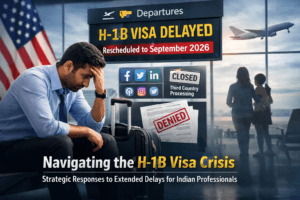
Navigating the H-1B Visa Crisis: Strategic Responses to Extended Delays for Indian Professionals
The year-end travel plans of thousands of Indian professionals in the United States have unraveled into a visa crisis. What began as routine trips home for H-1B visa renewations has turned into a state of limbo, with the U.S. State Department’s recent policy shift creating what immigration attorney Rajiv Khanna describes as a “systemic problem that appears deliberate”. This analysis examines the root causes, profound human impact, and actionable strategies for navigating this unprecedented disruption.
The Scale of the Disruption: From Weeks to Months in Limbo
The scope of the delays is both wide and deep. Beginning in mid-December 2025, U.S. consular posts across India initiated a mass, unilateral rescheduling of H-1B and H-4 visa appointments. The pattern is consistent and severe:
- Original Appointments: Scheduled for December 2025 through March 2026.
- New Dates: Pushed to dates ranging from March to October 2026, with some reports of appointments being deferred as far out as 2027.
- The Process: Notifications are delivered via email, instructing applicants not to contact the consulate and to appear only on the new date. Critically, while the interviews are postponed, biometrics appointments remain valid and unchanged.
This has created a domino effect of personal and professional crises. Individuals who had already booked flights and arranged leave are facing financial losses, while those already in India find themselves unexpectedly stranded, separated from jobs, homes, and families in the U.S..
The Core Driver: New “Online Presence Review” Mandate
The primary and officially cited reason for these delays is the implementation of an expanded social media and online presence vetting requirement for H-1B workers and their H-4 dependents, effective December 15, 2025.
- The Requirement: Applicants must now make their social media profiles public for consular officers to review online activity and employment history as part of security screening. This policy extends a model previously applied to student visas to the employment visa category.
- The Consequence: This additional scrutiny has temporarily reduced the daily interview capacity at U.S. consulates in India. The State Department has stated that the enhanced review creates “operational constraints,” forcing a reduction in the number of interviews conducted each day. The shift in priority, as a State Department spokesperson noted, is now toward “thoroughly vetting each visa case above all else,” rather than processing cases quickly.
The Perfect Storm: Elimination of “Third-Country National” Processing
Compounding the problem is another significant policy change that closed a critical escape valve for applicants. In September 2025, the State Department severely restricted Third-Country National (TCN) processing.
- What Changed: Foreign nationals can no longer freely schedule appointments at U.S. consulates outside their country of nationality or residence. This practice, often called “forum shopping,” where applicants would seek faster appointments in countries like Canada or Mexico, is now largely unavailable except under narrow, urgent circumstances.
- The Combined Impact: The restriction on TCN processing, layered on top of the interview delays in India, has created what attorney Rajiv Khanna calls a “wall” for employers and employees. The options for securing a timely visa stamp have been reduced to nearly zero, leaving affected individuals with no viable alternatives.
The Human and Professional Toll
The delays are more than a scheduling inconvenience; they represent a profound disruption to careers and lives.
- Career Instability and Financial Strain: Professionals face the risk of unpaid leave or even job loss if they cannot return to work. As one stranded individual posted anonymously, “I’m on unpaid leave, been living off savings for weeks and now I gotta stretch it till march somehow”.
- Family Separation: For those with families—especially children in U.S. schools or spouses on H-4 visas—the separation is emotionally devastating and logistically complex.
- Corporate Disruption: U.S. employers, particularly in the technology sector, are scrambling. Projects are delayed, teams are understaffed, and companies are urgently devising contingency plans. Major firms like Google and Apple have reportedly warned visa-holding employees against international travel due to the risk of year-long processing delays.
Navigating the Crisis: Practical Steps and Strategic Pivots
Given that legal remedies against the cancellations themselves are extremely limited, the path forward requires proactive management and strategic planning.
Immediate Actions for Stranded and Affected Applicants
- Do Not Ignore Notifications: Retrieve and save your updated appointment letter. Do not appear for your original interview date, as only the newly issued date will be honored.
- Communicate Transparently with Your Employer: This is the most critical step. Immediately notify your HR department and manager of the delay. As immigration attorney Sangeetha Mugunthan advises, the better option is to “plead with employers for remote work or leave, if that’s possible”.
- Prepare for Social Media Review: Set all relevant social media profiles (LinkedIn, Facebook, Twitter, etc.) to “public” mode in preparation for the consular review.
- Document Everything: Keep a detailed record of all communications from the consulate, correspondence with your employer, and any financial losses incurred (e.g., non-refundable tickets). This documentation can be crucial for future visa applications or discussions with your company.
- Understand the Reschedule Rules: Be aware that if you cannot attend the new appointment, you are generally permitted only one reschedule attempt. Furthermore, your visa application fee (MRV) receipt must be valid; receipts older than one year cannot be reused.
Strategic Recommendations for U.S. Employers
Employers must shift from a reactive to a proactive stance to protect their workforce and business continuity.
- Advise Against Non-Essential Travel: Strongly recommend that any H-1B employee with an expired visa stamp, or a first-time applicant, avoid all international travel unless absolutely critical.
- Develop Remote Work and Leave Policies: Create legally compliant contingency plans for extended remote work from abroad, considering tax and employment law implications. Also, formalize policies for extended unpaid or personal leave.
- Prioritize Return for Those with Valid Stamps: Urge employees currently in the U.S. whose visa stamps are still valid but nearing expiration to return from any international travel immediately, before the stamp expires.
- Model for Extended Absences: Integrate potential multi-month absences for impacted workers into workforce planning, project timelines, and client deliverables.
Exploring Alternative Pathways
For some, the scale of the delay may warrant considering other options:
- Domestic Opportunities in India: Roles with multinational corporations or startups in India, especially those offering global project exposure.
- Alternative International Destinations: Countries like Canada, Australia, and Germany offer skilled-worker programs with more predictable processing.
- Long-Term U.S. Immigration Routes: Some are exploring pathways like the EB-5 investor visa as uncertainty around the H-1B program grows.
The Broader Context and Future Outlook
This crisis is not an isolated incident but part of a broader recalibration of the H-1B program under the current U.S. administration. Other recent changes include:
- A new $100,000 fee accompanying most new H-1B petitions submitted after September 21, 2025.
- Proposed rules to replace the random H-1B lottery with a wage-level-based selection process, prioritizing higher-paid applicants.
While the current mass rescheduling is concentrated in India, the State Department’s online presence review is a global policy. Immigration law firms and analysts warn that other high-volume consular posts could soon experience similar delays as they implement the new vetting procedures.
Action Plan at a Glance
| Stakeholder | Immediate Actions (Next 48 Hours) | Strategic Planning (Next 30 Days) |
| Stranded Applicant | 1. Inform employer & HR. 2. Secure updated appointment letter. 3. Set social media to public. | 1. Formalize remote work/leave agreement. 2. Create a financial runway plan. 3. Document all communications. |
| Applicant in the U.S. | 1. Verify visa stamp expiration. 2. Cancel any non-essential travel to India. | 1. Discuss long-term renewal strategy with employer. 2. Monitor consulate wait times for future planning. |
| U.S. Employer | 1. Identify all impacted employees. 2. Communicate travel warning to H-1B staff. | 1. Implement formal remote work/leave policy. 2. Adjust project timelines and staffing models. 3. Consult immigration counsel on complex cases. |
Conclusion: Resilience in the Face of Uncertainty
The current H-1B visa delays represent a significant challenge, born from policy shifts that prioritize enhanced security over processing speed. For the thousands of Indian professionals caught in this bind, the path forward requires a blend of practical compliance, clear communication with employers, and strategic personal planning.
While the situation fosters undeniable frustration and anxiety, it also calls for resilience. By understanding the systemic causes, taking documented and proactive steps, and exploring all available contingencies, applicants and employers can navigate this period of uncertainty. The key is to recognize that while the timeline for return is uncertain, control over one’s response is not. In this interim, focusing on skill development, maintaining professional value, and strengthening documentation can turn a period of waiting into one of strategic preparation for the eventual return.
You must be logged in to post a comment.