
Navigating the Crossroads: A Deep Dive into India’s Economic Signals in 2025
In 2025, India’s economy presents a mixed and pivotal outlook, marked by significant domestic reforms and strategic global outreach, yet challenged by escalating external trade tensions. Domestically, growth‑oriented policies such as income tax reductions, a simplified GST structure, and the implementation of labour codes aimed to boost consumption, streamline compliance, and formalize employment.
Internationally, India advanced its trade diversification through key agreements with the UK, EFTA (including a $100‑billion investment pledge), Oman, and New Zealand, while nearing a deal with the EU. However, this progress was severely undermined by abrupt U.S. tariff escalations—rising to 50%—which disrupted key export sectors like textiles and leather, exposing India’s vulnerability to geopolitical friction.
Looking ahead, while the RBI projects a moderated growth of 7.3% for 2025‑26 and long‑awaited revisions to economic data methodologies promise greater accuracy, the overall trajectory remains cautiously optimistic, contingent on India’s ability to leverage new trade partnerships, sustain domestic demand, and navigate persistent global uncertainties.
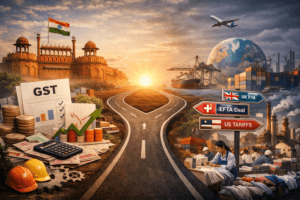
Navigating the Crossroads: A Deep Dive into India’s Economic Signals in 2025
The year 2025 has emerged as a defining chapter in India’s economic narrative—a story not of unambiguous boom or bust, but of a determined nation navigating a complex web of domestic reforms and global headwinds. The economic signals emanating from New Delhi and beyond paint a picture of an economy at a crucial inflection point, where policy intent is being rigorously tested by external realities. To understand India’s trajectory, one must look beyond singular metrics and examine the interplay between strategic advancement and unforeseen challenge.
The Domestic Engine: A Calculated Push for Growth and Stability
The government’s playbook for 2025 was clear from the outset: stimulate demand, simplify systems, and strengthen the social safety net. This triad formed the cornerstone of a proactive domestic agenda.
The Union Budget 2025 set the tone with its significant restructuring of income tax slabs. By putting more money directly into the pockets of the middle class, the policy was a direct stimulus to private consumption, which accounts for nearly 60% of India’s GDP. This was not merely a populist measure but a calculated risk to reignite the virtuous cycle of spending and investment in a post-pandemic world where demand had remained uneven.
This push was complemented by a landmark rationalization of the GST framework. The scrapping of the 12% and 28% slabs, moving goods to 5% and 18% rates respectively, represents the most significant simplification since the tax’s inception. For consumers, it translated to lower prices on a range of items, from daily essentials to consumer durables. For businesses, especially MSMEs, it reduced compliance complexity and working capital locked up in tariffs. This move signaled a maturation of the GST regime, transitioning from a disruptive rollout to a refined tool for economic efficiency.
Perhaps the most transformative domestic reform was the nationwide implementation of the four Labour Codes. By extending formal social security, minimum wage guarantees, and other benefits to contract and gig workers, India is attempting a profound structural shift. The goal is twofold: to protect a vast, vulnerable workforce in the evolving digital economy and to accelerate the formalization of the economy, thereby broadening the tax base and improving productivity data. The success of this code, however, hinges on seamless adoption by states and industries without stifling job creation.
The Global Gambit: Strategic Diversification Through Trade Diplomacy
While domestic reforms aimed to solidify the foundation, 2025’s foreign economic policy was characterized by an assertive and strategic diversification drive. The “China-plus-one” strategy, geopolitical recalibrations, and the pursuit of strategic autonomy converged into a successful year of trade diplomacy.
The India-UK Comprehensive Economic Partnership Agreement was more than a trade deal; it was a statement of strategic alignment. Beyond tariff concessions, its enhanced mobility provisions for Indian professionals address a long-standing demand, facilitating the export of high-value services and fostering deeper people-to-people ties.
The Trade and Economic Partnership Agreement (TEPA) with EFTA is a benchmark for what India seeks from modern agreements. The binding $100 billion investment commitment from Switzerland, Norway, Iceland, and Liechtenstein over 15 years is unprecedented. It targets sectors like pharmaceuticals, chemicals, and renewable technology, aiming to move beyond traditional trade to technology transfer and manufacturing partnerships. This model—trade ties coupled with guaranteed investment—could become a template for future negotiations.
Agreements with Oman and the concluded FTA with New Zealand (with its own $20 billion investment pledge) illustrate the geographic and strategic spread of this outreach. Oman provides a critical gateway to the Gulf and East African markets, while New Zealand opens doors for Indian exports in agriculture and services in the Pacific. The advanced stage of India-EU negotiations underscores a patient, deliberate approach, prioritizing a balanced outcome over a hasty signing.
Collectively, these deals represent a clear pivot: reducing over-reliance on any single region, securing value-chain partnerships, and using market access as leverage for long-term capital inflows.
The American Adversity: When Geopolitics Disrupts Economics
The most potent lesson of 2025 has been the vulnerability inherent in global interdependence. The early-year optimism surrounding a potential India-U.S. Bilateral Trade Agreement quickly dissipated, replaced by the shock of President Trump’s “Liberation Day” tariffs. The escalation from a proposed 26% to a crushing 50% tariff on key Indian exports—first on general trade grounds, then penalizing India’s energy imports from Russia—revealed a harsh truth. In an era of renewed protectionism and great-power rivalry, economic logic can be swiftly overridden by political and strategic posturing.
The impact has been severe and concentrated. Labor-intensive sectors like textiles, leather goods, and select engineering products—which employ millions and for whom the U.S. is a primary market—face an existential threat. The ripple effect through supply chains in Tiruppur, Agra, and Ludhiana could undo years of growth and job creation. While the government’s announced Export Promotion Mission is a step toward mitigation, its efficacy depends on the specifics: the cost of credit, logistical support, and aid in navigating complex non-tariff barriers in alternative markets.
This tension underscores India’s delicate balancing act. It highlights the near-impossible task of maintaining a strategic partnership with the U.S. while safeguarding sovereign foreign policy choices and protecting domestic industries from sudden geopolitical fallout.
The Road Ahead: Cautious Optimism Amidst Structural Reforms
Peering into 2026, the outlook is one of cautious growth amidst elevated uncertainty. The Reserve Bank of India’s projection of 7.3% GDP growth for 2025-26, while robust globally, indicates a perceptible slowdown from the 8%+ pace of the first half. This moderation reflects the cumulative impact of global demand softness, the lagged effect of high interest rates, and the U.S. tariff shock.
However, 2025 also sowed seeds for a more transparent and reliable economic future. The impending revision of base years and methodologies for GDP, IIP, and CPI is a quietly significant development. By updating these statistical pillars—which currently rely on data structures from 2011-12—India will gain a far more accurate, contemporary picture of its economy. This will better capture the contributions of the digital economy, new industries, and changing consumption patterns, leading to more informed policymaking and enhanced credibility on global platforms.
Key Signals to Monitor in 2026
For observers and investors, the following signals will be critical:
- Export Resilience: How effectively can sectors pivot to markets covered by the new FTAs (UK, EFTA) to offset U.S.-related losses?
- Investment Follow-Through: Will the ambitious investment commitments from EFTA and New Zealand see tangible ground-breaking projects, or remain on paper?
- Domestic Demand Durability: Will the tax-cut and GST rationalization boost sustain household spending beyond the short term?
- Data Revolution: How will the new statistical series alter our understanding of India’s economic size, growth, and inflation dynamics?
Conclusion: The Forging of a Resilient Economy
India’s 2025 economic story is not one of simple triumph or setback. It is a narrative of a maturing economy actively reshaping its internal architecture while engaging with a volatile world. The year demonstrated that domestic reform and global trade strategy can proceed in tandem, as seen with the concurrent rollout of labour codes and sealing of FTAs. Yet, it also served as a stark reminder that in a fragmented world, external shocks can rapidly undermine domestic momentum.
The ultimate takeaway is that India’s economic journey is being forged in the fire of this complexity. The success of its model will depend not on avoiding challenges, but on the agility of its response—leveraging new partnerships, deepening domestic capabilities, and building systemic resilience. The path ahead is one of measured steps, not leaps, but the direction remains oriented toward sustainable, inclusive growth in an uncertain age.
You must be logged in to post a comment.