
Navigating the Chill: A State-by-State Guide to India’s Extended School Closures Amid the 2025 Cold Wave
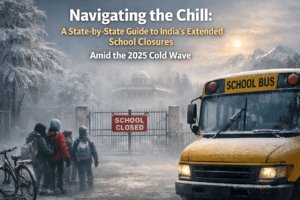
Navigating the Chill: A State-by-State Guide to India’s Extended School Closures Amid the 2025 Cold Wave
As a dense, icy fog blankets large swathes of Northern and Eastern India, the familiar morning ritual of school bells and bustling buses has fallen silent. The winter of 2025 is not just a season; it has become a significant disruptor, prompting state administrations to prioritise child safety over classroom schedules. This isn’t merely a holiday extension; it’s a public health response to plummeting mercury, transforming the annual winter break into a protective measure against the cold wave’s bite. For parents, students, and educators, understanding the “why” and “until when” behind these closures is crucial for navigating this frosty interlude.
Beyond the Thermometer: The Human Decision Behind Closed Doors
The decision to shutter schools is never taken lightly. It emerges from a complex intersection of meteorology, infrastructure, and child welfare. The Indian Meteorological Department’s (IMD) “cold wave” warnings are the primary trigger, issued when minimum temperatures plummet significantly below normal, or dip to 4°C or lower in the plains. For children, especially the younger ones, exposure during early morning hours can lead to severe health risks like hypothermia, frostnip, and aggravated respiratory illnesses. Furthermore, visibility often drops to near-zero in many regions due to dense fog, making commutes hazardous for school transport and students travelling on foot or bicycles.
These closures represent a pragmatic, child-centric policy. As Uttar Pradesh Chief Minister Yogi Adityanath emphasised, the “well-being of children remains a top priority,” a sentiment echoed across state lines. It’s a recognition that learning cannot thrive in conditions that jeopardise basic health and safety.
A Detailed State-Wise Analysis of Closures and Adjustments
Here’s a comprehensive breakdown of how different states are adapting, going beyond a simple list to understand the local context.
- Uttar Pradesh: A Statewide Pause
- Status: All schools closed until January 1, 2026.
- The Insight: This is one of the most blanket and decisive orders, covering the entire state. It underscores the severity of the conditions across the Indo-Gangetic plain. The directive carries a strict warning against lapses, indicating a top-down enforcement to ensure uniformity and compliance. For parents, this provides clarity but also an extended period of managing children at home during peak winter.
- Jharkhand: District-Led Precaution
- Status: In capital district Ranchi, and other affected areas, schools are closed until December 31, 2025. The order specifically invokes legal authority (Bharatiya Nagrik Suraksha Samhita), applying to all KG to Class 12 institutions.
- The Insight: Jharkhand’s approach highlights how localised conditions can be. While many schools were already on a scheduled winter break (Dec 26-31), the district administration felt compelled to mandate it for the few that were still open. This points to an active, responsive governance model where district authorities are empowered to act based on immediate local weather data.
- Bihar: A Graded, Age-Sensitive Response
- Status: A nuanced approach is visible here. In Patna, schools up to Class 8 are closed until December 30, while Classes 9-12 have restricted timings (10 AM – 3:30 PM). Districts like Saharsa (till Dec 30) and Nalanda (till Dec 31) have closures for higher classes as well. Bhojpur has shut schools up to Class 8 and Anganwadi centres until Dec 31.
- The Insight: Bihar’s strategy is particularly insightful. It recognises that older students are more resilient and may have critical academic milestones (board prep, etc.), hence the modified timings instead of a full closure. This balanced approach attempts to mitigate learning loss for senior students while protecting the most vulnerable younger children. It reflects an understanding of developmental differences in cold tolerance and academic pressure.
- Himachal Pradesh (Una District): The “Revised Timings” Model
- Status: Not a full closure, but a shifted schedule from December 29 to January 31. All schools will operate from 10 AM to 3:30 PM.
- The Insight: This is a classic hill-region adaptation. A full winter-long closure isn’t always feasible. By pushing the school day into the warmer hours, the administration ensures continuity of education while avoiding the harsh early mornings. The directive to compensate for academic loss by adjusting assembly and break times is a clever operational detail, showing forethought in curriculum planning.
- The Prolonged Winter of Jammu & Kashmir
- Status: An extended winter vacation, with lower schools (1-8) closed from Dec 1, 2025, to Feb 28, 2026, and higher classes (9-12) from Dec 11, 2025, to Feb 22, 2026.
- The Insight: This is less a reactionary closure and more a built-in, pragmatic academic calendar feature. It acknowledges the region’s geographical reality where severe winter is a certainty, not an anomaly. Education planning here is intrinsically designed around this long break, with possible provisions for remote learning or adjusted syllabi.
- The Southern Schedule: Kerala’s Planned Break
- Status: A scheduled winter break from January 1 to January 15, 2026.
- The Insight: Kerala’s inclusion here is crucial for perspective. Its “winter break” is not cold-wave driven but a calendared period, often coinciding with harvest festivals and milder weather tourism. It highlights how the term “winter break” carries vastly different meanings across India—from a health imperative in the north to a cultural/seasonal holiday in the south.
- Punjab: The Standard Vacation Window
- Status: Winter vacation ongoing from December 22 to early January (around Jan 10, 2026).
- The Insight: Punjab’s break, while slightly extended, largely follows its traditional schedule. The cold wave has likely reinforced this timeline, but it represents the standard annual recess period for many northern states, now blending seamlessly with the advisory closures elsewhere.
The Ripple Effect: Implications Beyond the Classroom
These widespread closures create a cascade of effects:
- For Parents: It brings a challenge of childcare, especially for working parents, and the responsibility of ensuring productive time at home. It also raises anxiety about syllabus completion.
- For Students: While initially met with joy, the extended break can lead to learning decay, disrupted routines, and reduced physical activity if not managed well. The gap highlights digital divides—where some continue learning online, while others cannot.
- For Educators: Teachers face the task of compressing syllabi upon return and potentially supporting catch-up efforts. It tests the resilience of the academic year’s structure.
- For Policy Makers: It reinforces the need for robust contingency plans, such as blended learning models and flexible academic calendars that can accommodate climate-induced disruptions, which are likely to increase in frequency.
Turning Frost into Foundation: Making the Most of the Break
This period need not be a total academic freeze. It can be an opportunity for:
- Experiential Learning: Engaging in indoor science experiments, reading marathons, documenting family histories, or learning a new craft.
- Life Skills: Involving children in age-appropriate cooking, budgeting, or home organization projects.
- Digital Detox & Connection: Using the time for family games, storytelling, and conversations that the regular school rush often sidelines.
- Future-Proofing: For older students, it’s a chance for self-paced revision, exploring online courses on platforms like SWAYAM or Khan Academy, or working on portfolio projects.
Looking Ahead: Education in an Era of Climate Uncertainty
The 2025 winter school closures are a stark reminder that climate is no longer just a backdrop to our lives but an active participant in shaping them. It prompts critical questions: Should school calendars in vulnerable regions be inherently more flexible? How can remote learning infrastructure be democratised to serve as a true backup? The proactive steps taken by states like UP and Bihar today are immediate responses, but they also lay the groundwork for a necessary, longer-term conversation about building an education system that is as resilient as it is aspirational.
As heaters hum and children find warmth indoors, the closed school gates tell a story of caution and care. They remind us that sometimes, the most profound lesson is learning to adapt—and that ensuring a child’s safety is the fundamental prerequisite for all other education.
You must be logged in to post a comment.