
Navigating Delhi’s Winter Onslaught: A Traveler’s Survival Guide for the Cold Wave and Fog
The India Meteorological Department has issued a yellow alert for Delhi-NCR from December 2 to 5, warning residents and travelers of a severe early-winter phase characterized by a sharp temperature drop to 5-8°C and dense morning fog, which is expected to significantly disrupt air, rail, and road travel through delays and congestion. Compounding the challenge, air quality has deteriorated to the ‘Very Poor’ to ‘Severe’ category due to temperature inversion, prompting health advisories to limit outdoor activity and use N95 masks. Travelers are advised to prepare for these conditions by packing warm clothing, rescheduling outdoor sightseeing to late morning and afternoon hours, and staying updated on real-time transport and weather advisories to navigate this period safely.
Navigating Delhi’s Winter Onslaught: A Traveler’s Survival Guide for the Cold Wave and Fog
If you’ve ever experienced a Delhi winter, you know it’s a creature of its own—a mesmerizing blend of golden morning sun, mystical fog, and a biting chill that seeps into your bones. This year, however, winter has arrived with a pronounced sternness. As the India Meteorological Department (IMD) issues a yellow alert from December 2 to 5, the capital and its surrounding regions are bracing for one of the harshest early-winter phases in recent memory. For travelers and residents alike, this isn’t just about pulling out a sweater; it’s about navigating a complex web of disrupted plans, health advisories, and logistical challenges. This guide goes beyond the forecast to offer a deep, practical understanding of what this weather truly means for you.
Decoding the Alert: More Than Just a “Cold Wave”
A “yellow alert” from the IMD is the least severe warning in its color-coded system, but it signals caution—conditions are likely to disrupt daily life. The core drivers are a severe temperature dip and dense fog formation, a classic yet potent winter combination for North India.
The Temperature Plunge in Context: The forecast of minimum temperatures hitting 5–8°C, with some stations already recording near 5.7°C, is significant. To put this in perspective, early December averages for Delhi usually hover around 10-12°C. A drop to 5°C represents a drastic deviation, more typical of late December or January. This sharp decline is fueled by clear skies, which allow maximum heat to escape at night, and cold, dry northwesterly winds sweeping down from the Himalayas. The result isn’t just a cold day; it’s a radiative cooling event that creates a stark difference between daytime warmth (22–25°C) and nighttime cold, a swing the human body and infrastructure both struggle to adapt to rapidly.
Fog: The Real Disruptor: While the cold is a personal challenge, fog is the systemic disruptor. The formation of dense to very dense fog, especially from midnight to 9 AM, is due to high moisture levels in the lower atmosphere meeting the rapidly cooling ground. This isn’t a light mist; it’s a visibility-reducing blanket that brings megacity movement to a crawl.
The Ripple Effect: What This Means for Your Travel and Health
The immediate impact of this alert is practical and multi-faceted. Understanding these layers can help you mitigate frustration and risk.
- Transportation Gridlock: Patience is Not an Option, It’s a Necessity
- Aviation: Delhi’s Indira Gandhi International Airport operates at near-capacity. Fog reduces the Runway Visual Range (RVR) below safe landing minima. While CAT III-B Instrument Landing Systems allow some flights to land in very low visibility (as low as 50 meters), not all aircraft and pilots are certified for it. Expect a cascade of effects: delays, diversions, and cancellations. Early morning and late-night flights are most vulnerable. Pro Tip: If you have a flight during this period, opt for one scheduled between 10 AM and 5 PM, when fog is most likely to dissipate. Always check your flight status directly with the airline app before heading to the airport.
- Railways: The northern railway network is exceptionally fog-prone. Signals become hard to see, and speed restrictions are imposed for safety. A journey from Delhi to Chandigarh or Jaipur can take hours longer. Chain reactions of delays are inevitable. Keep your schedule flexible, pack extra snacks and water, and monitor your train’s real-time status via the IRCTC app.
- Roads: This is where the crisis feels most personal. Highways like NH-44 (Delhi-Amritsar), the Delhi-Jaipur Expressway, and the Delhi-Meerut Expressway become treacherous. Dense fog creates “black hole” conditions, where depth perception vanishes. The risk of multi-vehicle pile-ups skyrockets. The advisory against early morning long-distance travel is not a suggestion; it’s a critical safety warning. If you must drive, use low-beam fog lights (never high beams), maintain extreme distance, and consider pulling over in a safe location if visibility drops below 50 meters.
- The Silent Adversary: Air Quality in the “Severe” ZoneThe cold wave intensifies Delhi’s perennial air pollution crisis. This is due to a phenomenon calledtemperature inversion. Normally, air is warmer near the ground and cools as it rises, allowing pollutants to disperse vertically. During a cold wave, a layer of warm air acts as a lid, trapping cold, pollutant-heavy air near the surface. Combined with low wind speeds, this creates a toxic cocktail. With AQI levels between 300-400+ (Severe), the air is a public health hazard. For travelers, this means:
- Rescheduling Outdoor Activities: Iconic sightseeing like India Gate, Rajpath, or Humayun’s Tomb should be planned for late morning to afternoon—the brief window when fog lifts and pollution dips slightly. Sunset and early morning walks are off the table.
- Health First: This air is not just an inconvenience; it can trigger asthma attacks, worsen COPD, cause throat infections, and lead to persistent coughing. The advice to wear N95/KN95 masks is critical. A cloth mask or surgical mask offers negligible protection against PM2.5 particles. Limit strenuous activity entirely outdoors.
- Health Beyond Pollution: The Winter AilmentsThe cold wave weakens immune response and facilitates the spread of viruses. Be vigilant about:
- Respiratory Infections: The dry, cold air irritates airways. Flu and common colds spread rapidly.
- Hypothermia: For unhoused populations or those in poorly heated homes, prolonged exposure is dangerous. As travelers, ensure your accommodation has adequate, safe heating.
- Aggravation of Chronic Conditions: Arthritis pain often intensifies, and blood pressure can fluctuate.
A Strategic Blueprint for Travelers: Thriving, Not Just Surviving
Given these conditions, should you cancel your trip? Not necessarily. Delhi in winter has a unique charm—crisp sunshine, seasonal delights like gajar ka halwa, and festive buzz. The key is strategic adaptation.
Packing List Reimagined:
- Layering is Law: Forget one heavy jacket. Pack thermal inners, fleece or wool sweaters, a windproof and water-resistant outer layer, and a thick scarf or stole (to also cover your mouth in polluted air).
- Protect Extremities: Insulated gloves, warm socks, and a beanie are non-negotiable. A significant amount of body heat is lost from the head and hands.
- Tech & Gear: A power bank (delays mean drained phones), a reliable portable air purifier for your hotel room, and high-quality N95 masks.
Daily Rhythm Adjustment:
- Become a Midday Explorer: Structure your day around the 11 AM to 4 PM window. Visit open-air monuments and markets during this time.
- Embrace Indoor Culture: This is the perfect opportunity to explore Delhi‘s world-class indoor attractions: the National Museum, the crafts museum, art galleries like Kiran Nadar or NGMA, or enjoying a leisurely breakfast at a historic venue like the Indian Habitual Centre.
- Stay Informed Dynamically: Bookmark the IMD website, use the Sameer AQI app for real-time air quality, and follow Delhi Airport and Northern Railways on social media for instant updates.
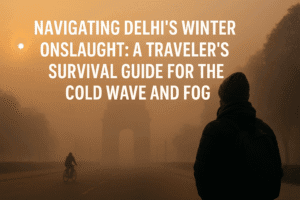
Mindset Shift: Accept that delays and schedule changes are part of the experience. The frustration multiplies if you fight it. Instead, see it as an opportunity to observe the city in a different light—literally. The fog that disrupts travel also paints the India Gate and Rashtrapati Bhavan in an ethereal, mysterious hue, a sight few tourists deliberately get to see.
The Bigger Picture: A Sign of Changing Patterns?
This early and intense cold wave prompts reflection. While one event doesn’t confirm a trend, meteorologists note that climate change is increasing the volatility of weather patterns. More pronounced Western Disturbances, changing wind patterns, and urban heat island effects colliding with continental cold can lead to these sharper, more severe early-winter shocks. For the perennial traveler, this underscores the need to move beyond seasonal assumptions and prepare for greater unpredictability.
In Conclusion: Respect the Winter Delhi’s current winter alert is a call for heightened awareness and prepared action. It’s a reminder that traveling in extreme seasons is about respect—for the power of nature, the complexity of urban systems under stress, and the needs of your own body. By understanding the science behind the fog, the mechanics of the travel disruptions, and the serious health implications of the air, you transform from a vulnerable bystander into a resilient, adaptable traveler. You can still capture the essence of a Delhi winter—its cool serenity and warm hospitality—by simply shifting your perspective and your schedule. Pack wisely, plan smartly, and stay informed. The city, in its frosty majesty, awaits the prepared.
You must be logged in to post a comment.