
Navigating Crosscurrents: Trade Winds, Inflation Data, and Earnings to Define Dalal Street’s Week Ahead
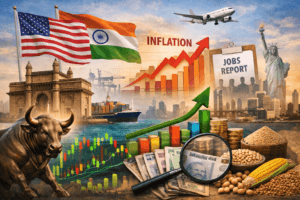
Navigating Crosscurrents: Trade Winds, Inflation Data, and Earnings to Define Dalal Street’s Week Ahead
As Dalal Street opens for the week of February 9, 2026, market participants find themselves at a complex juncture. Fresh tailwinds from a landmark U.S.-India trade agreement blow against global economic crosscurrents and the final throes of earnings season. This week’s trajectory will be shaped by a potent mix of diplomatic breakthroughs, domestic and international inflation prints, and corporate scorecards, all demanding a nuanced approach from investors.
- The U.S.-India Trade Deal: More Than a Headline
The interim trade agreement announced on February 6 has provided a significant psychological and fundamental boost to markets. The deal, which led to a sharp 3.5% rebound in benchmarks last week, moves beyond symbolism with tangible tariff adjustments. The U.S. has removed the additional 25% penalty on Indian goods linked to Russian oil imports and will apply a reciprocal tariff of 18% on key Indian exports like textiles, apparel, and leather. In return, India has agreed to eliminate or reduce tariffs on a wide range of U.S. goods, including agricultural products like dried distillers’ grains (DDGs), tree nuts, fruits, soybean oil, and wine.
Sectoral Winners and Emerging Concerns
While the deal broadly enhances market access, its impact is sector-specific:
| Sector/Area | U.S. Action | Indian Concession | Key Market Implication |
| Indian Gems, Pharma, Smartphones | Zero reciprocal tariffs | – | Direct boost to export competitiveness in the U.S. market. |
| Indian Textiles & Apparel | Tariff reduced to 18% | – | Improved pricing power for a major employment sector. |
| U.S. Agriculture | – | Tariff elimination/reduction on DDGs, soy oil, nuts, fruit | Potential pressure on Indian farmers; concerns over GM imports. |
| U.S. Aircraft | Removal of tariffs on certain aircraft/parts | – | Benefits for aviation and defense procurement. |
| Bilateral Trade | – | – | India intends $500B in U.S. purchases over 5 years. |
However, the agreement has sparked immediate concern among Indian farmer groups, who plan nationwide protests on February 12. Their anxiety centers on the potential for increased imports of products like soybean oil and DDGs to depress domestic prices and distort the feed market, affecting growers of maize, jowar, and soybean. The mention of addressing “non-tariff barriers” also raises questions about long-standing regulations, including those governing genetically modified (GM) food imports. This domestic friction presents a subtle risk that could influence related agri-stocks and policy-sensitive sectors.
- Earnings Finale: A Focus on Domestic Consumption and Capex
This week hosts the final wave of December quarter (Q3 FY26) earnings. The results will offer critical checks on two central market narratives: the resilience of domestic consumption and the momentum of private capital expenditure.
Heavyweights from the consumption universe like Hindustan Unilever, Titan Company, and Britannia Industries will be scrutinized for volume growth and margin commentary amid fluctuating input costs. Meanwhile, Mahindra & Mahindra and Ashok Leyland will provide insights into the automotive and rural demand pulse. On the industrial and capex front, numbers from Grasim Industries, Bharat Forge, and Hindalco Industries will be key to validating the ongoing infrastructure and manufacturing investment cycle. The market’s reaction will likely be stock-specific, pivoting on management outlooks for the coming year as much as on past performance.
- Global Inflation Check: A Tale of Two Economies
Concurrent inflation releases from the U.S. and India on February 12 will highlight a stark divergence in price pressures, with significant implications for monetary policy.
United States: The “Last Mile” Challenge
The U.S. headline Consumer Price Index (CPI) has held steady at 2.7% year-on-year in December. While core inflation has eased to 2.6%—its lowest since 2021—the persistence of “sticky” components is evident. Shelter costs rose 3.2% and food inflation accelerated to 3.1% in December. The forecast for January suggests a potential dip to 2.5%. The market’s focus will be on the “super-core” services inflation (excluding housing), which remains stubbornly above the Federal Reserve’s 2% target. A softer print could reinforce expectations for rate cuts later in the year.
India: Benign Prices Offer Policy Flexibility
In contrast, India’s inflation landscape remains subdued. CPI rose to 1.33% in December 2025 from 0.71% in November, but this remains sharply below the Reserve Bank of India’s (RBI) 4% target and even under its 2% lower tolerance band. The increase was driven by a lesser decline in food prices (-2.71% vs. -3.91%). With inflation risks perceived as balanced, the RBI has signaled a shift in priority. A Bank of Baroda report notes the central bank has likely “come to the end of its rate-cutting cycle” and will opt for a “long pause,” focusing on preserving financial stability and supporting growth.
Table: Key Inflation Metrics – U.S. vs. India
| Metric | United States (Dec 2025) | India (Dec 2025) | Upcoming Release (Jan 2026) |
| Headline CPI (YoY) | 2.7% | 1.33% | Feb 12 (U.S.), Feb 12 (India) |
| Core CPI (YoY) | 2.6% | N/A | – |
| Key Driver | Shelter, Food | Food Basket (less negative) | – |
| Policy Implication | Guides timing of Fed rate cuts. | Allows RBI extended pro-growth pause. | – |
- The U.S. Labor Market: Cracks Beneath the Surface?
Scheduled for release on February 11, the U.S. January non-farm payrolls (NFP) data is arguably as critical as the inflation print. December’s report showed a modest gain of +50,000 jobs, with a concerning concentration in non-cyclical sectors like health care and social assistance. Excluding this sector, job gains were a mere +11.5k. The unemployment rate held at 4.4%.
Market consensus expects a rebound to +69k for January, but analysts see risks “skewed to the downside”. More importantly, the report will include the final benchmark revisions, which are preliminarily estimated to show a downward adjustment of -911,000 jobs for the year ending March 2025. A combination of weak current data and substantial historical downward revisions could significantly alter the perceived health of the U.S. labor market, strengthening the case for earlier Federal Reserve easing.
- The Global Context: From Japan to Europe
Beyond the U.S. data, global events will contribute to the risk sentiment:
- Japan’s Political Shift: Prime Minister Sanae Takaichi’s election victory, granting a supermajority, signals a strong push for pro-stimulus fiscal policy. This could initially pressure the Yen and boost Japanese equities, affecting regional capital flows.
- European Growth Pulse: The UK’s Q4 GDP data (expected +0.2% q/q) and inflation prints from Norway and Switzerland will offer clues on the pace of monetary policy divergence from the U.S..
- RBI’s Stance: A Long Pause in a Growth-Supportive Mode
The domestic monetary policy environment offers stability. With inflation comfortably within target and the RBI having delivered a cumulative 125 basis points in cuts since early 2025, the central bank is poised for an extended hold. The policy stance is now explicitly “focused on supporting growth while preserving financial stability”. This provides a favorable backdrop for equities, as it ensures liquidity support and keeps financing costs conducive for the corporate sector.
- Technical and Flow Outlook
Technically, the Nifty 50, after its strong rebound, faces immediate resistance in the 25,800-26,000 zone. A decisive break above could target 26,400, with support placed firmly at 25,500. The sharp 20.9% drop in the India VIX to 11.94 last week indicates receding fear and provides comfort for the bulls.
Foreign Institutional Investor (FII) flows, which turned positive last week, bear watching. The trade deal and a stabilizing rupee (which appreciated 1.19% to 90.56/USD) have improved the sentiment. Continued FII buying could be the catalyst needed for a sustained breakout.
In conclusion, Dalal Street navigates a week defined by positive structural developments clouded by global macroeconomic uncertainty. The trade deal lays a foundation for long-term export growth, while subdued domestic inflation allows the RBI to remain growth-friendly. However, investors must cautiously parse the U.S. inflation and jobs data, which hold the power to recalibrate global risk appetite. The net effect is likely a range-bound market with a positive bias, where stock-specific actions driven by earnings and sectoral trade deal impacts will offer the clearest opportunities.
You must be logged in to post a comment.