
Nature’s Cleanup Crew: How Indigenous Microbes Are Detoxifying Coal Mining Waste
This groundbreaking study demonstrates how indigenous bacterial and fungal strains, pre-isolated from coal mining sites and formulated into compatible consortia immobilized in alginate beads, can effectively remediate toxic heavy metals in coal overburden spoil. The most complex microbial consortium achieved significant removal efficiencies—60.52% for chromium, 29.31% for copper, and 25.91% for nickel—over 60 days while also beneficially shifting the soil pH from highly to moderately acidic.
The research, confirmed by scanning electron microscopy showing metal-induced microbial adaptations, highlights a sustainable, low-cost bioremediation strategy that leverages native microorganisms already adapted to harsh mining environments, offering a promising ecological alternative to traditional, more invasive cleanup methods for mitigating long-term environmental risks.
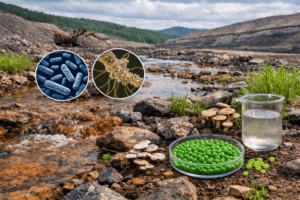
Nature’s Cleanup Crew: How Indigenous Microbes Are Detoxifying Coal Mining Waste
The Unseen World Beneath Our Feet
In the shadow of opencast coal mines, where the earth lies scarred and exposed, a silent revolution is taking place. Not with heavy machinery or chemical treatments, but through the microscopic work of indigenous bacteria and fungi. Recent groundbreaking research reveals how these native microorganisms are being harnessed to tackle one of mining’s most persistent environmental legacies: heavy metal contamination in coal overburden spoils. This isn’t science fiction—it’s bioremediation in action, offering a sustainable, low-cost solution to a problem that has plagued mining regions for generations.
The study demonstrates that specially formulated microbial consortia, immobilized in alginate beads, achieved remarkable removal rates of toxic metals—up to 60.52% for chromium, 29.31% for copper, and 25.91% for nickel over just 60 days. More than just extraction, these microscopic workers transformed the very character of the soil, shifting its pH from highly acidic toward more neutral conditions. This represents a paradigm shift in how we approach environmental restoration, moving from energy-intensive engineering solutions toward working with nature’s own cleanup specialists.
The Heavy Metal Legacy of Opencast Mining
Coal mining has powered industrialization for centuries, but its environmental footprint extends far beyond carbon emissions. Opencast mining, in particular, involves removing vast quantities of overlying rock and soil (called overburden) to access coal seams beneath. This overburden, once disturbed and exposed to air and water, undergoes chemical transformations that can release toxic heavy metals like nickel, copper, and chromium into the surrounding environment.
These metals don’t biodegrade—they persist in ecosystems for centuries, accumulating in soil, leaching into groundwater, and entering food chains. Traditional remediation approaches often involve excavation and disposal in hazardous waste facilities, or chemical treatments that can themselves create secondary environmental issues. Both methods are prohibitively expensive for the vast areas affected by mining activities, particularly in developing regions where regulations may be less stringent.
The environmental consequences are measurable and concerning. Acid mine drainage, created when sulfide minerals in exposed overburden react with air and water, creates highly acidic conditions that further mobilize heavy metals, creating a toxic cocktail that can devastate local ecosystems. This creates a dual challenge: neutralizing acidity while immobilizing or removing metals—exactly where microbial solutions show exceptional promise.
The Science of Microbial Metal Mop-Up
Bioremediation harnesses living organisms to degrade, transform, or sequester environmental contaminants. In the context of heavy metals, which cannot be broken down into harmless elements, microbes employ sophisticated biochemical strategies:
- Biosorption: Microbial cell walls contain functional groups that act like molecular magnets, binding metal ions through physical and chemical interactions.
- Bioaccumulation: Active transport of metals into microbial cells, where they’re sequestered in specialized compartments.
- Biotransformation: Enzymatic conversion of metals into less toxic or more easily removable forms.
- Bioleaching: Microbial production of organic acids that solubilize metals, making them available for removal.
What makes the recent study particularly innovative is its focus on indigenous microbial strains—bacteria and fungi already adapted to survive in the harsh conditions of coal overburden environments. These organisms have naturally evolved metal tolerance mechanisms over generations of exposure, making them uniquely suited for remediation work in their native habitats. By not introducing foreign species, researchers minimize ecological disruption while maximizing survival and effectiveness.
Inside the Groundbreaking Study
Researchers undertook a meticulous process to identify and harness nature’s best metal detoxifiers. From coal overburden materials, they isolated numerous bacterial and fungal strains, then subjected them to rigorous selection based on two key criteria: metal tolerance and mutual compatibility. The latter is crucial—in a consortium, different species must coexist without inhibiting each other’s growth or function.
After initial screening, four bacterial and seven fungal isolates were selected for further experimentation. These weren’t random choices; each brought unique capabilities to the remediation process. Some excelled at chromium transformation, others at pH modulation, and others at producing binding agents that immobilized multiple metals simultaneously.
The researchers then formulated four different microbial consortia with varying compositions, ranging from simple pairs to complex communities containing all selected isolates. A critical innovation was the immobilization technique—encasing these microbial communities in alginate beads. This simple yet brilliant approach serves multiple purposes: it protects the microbes from immediate environmental shocks, creates a concentrated local environment for microbial interaction, and allows for easy application and potential retrieval from treated sites.
A Consortium Outperforms: The Power of Microbial Teamwork
The results clearly demonstrated that microbial teamwork delivers superior results. While individual strains showed some metal-removal capabilities, the most complex consortium (containing all selected isolates) achieved the highest removal efficiencies across all three target metals. This synergistic effect suggests that different species perform complementary functions—some might break down metal complexes, while others transport or immobilize the released ions.
The transformation wasn’t limited to metal removal. Researchers observed a significant pH shift in the treated overburden material, from highly acidic conditions toward a more moderate acidity. This is crucial because acidic conditions typically increase metal solubility and toxicity. By moderating pH, the microbial consortium created a less hostile environment for both continued microbial activity and eventual plant recolonization—the next step in ecological restoration.
Scanning electron microscopy (SEM) provided stunning visual confirmation of microbial activity. The images revealed distinct morphological adaptations in microbes exposed to metals—changes in cell surface structure, production of extracellular polymeric substances, and other physical transformations that enhance metal binding and tolerance. These visible adaptations correlate with the biochemical processes making bioremediation possible.
From Laboratory to Landscape: Real-World Applications
The implications of this research extend far beyond laboratory experiments. Consider the practical applications:
- Passive Treatment Systems: Microbial consortia immobilized in beads could be deployed in permeable barriers downstream from mine sites, intercepting and treating contaminated groundwater with minimal maintenance.
- In-Situ Treatment: Direct application to overburden dumps could gradually detoxify these sites without the massive disturbance and expense of excavation and removal.
- Combined Strategies: Microbial treatment could be integrated with phytoremediation (using metal-accumulating plants) for enhanced results—microbes prepare the ground, both chemically and physically, for plant establishment.
- Cost Effectiveness: Compared to traditional remediation methods that can cost millions per acre, microbial approaches offer potentially dramatic cost reductions, making large-scale restoration financially feasible.
The timing couldn’t be more relevant. As global efforts toward a just energy transition accelerate, addressing the legacy environmental damage from fossil fuel extraction becomes both an ecological imperative and a social responsibility. Communities living near abandoned mine sites disproportionately bear health burdens from metal contamination. Bioremediation offers not just environmental restoration but potential economic opportunities through green technology application.
Challenges and Future Directions
While promising, microbial bioremediation faces several challenges that researchers continue to address:
- Field Validation: Laboratory results under controlled conditions need verification in variable field environments where temperature, moisture, and competing microorganisms create more complex dynamics.
- Long-Term Stability: The persistence of remediation effects after initial treatment requires further study—do metals remain immobilized, or can they be re-mobilized by changing conditions?
- Consortium Optimization: Determining the minimum effective consortium composition could reduce complexity and cost while maintaining effectiveness.
- Integration with Traditional Knowledge: In many mining regions, indigenous communities possess deep knowledge of local ecosystems that could inform and enhance scientific approaches.
Future research directions likely include genetic analysis to identify specific metal-resistance genes, engineering of consortia for specific metal combinations, and development of delivery systems that enhance microbial survival and activity in challenging field conditions. The intersection of traditional microbiology with emerging fields like synthetic ecology and materials science promises even more sophisticated solutions.
A Microbial Blueprint for Environmental Healing
The silent work of bacteria and fungi in coal overburden represents more than just a technical solution—it embodies a philosophical shift in how humanity relates to damaged environments. Instead of imposing engineered solutions from outside, we’re learning to amplify and direct nature’s own resilience mechanisms. These indigenous microbes have survived and adapted to extreme conditions; now we’re discovering how to partner with them in restoration.
The implications extend beyond mining sites. Similar principles could apply to industrial brownfields, contaminated agricultural lands, and urban areas with legacy pollution. The fundamental insight—that every contaminated environment likely contains microorganisms already adapted to those conditions—opens doors to context-specific, locally adapted remediation strategies worldwide.
As we face the interconnected challenges of pollution, biodiversity loss, and climate change, solutions that work with natural systems rather than against them offer particularly promising pathways forward. The microbes cleaning up coal overburden today might just teach us how to heal many of the wounds we’ve inflicted on our planet.
The next time you see a scarred mining landscape, remember: beneath the surface, nature’s smallest organisms may already be at work, patiently undoing the damage, one metal ion at a time. In their microscopic biochemistry lies a powerful blueprint for environmental renewal—one that honors both the complexity of natural systems and the ingenuity of scientific discovery.
You must be logged in to post a comment.