
National Ambition vs. Local Resistance: The Battle Over J&K’s Ratle Hydropower Project
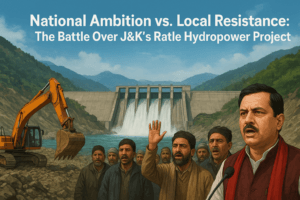
National Ambition vs. Local Resistance: The Battle Over J&K’s Ratle Hydropower Project
A high-stakes confrontation is unfolding in the remote Kishtwar district of Jammu & Kashmir, where a critical national infrastructure project has become ensnared in allegations of political interference, workforce pressure, and compromised safety. The Hyderabad-based Megha Engineering and Infrastructure Limited (MEIL), builder of the 850 MW Ratle Hydroelectric Project, has issued a startling ultimatum: it may abandon the ₹3,700 crore venture if “undemocratic” interference from local politicians does not cease.
This standoff transcends a simple contractual dispute, exposing the complex tensions between national energy ambitions, local political demands, and the practical challenges of engineering safety in one of India’s most strategically significant regions. At its core, the conflict asks a difficult question: how can a nation balance its strategic development goals with the legitimate pressures of local employment and political accountability?
A Project of “National Importance” Under Siege
The Ratle project is no ordinary dam. Classified as a project of national importance, it is a run-of-the-river hydroelectric plant on the Chenab river at Drabshalla village. It features a 133-meter-high dam and an underground power station designed to generate 850 MW of electricity. The project is being executed by Ratle Hydroelectric Power Corporation Limited (RHPCL), a joint venture where the National Hydroelectric Power Corporation (NHPC) holds a 51% stake and the Jammu & Kashmir State Power Development Corporation holds 49%.
According to Harpal Singh, MEIL’s Joint Chief Operating Officer for the project, the company currently employs 1,434 workers. Of these, a significant majority—960—are from Kishtwar district itself, with another 220 from the neighboring Doda district. Despite this substantial local engagement, Singh alleges relentless pressure to hire even more local workers, often under what he describes as coercive conditions.
“Most of these local workers are unskilled and inexperienced. Yet, we had to hire them because of political pressure and blackmail,” Singh stated. He claims that workers have been employed through “pressure, blackmail and repeatedly stopping work and assaulting officials”. The situation reportedly escalated on December 4, 2025, when the company’s Human Resources head was allegedly assaulted near Joshana village, an incident that spread fear among the workforce.
The Accusation: Political Interference by a BJP MLA
The corporate frustration has crystallized into a specific accusation against BJP MLA Shagun Parihar, the legislator representing Kishtwar. Singh has publicly stated that Parihar, “with the involvement of some outsiders, keeps interfering in the project with mala-fide intentions to disrupt it”.
He claims the MLA demands the engagement of workers according to her wishes, leveraging political influence to fulfill promises likely made during election campaigns. In a video statement that has circulated on social media, Singh appealed for the project to be kept free of politics, emphasizing that the company maintains a “secular character” and cannot function as an extension of any political party.
“The way locals and politicians act is undemocratic and should not happen… If the outsiders don’t allow us to work, we may have to leave the project,” Singh warned, noting the massive losses such a withdrawal would entail, including bank guarantees submitted to NHPC and substantial investments in machinery and materials.
Table: The Conflicting Narratives in the Ratle Project Dispute
| Perspective of MEIL (Company) | Counter-Perspective (From MLA & Local Viewpoint) |
| Faces illegal pressure to hire beyond sanctioned workforce strength. | Company has retrenched locals without notice. |
| Forced to employ unskilled workers, compromising project safety & quality. | Company has recruited “surrendered militants” at the expense of locals. |
| BJP MLA Shagun Parihar instigates interference for political gain. | Official is “peddling lies” and trying to create communal disharmony. |
| Project delays and safety risks are due to this political interference. | Official may have ulterior motives to stall the project. |
The MLA’s Rebuttal and a History of Violence
MLA Shagun Parihar has categorically denied all allegations, labeling them a “bundle of lies”. In a sharp rebuttal, she has accused Harpal Singh of misconduct, including recruiting “surrendered militants” in the project while retrenching approximately 250 local workers without prior notice.
Parihar has also made a deeply personal allegation, claiming that Singh has issued veiled threats referencing the tragic murders of her father and uncle, BJP leader Anil Parihar and his brother Ajit Parihar, who were killed by terrorists in Kishtwar in November 2018. She has threatened to file a defamation suit and take the matter to higher authorities.
This bitter exchange occurs against a backdrop of regional sensitivity. The Chenab Valley, where Kishtwar is located, has witnessed political violence, and large infrastructure projects often become flashpoints for broader socio-political tensions.
A Pattern of Trouble and Strategic Timing
The Ratle project has been here before. It faced similar disruptions in 2013, which led to an eight-year stall in work. Awarded to MEIL in April 2022, the project was originally slated for completion by 2026 but has already been granted an extended deadline to 2029.
Singh alleges the problem is not isolated to Ratle. He claims that four major hydro projects in Kishtwar district—Pakal Dul, Ratle, Kiru, and Kwar—are all running behind schedule due to interference from “BJP-sponsored unions”. This claim aligns with a recent incident at the 540 MW Kwar project, where a truck fire inside a tunnel highlighted ongoing safety concerns in Himalayan hydro infrastructure.
The current crisis gains an additional layer of significance from its geopolitical context. Following a terror attack in Pahalgam in April 2025, India announced the temporary suspension of the Indus Waters Treaty (IWT) with Pakistan. For decades, this 1960 treaty, brokered by the World Bank, has governed the sharing of the Indus River system between the two nations, surviving multiple wars.
India‘s suspension, framed as a response to Pakistan-based militancy, removed a key political and procedural hurdle. It meant that projects on the western rivers, including the Chenab, could theoretically proceed without the objections or clearance mechanisms previously required from Pakistan. Consequently, the Indian government fast-tracked several projects in the Chenab basin, including Ratle, as part of a strategic push to harness Jammu & Kashmir’s hydropower potential.
The Larger Stakes: Energy, Ecology, and Equity
The confrontation at Ratle is a microcosm of a much larger dilemma facing infrastructure development in ecologically fragile and politically sensitive regions like the Himalayas.
From a national perspective, these projects are pillars of energy security and strategic assertion. Hydropower is essential for India’s clean energy transition, providing reliable power for grid stability. In the context of the suspended Indus Treaty, developing these projects also becomes a statement of sovereign right and a strategic lever.
From a local perspective, the narrative is different. Indigenous communities like the Gujjars and Bakerwals, along with local farmers, express profound anxiety about displacement and ecological damage. Past projects like the Baglihar Dam have left a legacy of inadequate compensation and broken rehabilitation promises, fueling skepticism about new dams. The promise of jobs often rings hollow for semi-nomadic communities or for those lacking specialized construction skills.
Furthermore, environmental experts and geologists warn of cumulative ecological risks. The Himalayas are seismically active, prone to landslides and flash floods. The concentration of multiple large projects in a single basin alters river flows, impacts aquatic life, and may increase disaster risks. A significant earthquake in the region could have catastrophic consequences.
The Path Forward: Beyond the Impasse
The threat by MEIL to exit the project is a drastic step that would cause severe financial losses for the company and major delays for a nationally important energy asset. It signals a breakdown in the social and political license to operate.
Resolving this impasse requires moving beyond the current blame game. It necessitates:
- Transparent and Accountable Dialogue: A mediated forum involving the company, local representatives (beyond a single MLA), district administration, and NHPC to address grievances related to employment and contracts.
- Skill Development vs. Mere Employment: Shifting the focus from demanding quota-based hiring to creating structured skill development programs that enable locals to qualify for specialized project roles, ensuring both employment and safety.
- Independent Safety and Hiring Audit: To break the deadlock of mutual accusations, an independent audit of workforce competence and hiring practices, as suggested by MLA Parihar herself regarding environmental compliance, could be a starting point.
- Holistic Community Engagement: Addressing the broader fears of displacement and environmental impact by ensuring transparent rehabilitation plans and meaningful sharing of project benefits with local communities, as advocated by local council members.
The Ratle project stands at a crossroads. It can continue to be a battleground of competing interests, or it can evolve into a model for how strategic national development can be pursued with fairness, transparency, and respect for local communities and ecological limits. The outcome will resonate far beyond the banks of the Chenab, offering lessons for India’s entire ambitious infrastructure agenda in its frontier regions. The central and state government’s response to this corporate SOS will reveal much about the balance of power and priority in New India’s development playbook.
You must be logged in to post a comment.