
‘My Father Was Saying the Shahada’: 11-Year-Old Survivor Recounts Israeli Military Shooting That Killed His Parents and Two Brothers
In a tragic incident in the occupied West Bank, Israeli forces opened fire on a Palestinian family’s car, killing four members of the same family—parents Ali (37) and Wa’ed (35) Bani Odeh and their two young sons, Mohammed (5) and Othman (7)—while their two other sons, including 11-year-old Khaled, survived and witnessed the entire ordeal, with Khaled recounting how his father recited the Islamic declaration of faith as he faced death and his mother screamed before falling silent. The Israeli military claims soldiers felt threatened by the vehicle’s movement and are investigating, but Palestinian officials and human rights observers point to a pattern of escalating violence and impunity in the West Bank, with a separate settler attack the same weekend killing another Palestinian, as the UN warns of “utter disregard for Palestinian lives” amid intensified Israeli military operations and settlement expansion since 2023.
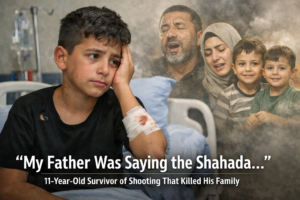
‘My Father Was Saying the Shahada’: 11-Year-Old Survivor Recounts Israeli Military Shooting That Killed His Parents and Two Brothers
A family’s Ramadan evening turns to tragedy as four generations of loss unfold in a single burst of gunfire
The car was meant to carry joy. Instead, it carried death.
On a cool evening during the holy month of Ramadan, Ali Bani Odeh, a 37-year-old Palestinian father, made a simple decision that countless parents make during the fasting month: after sunset, when the fast breaks and families gather to eat together, he would take his wife and four young sons for a drive. The roads would be quieter. The air would be softer. The children could feel the night breeze through the windows after a long day without food or water.
It was meant to be a small moment of family peace in a land where peace has become a luxury few can afford.
Hours later, Ali was dead. His wife Wa’ed, 35, was dead. Their sons Mohammed, age 5, and Othman, age 7, were dead. The family’s car sat shattered on a West Bank road, its windshield perforated, its seats stained, its purpose as a vessel for family life permanently obliterated.
Only two people walked away from that vehicle: Khaled, 11, and his younger brother Mustafa. They walked away because they were small enough to duck. They walked away because fate, in its most brutal arithmetic, decided that four deaths were enough for one family on one night.
“I tried to turn over my brother Mohammed, but I was unable,” Khaled later told a Palestinian journalist from his hospital bed, his voice carrying the weight of a witness far beyond his years. “There is no one left other than me and my brother Mustafa.”
The Last Drive
The Bani Odeh family lived like hundreds of thousands of Palestinian families across the occupied West Bank—navigating checkpoints, curfews, and the slow erosion of normal life under military occupation. But on this night, they were simply a family breaking their fast together, then deciding to stretch the evening into something resembling normalcy.
They drove from their home toward Nablus, one of the largest cities in the northern West Bank, a place rich with history and commerce. The roads after iftar, the evening meal that breaks the daily Ramadan fast, often carry families moving between relatives’ homes, enjoying the cooler temperatures, savoring the rare gift of unstructured time.
The drive back should have been uneventful. The roads were familiar. The hour was late but not unusual.
Then the shooting started.
“Suddenly there were direct gunshots towards us. We didn’t know where from,” Khaled recounted, his words painting a picture of chaos erupting without warning. Inside the family vehicle, the ordinary sounds of children settling after an evening out were replaced by the crack of military firearms and the shatter of glass.
What follows in Khaled’s testimony is not the stuff of news reports or political statements. It is the stuff of nightmares that will never end.
“My father was saying the shahada and raised his finger. My mother was screaming and then went silent.”
The shahada—the Islamic declaration of faith, the words “There is no god but God, and Muhammad is His messenger”—is what Muslims recite when facing death. It is the last thing Ali Bani Odeh wanted his sons to hear him say. It is the last thing his sons will ever forget hearing.
The Aftermath
The Israel Defense Forces offered a different account. In a statement to CNN, the military said that “a vehicle accelerated toward the forces. The forces felt threatened and responded by opening fire.”
Four Palestinians in the vehicle were killed, the IDF confirmed. The statement added that the “circumstances of the incident are being investigated by the relevant authorities.”
But for those who arrived at the scene, the military’s characterization of events raised immediate questions. Palestinian paramedics from the Red Crescent Society told CNN that they were prevented from entering the site to offer medical care. For an hour, while the wounded and the dead lay in the vehicle, medical help was kept away.
When health workers at a local hospital finally received the four slain members of the Bani Odeh family, there was nothing left to do but count the bodies and wonder what might have been different if ambulances had been allowed to reach the scene sooner.
Footage from the aftermath shows bullets strewn across the road. Blood stains mark the asphalt. The family’s car, its windshield destroyed, was eventually towed away by an Israeli military vehicle—a final indignity for a vehicle that had carried so much life just hours before.
No CCTV footage has emerged that could independently verify the car’s movements. The IDF has not provided any video evidence to support its claim that the vehicle accelerated toward soldiers. What exists instead is an 11-year-old boy’s account of watching his father recite deathbed prayers while his mother screamed herself into silence.
A Pattern, Not an Isolated Incident
The killing of the Bani Odeh family did not occur in a vacuum. It happened in a territory where violence has become so routine that each new death risks becoming just another statistic, another headline, another statement of condemnation quickly forgotten.
Since 2023, Israel has significantly escalated military activities in the occupied West Bank. The right-wing government of Prime Minister Benjamin Netanyahu has simultaneously pushed to expand Jewish settlements—considered illegal under international law—and entrench Israeli control over Palestinian land and movement.
The results have been predictable to anyone watching: more military operations, more settler violence, more Palestinian deaths, and a growing sense among human rights observers that the situation is spiraling toward something worse.
The Israeli human rights group B’Tselem has accused Israel of using the “cover of war with Iran” to accelerate what it describes as the “ethnic cleansing” of the West Bank. Whether one accepts that characterization or not, the numbers tell their own story: rising fatalities, expanding settlements, increasing restrictions on Palestinian movement, and a military justice system that rarely holds soldiers accountable for civilian deaths.
Another Attack, Same Weekend
The Bani Odeh family were not the only Palestinians killed by Israeli forces or settlers that weekend. In a separate attack, masked Israeli settlers shot dead a 28-year-old Palestinian, Amir Oudeh, as they launched two assaults on the village of Qusra.
The details of that attack follow a pattern that has become distressingly familiar. Settlers enter a Palestinian village. Violence erupts. Someone is killed. Then Israeli military forces arrive—not necessarily to protect the Palestinians who were attacked, but often to further punish the community.
According to the activist group Sumud Network, Amir Oudeh’s father, Moatassem, was shot in the leg as he tried to rush to his son’s aid. He was then beaten in the head with a wooden club and stabbed multiple times in different parts of his body by settlers. After the fatal shooting, Israeli military forces raided the village and assaulted its residents, “punishing (the villagers) for being the target of a lynching by an armed militia.”
The Israeli military, when asked about this attack, said it “strongly condemns such incidents which harm innocent civilians” and noted that an investigation had been opened by the Israel Police and Israel Security Agency.
But for Palestinians who have watched decades of investigations yield few convictions and even fewer consequences, such statements offer cold comfort.
The Children Who Survived
Khaled Bani Odeh now faces a future that no 11-year-old should have to contemplate. He and his brother Mustafa must somehow navigate a world where their parents and two siblings were erased in a single burst of gunfire, where the family car became a tomb, where the sound of gunshots will forever be linked to the sight of his father raising a finger in final testimony of faith.
The psychological toll on child survivors of such violence is incalculable. Studies of children in conflict zones have documented lasting trauma: nightmares, hypervigilance, difficulty forming attachments, depression, and post-traumatic stress that can persist for decades. For Khaled and Mustafa, the trauma is compounded by the knowledge that they survived while their younger brothers did not—a burden of guilt that no child should carry.
“We don’t know yet how to help them process what they’ve seen,” a relative told local media, speaking on condition of anonymity. “They saw their parents killed. They saw their brothers killed. They sat in that car with the bodies of their family. How does any child come back from that?”
International Reaction
The head of the UN’s human rights office in the occupied Palestinian territories, Ajith Sunghay, warned on Sunday that the attacks reflect a “pattern of utter disregard for Palestinian lives.”
“Impunity is driving more killings, more displacement and dispossession, and more suffering for Palestinians across the occupied territory,” Sunghay said in a statement.
The warning echoes concerns raised by multiple human rights organizations over the past year. Amnesty International, Human Rights Watch, and B’Tselem have all documented what they describe as a systemic failure to hold either soldiers or settlers accountable for violence against Palestinians. When perpetrators face no consequences, the logic goes, violence becomes normalized, and the threshold for using lethal force continues to lower.
The Oslo Legacy
The road where the Bani Odeh family died exists within a territory whose legal and political status remains one of the most contested on earth. The West Bank, including East Jerusalem, was captured by Israel in the 1967 Six-Day War and has been under varying degrees of Israeli military occupation ever since.
The 1995 Oslo Agreement and 1997 Hebron Agreement divided the city of Hebron—near where this shooting occurred—into two sectors. H2, including the Old City, remains under Israeli military control, while H1 is administered by the Palestinian Authority. Most Palestinians live in the H2 sector, where approximately 70,000 people were placed under curfew on the same day as the Bani Odeh shooting, with troops erecting new gates and earth mounds to isolate the area while searching for weapons and wanted individuals.
This fragmentation of Palestinian life—the checkpoints, the curfews, the permits, the zones A, B, and C, the areas where Palestinians can live but cannot build, the areas where settlers can build but Palestinians cannot enter—has created a reality where violence can erupt at any moment, and where accountability remains elusive.
A Family’s Loss, A People’s Grief
For Palestinians across the West Bank and beyond, the deaths of the Bani Odeh family resonate as both a personal tragedy and a collective wound. In a society where family bonds remain central to social identity, the image of parents and children wiped out together carries particular weight.
Funerals for the four family members drew crowds of mourners, their grief mingling with anger at a system that allows such deaths to occur with seeming impunity. The bodies of Ali, Wa’ed, Mohammed, and Othman were carried through streets lined with people who understood that it could have been their family, their children, their car on that road at that moment.
“In Ramadan, we are supposed to be gathered around tables, not graves,” one mourner said. “They broke their fast together, and then they were broken apart forever.”
The Investigation Question
The IDF’s promise of an investigation will be watched closely by human rights organizations, journalists, and Palestinian families who have learned to be skeptical of military inquiries into military actions.
Previous investigations into civilian deaths have often resulted in no charges, or in charges that are later dropped. In March 2026, Israel dropped charges against soldiers accused of abusing a Gaza detainee—a case that exposed deep divisions within Israeli society over whether soldiers can abuse enemy prisoners with impunity.
The pattern, critics say, is consistent: when soldiers kill Palestinians, the military investigates itself, and the military rarely finds its own soldiers guilty of serious wrongdoing. Whether the Bani Odeh case will prove different remains to be seen, but few Palestinians are holding their breath.
The Larger Context
The deaths of the Bani Odeh family occurred against a backdrop of escalating violence across the region. In Gaza, aid organizations struggle to get supplies into the city as Israel restricts humanitarian access. Tens of thousands of Gazans live in tents or damaged homes in areas where the Israeli army maintains control and operates checkpoints.
The Israeli government has approved major expansions of West Bank settlements, with 19 settler outposts legalized in a single decision—a move Palestinians say further buries hopes of a future state. Meanwhile, international statements warning of deteriorating conditions in Gaza have failed to produce meaningful change, with countries like New Zealand opting not to join warnings that describe conditions for civilians as “appalling” as winter approaches.
The Trump administration, which returned to power in 2025, has taken a different approach than its predecessor. President Donald Trump and Prime Minister Netanyahu have discussed the next phase of what Trump calls his “Gaza plan,” releasing a 20-point peace proposal that critics say favors Israeli positions while offering Palestinians little more than they have already rejected.
What Khaled Saw
But amid all the geopolitics, the diplomatic statements, the investigations and counter-investigations, the condemnations and justifications, there remains the simple, devastating testimony of an 11-year-old boy.
“My father was saying the shahada and raised his finger.”
That image—a father, facing death, making the sign of faith as his final act—is not political. It is not about settlements or borders or military strategies. It is about a man who wanted his last words to be words of devotion, who wanted his children to see him turn toward God even as bullets turned toward him.
Khaled saw that. At 11 years old, he watched his father die with his finger raised in testimony. He watched his mother scream and then fall silent. He tried to turn over his 5-year-old brother but couldn’t. He sat in a car filled with the bodies of his family and somehow walked away.
“There is no one left other than me and my brother Mustafa.”
The Road Ahead
For Khaled and Mustafa, the road ahead stretches empty and uncertain. They will be raised by relatives, if relatives can be found who have the capacity to take in two traumatized boys. They will grow up in a society that has become expert at grief but struggles to heal. They will carry memories that no therapy can erase and questions that no answer can satisfy.
Why did soldiers shoot at a family car? Why were ambulances kept away? Why does violence against Palestinians so rarely result in accountability? Why did their parents take them for a drive on a Ramadan evening? Why did their brothers die while they survived?
Some questions have answers. Some do not. Some answers would not help even if they were found.
What remains is the image of a father raising his finger in final testimony. What remains is an 11-year-old boy telling the world what he saw. What remains are four graves in a Palestinian cemetery, two of them small enough to break any heart that sees them.
And what remains, too, is the knowledge that somewhere, in some village or city or refugee camp across the West Bank, another family is loading into another car, hoping that this drive will be different, that this time the soldiers won’t shoot, that this time everyone will come home.
In Ramadan, Muslims fast from dawn to sunset, then gather to break bread together. The Bani Odeh family broke their fast together on what would be their last night as a family. Then they went for a drive. Then they died.
You must be logged in to post a comment.