
Mumbai’s Metro Moment: From Patchwork Promise to 120 km of Reality
Mumbai’s metro network has surpassed 90 km with the opening of partial stretches on Lines 9 and 2B on April 3, 2026, and is set to cross 120 km by year-end as 40–50 km of new corridors become operational in phases during 2026—including full opening of Line 9, partial runs on Lines 4, 4A, 2B, 5, and possibly Line 6. The expansion aims to deliver a city-wide interconnected system by 2027, linking suburbs to business districts and easing pressure on the suburban rail network. However, several corridors (Lines 10, 13, and 14) remain in early planning or construction stages, highlighting that while the core network is rapidly taking shape, the full regional vision is still years away.
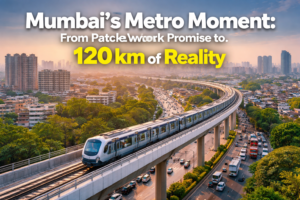
Mumbai’s Metro Moment: From Patchwork Promise to 120 km of Reality
For decades, the Mumbai Metropolitan Region (MMR) has been defined by a paradox: it is India’s financial capital, a city that never sleeps, yet its skeletal public transport system has long struggled to keep pace with its pulsating population. The local trains—the city’s lifeline—have run at over 400% of their capacity for years, while a maze of choked roads has turned commutes into endurance tests.
But this week, that narrative begins to change in a tangible way. On April 3, 2026, Mumbai will add another 10 km to its growing metro network, pushing the operational total past the 90 km mark. While a single milestone is noteworthy, what is truly transformative is the cascade of construction set to follow. The city isn’t just opening a line; it is on the cusp of stitching together a fragmented transit vision into a cohesive network.
This is the story of how Mumbai is finally, after years of delays and political flip-flops, beginning to look like a city with a 21st-century metro system.
The Week’s Opening: More Than Just a Few Stations
When the gates open on April 3, the additions might seem modest on a map—a partial extension here, a few stations there—but their impact is deeply local and intensely human.
The opening of partial stations on Line 9 (Dahisar East to Mira Bhayandar) marks a watershed moment for the twin cities of Mira-Bhayandar. For residents of these rapidly growing suburbs north of Mumbai, the metro has been a distant dream. This stretch represents the first time a metro rail will service their area, offering an alternative to the notoriously congested Western Express Highway and the overcrowded Western Railway line.
For commuters like Priya Mishra, a school teacher who commutes from Mira Road to Andheri, the change is existential. “Every morning, I plan my exit from home based on whether I can squeeze onto a local train or risk being stuck in a bus for two hours,” she says. “The metro isn’t just about speed; it’s about dignity. It’s about knowing when I leave home, I have a predictable chance of reaching school on time.”
Simultaneously, the partial opening of Line 2B (DN Nagar to Mandale) is extending the reach of the metro into the eastern suburbs, weaving a new thread into the city’s fabric. These openings, though partial, serve a crucial psychological purpose: they demonstrate momentum. After years of witnessing construction barricades with little to show, Mumbaikars are finally seeing the steel and concrete convert into a functional service.
2026: The Year of the “Almost There”
The 90 km mark is merely a starting pistol. The Indian Express report highlights a crucial detail: 2026 is poised to be a year of explosive growth, with an estimated 40-50 km slated to open in phases. If this target is met—a significant caveat in the world of Indian infrastructure—Mumbai’s operational network will vault past 120 km by the year’s end.
This expansion is not about a single line but about creating choices.
- Line 4 and 4A (Wadala to Thane): Perhaps the most anticipated corridor, this line promises to link the eastern suburbs and the industrial city of Thane directly to South Mumbai via the monorail network at Wadala. Currently, traveling from Thane to the business districts of Lower Parel or Nariman Point involves a grueling train journey with a transfer at Dadar or a car ride that can take anywhere from 45 minutes to three hours, depending on the mood of the traffic gods. This line offers a direct, high-capacity alternative.
- Line 5 (Thane to Bhiwandi): For the first time, this line connects the logistics hub of Bhiwandi—a city often seen as a back-office for Mumbai’s commerce—to the main transit grid. It promises to decongest the already saturated Thane-Bhiwandi road corridor, which sees heavy truck traffic.
- Line 6 (Lokhandwala to Vikhroli): This is the “connector” that the city has desperately needed. It will run perpendicular to the existing north-south corridors, linking the western suburbs (Lokhandwala) to the eastern suburbs (Vikhroli) without forcing commuters to go all the way to the city center. This east-west connectivity is vital for a metropolis where jobs are scattered across the geography.
The theme of 2026 is interconnectedness. The network is moving from a collection of isolated lines (like the original Versova-Andheri-Ghatkopar monorail or the early Metro 1) into a mesh where transfers become logical, and the journey time across the city shrinks from hours to minutes.
The Vision for 2027: A City-Wide Reality
The report identifies 2027 as the year “when a substantial, city-wide network could finally become a reality.” This hinges largely on the completion of the spine of the system—Line 2A (Dahisar to DN Nagar) and Line 2B (DN Nagar to Mandale) —and Line 7 (Dahisar East to Andheri East) .
When these lines are fully integrated with the underground Aqua Line (Line 3), which already connects the Cuffe Parade business district to the airport and Seepz, Mumbai will have something it has never had: a true mass transit alternative to the suburban railway.
Imagine a commuter living in Borivali (north-west) working in the Bandra Kurla Complex (BKC) financial hub. Currently, this is a journey involving a train change at Dadar and a rickshaw ride, or a car journey that takes over an hour. By 2027, that same commuter could potentially take Metro 2A south to a station connecting to the Aqua Line, which drops them directly in the heart of BKC—all in a cool, air-conditioned, predictable environment.
This is the promise of the network: reducing the dependency on the suburban rail system which, despite its efficiency, has been unable to expand its physical footprint due to land constraints. The metro, built largely on elevated corridors or underground, is circumventing the land acquisition nightmare that has stymied road and rail expansion for decades.
The Long Shadow of Delay: Lines Still in the Future
However, any honest assessment of Mumbai’s infrastructure journey must acknowledge the ghosts of delays past and the challenges that lie ahead. The report wisely notes that while the core network is solidifying, several corridors remain in the early stages.
Line 10 (Gaimukh to Mira Road) , which is critical for connecting the northern fringes of the MMR, is yet to begin construction despite tendering being due in 2025. Lines 13 and 14, meant to extend the network into the Kalyan and Navi Mumbai regions, are still in the planning phase.
This dichotomy reveals a classic Mumbai infrastructure story: the central arteries are being built with relative speed, but the veins and capillaries that serve the far-flung suburbs and satellite towns remain a “distant promise.”
For residents of these areas, the excitement about the 120 km milestone is tempered by skepticism born from decades of broken deadlines. Ramesh Patil, a businessman in Mira Road, captures this sentiment. “We hear about these tenders and plans every few years. We are happy that Line 9 is finally opening a bit. But until I see the metro connecting Gaimukh to Thane, it’s just a newspaper headline for me. The city has taught us to believe it when we see it.”
The Human Factor: More Than Just Steel and Concrete
Beyond the kilometers and the station names, the true value of this expansion lies in its impact on the urban experience.
For the middle-class family living in Thane, a job in the Nariman Point financial district—previously untenable due to a three-hour commute—becomes a viable option, potentially opening up new economic opportunities. For the student in Bhiwandi, access to colleges in Thane or Mumbai becomes a safer, more reliable reality. For the environment, the shift of a fraction of the city’s 10 million daily commuters from private vehicles to electric metro trains represents a significant reduction in carbon emissions and a breath of fresher air in a city where pollution levels are a constant concern.
Moreover, the completion of these corridors is expected to catalyze transit-oriented development (TOD). The areas around metro stations are poised to become high-density residential and commercial hubs, fundamentally altering the city’s sprawl. The days of “the office is in South Mumbai, so you must live there or endure a long commute” are slowly being eroded. The metro is democratizing the city’s geography.
Conclusion: A City on the Move
As Mumbai prepares for the April 3 opening, it is important to view this moment not as the finish line, but as the end of the beginning. The journey to a 120 km network has been fraught with bureaucratic hurdles, funding crunches, land acquisition battles, and political upheavals. Yet, the steel girders rising across the skyline and the newly opened stations stand as testaments to a relentless drive for change.
The next two years will be critical. The opening of 40-50 km in 2026 is an ambitious target that will test the execution capabilities of the Mumbai Metropolitan Region Development Authority (MMRDA) and other implementing agencies. But for the first time in recent memory, the vision is clear, the physical infrastructure is visible, and the momentum is palpable.
Mumbai’s metro story is shifting from one of delayed promises to one of rapid delivery. For a city that has long run on resilience, the prospect of running on reliable, rapid, and clean mass transit is not just a convenience; it is the key to unlocking its next chapter of growth. By 2027, the patchwork promise of a metro network is likely to have given way to a tangible, city-wide reality—one that will redefine how Mumbai lives, works, and moves.
You must be logged in to post a comment.