
MSF’s Standoff: Between Protecting Staff and Sustaining Gaza’s Lifeline
Médecins Sans Frontières (MSF) has refused to provide Israel with a list of its Palestinian and international staff, following the Israeli government’s requirement for NGOs to submit such personal information for registration. Despite initially offering to share staff names under strict conditions—including guarantees that the data would be used only for administrative purposes and would not endanger personnel—MSF states it received no such assurances from Israeli authorities. The organization concluded that sharing the information would compromise staff safety and its operational independence, a stance reinforced by the dangerous context in which over 1,700 health workers have been killed in Gaza since October 2023, including 15 MSF staff members. With the potential expiration of its registration, MSF warns that its forced departure would have a devastating impact, as it currently provides a critical medical lifeline in Gaza, having delivered 800,000 consultations and supporting one in five hospital beds in a nearly collapsed health system amid ongoing humanitarian catastrophe.
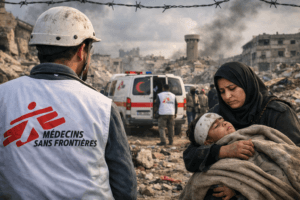
MSF’s Standoff: Between Protecting Staff and Sustaining Gaza’s Lifeline
When an Israeli government policy forces one of the world’s most experienced humanitarian organizations into an impossible choice—compromise staff safety or cease life-saving operations—the very principles of international aid are tested. Médecins Sans Frontières (MSF) has now made its agonizing decision. After months of attempted dialogue, it has refused to hand over a detailed list of its Palestinian and international staff to Israeli authorities, citing a lack of critical assurances for their safety and operational independence.
This standoff, which could lead to MSF’s expulsion from Gaza and the West Bank by March 2026, is not merely a bureaucratic dispute. It is a crisis point in a catastrophic humanitarian landscape, threatening to sever a major artery of medical care for hundreds of thousands of people. The decision comes against a backdrop where Israel has recently, and significantly, reversed its long-standing position by accepting the Gaza Health Ministry’s death toll of approximately 70,000 Palestinians killed since October 2023.
The Impossible Choice: Principles vs. Access
The conflict centers on new Israeli “security and transparency standards” for international NGOs. In late December 2025, Israel’s Ministry of Diaspora Affairs notified 37 aid organizations, including MSF, Save the Children, and Oxfam, that their registrations had expired. They were given a two-month grace period to comply with new requirements or cease operations.
The most contentious demand was for NGOs to submit highly sensitive personal data on Palestinian staff, including passport copies, CVs, and names of family members. While Israel framed this as a necessary security measure to “rule out any links to terrorism,” humanitarian groups saw it as an unacceptable overreach.
MSF, driven by the desperate need to maintain its medical lifeline, initially signaled a willingness to negotiate. On January 23, it offered to share a defined list of staff names as an “exceptional measure,” but only under strict conditions developed in consultation with its Palestinian colleagues. The core requirements were clear, non-negotiable assurances:
- That staff information would be used only for administrative purposes and not put colleagues at risk.
- That MSF would retain full authority over human resources and medical supply management.
- That Israeli authorities would stop public communications defaming MSF and undermining its staff.
According to MSF, “despite repeated efforts,” Israeli authorities would not engage on these concrete assurances. Facing what it called a “cynical and calculated attempt” to control or halt humanitarian work, MSF concluded it could not proceed. “No staff information has been shared,” the organization stated definitively.
The Staggering Scale of MSF’s Lifeline in Gaza
To understand the potential human cost of MSF’s expulsion, one must look at the sheer magnitude of its operations in a decimated territory. Following over two years of intense conflict, Gaza’s health system is described by MSF as “nearly non-functional,” with specialized care like burn treatment virtually unavailable. Into this void, MSF has become a cornerstone of survival.
Table: MSF’s Key Humanitarian Contributions in Gaza (2025)
| Service Provided | Scale of Impact | Contextual Significance |
| Outpatient Consultations | 800,000 | A primary source of medical access for a displaced and traumatized population. |
| Assisted Births | 1 in 3 of all births | Critical support for maternal and neonatal health in a shattered system. |
| Hospital Bed Support | 1 in 5 of all beds | Essential backing for inpatient care, trauma surgery, and chronic disease management. |
| Surgical Operations | 22,700 procedures | Addresses a continuous flow of war-related injuries and neglected medical conditions. |
| Mental Health Sessions | 40,000+ individual sessions | Addresses the pervasive psychological trauma of sustained violence and loss. |
MSF supports six public hospitals, runs two field hospitals, and operates numerous healthcare centers and clinics. Its work serves an estimated half a million people in Gaza, a population almost wholly reliant on aid for basic survival. The organization has committed 100-120 million euros to its 2026 response, underscoring the scale of its planned commitment.
“If MSF is expelled from Gaza and the West Bank it would have a devastating impact,” the organization warned, “as Palestinians face a brutal winter amidst destroyed homes and urgent humanitarian needs”.
A Climate of Fear: Why Staff Lists Are a Red Line
MSF’s refusal is rooted in a profound and justified fear for its personnel. The requirement for staff lists is not seen as routine paperwork but as a potential death warrant in a dangerous climate.
Since the war began in October 2023, over 1,700 health workers have been killed in Gaza. Fifteen of them were MSF staff members, killed by Israeli forces. Aid workers have also faced intimidation, arbitrary detention, and attacks. In this context, handing over detailed personal information of Palestinian staff—who fear surveillance, targeting, or persecution for themselves and their families—is considered an unconscionable risk.
This fear is amplified by what MSF and other NGOs describe as a sustained smear campaign by Israeli officials, who have publicly accused humanitarian groups like MSF and UNRWA of employing people with links to armed groups, often without providing evidence. Such accusations, aid groups argue, serve to delegitimize and endanger humanitarian workers, normalizing attacks against them.
The concern extends beyond immediate physical safety to the erosion of humanitarian principles. The requirement is seen as an attempt by a warring party to exert control over the staffing and operations of independent aid groups, compromising their neutrality and independence—the very attributes that allow them to operate in conflict zones.
The Broader Political Context: A Shift in Narrative
MSF’s announcement coincided with a notable shift in Israel’s official narrative. For over two years, Israeli officials had systematically dismissed the death toll figures from Gaza’s Health Ministry as “Hamas propaganda”. In a striking reversal, a senior Israeli military official briefed journalists in late January 2026, stating the army accepted that about 70,000 people had been killed in Gaza—a figure broadly in line with the Palestinian ministry’s count of over 71,600.
Analysts suggest this belated recognition may be a strategic recalibration. With increased international access to Gaza making outright denial “untenable,” accepting the scale of death may be an attempt to preserve credibility with allies and reframe the international debate toward reconstruction and future responsibility. As the Israeli newspaper Haaretz noted, this reversal forces the public to ask, “What other accusations could turn out to be true?”
This admission also intensifies scrutiny on the conduct of the war. Even by Israel’s new, partial acknowledgment, its own claim of killing around 22,000 militants would suggest that well over two-thirds of the dead were non-combatants. A leaked military database from August 2025 had concluded the civilian toll was over 80%.
The Path Forward and Global Implications
The standoff presents no easy solutions. MSF states it remains “open to ongoing dialogue” with Israeli authorities but will not compromise on the core safeguards it has outlined. The organization and its peer NGOs argue that Israel’s demands violate internationally recognized legal frameworks that obligate occupying powers to facilitate humanitarian relief.
The crisis has drawn significant international concern. Eight Muslim-majority nations, including Saudi Arabia, Egypt, and Jordan, have urged Israel to ensure UN and NGO operations continue “in a sustained, predictable, and unrestricted manner”. The issue is also a subject of high-level policy discussion among international relief experts, who warn of dangerous precedents being set.
The implications are global. If a state can force humanitarian organizations to choose between their operational principles and access to populations in need, the entire humanitarian system is weakened. It sets a template that could be replicated in other conflicts, further endangering aid workers and politicizing life-saving assistance.
Ultimately, the MSF standoff in Gaza is more than a regulatory dispute. It is a moral litmus test for the space in which humanitarian action can exist. As one MSF staffer reflected on the decision, the intent was never to ask colleagues “to carry the weight of an unbearable decision,” but to ensure their voices were heard on a question “existential for their safety and work”. In refusing to hand over the list, MSF has chosen to protect its staff today, even at the risk of not being there to treat the patients of tomorrow—a tragic calculus that reflects the brutal realities of a war where the rules of humanity are hanging by a thread.
You must be logged in to post a comment.