
Motorola Edge 70: A Premium Pivot That Tests the Limits of Mid-Range Value
The Motorola Edge 70, launched in India at ₹29,999, makes a bold design statement with an ultra-premium, 5.99mm thin and lightweight body, setting itself apart in the mid-range segment. However, this focus on slimness comes with significant compromises, most notably the removal of the optical telephoto zoom lens found in its predecessor, reducing camera versatility.
While it offers capable performance with a Snapdragon 7 Gen 4 chip, launches with Android 16, and includes useful Moto AI features, it faces intense competition from rivals that offer superior processors or more well-rounded features at similar or lower prices, making it a compelling but niche choice primarily for users who prioritize premium design and feel above all else.
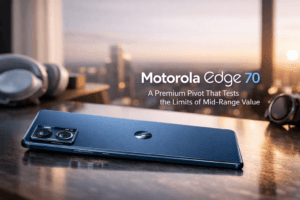
Motorola Edge 70: A Premium Pivot That Tests the Limits of Mid-Range Value
The newly launched Motorola Edge 70 enters India’s fiercely competitive smartphone market with a bold proposition: extreme thinness at a premium mid-range price. Priced at ₹29,999, this successor to the popular Edge 60 series has sparked debate by trading certain practical features for a sleek, 5.99mm profile. This analysis delves beyond the specifications to examine whether Motorola’s design-focused gamble pays off for the discerning buyer.
For a quick understanding of its position in the market, here is a comparison of the Edge 70 against its predecessor and a key competitor.
| Feature/Aspect | Motorola Edge 70 | Motorola Edge 60 Fusion (Predecessor) | OnePlus 13R (Key Competitor) |
| Launch Price (India) | ₹29,999 | Launched at ~₹27,999 (approx.) | ₹39,999 |
| Core Design Focus | Ultrathin (5.99mm) & Lightweight (159g) | Durable build with vegan leather option | Balanced performance & design |
| Processor | Qualcomm Snapdragon 7 Gen 4 | MediaTek Dimensity 7400 | Qualcomm Snapdragon 8 Gen 3 |
| Zoom Capability | Digital zoom only (Lossless 2x from main sensor) | 3x optical telephoto lens | Digital zoom (details vary) |
| Battery & Charging | 5000mAh, 68W wired, 15W wireless | 5200mAh, 68W wired | 5000mAh, 100W wired |
| Defining Trade-off | Premium design & thinness over camera versatility | Well-rounded features at a lower price point | Higher-tier performance at a higher price |
The Allure of the Ultrathin: Design as a Differentiator
Motorola’s primary pitch for the Edge 70 is its striking form factor. At just 5.99mm thick and weighing 159 grams, it is a significant departure from the increasingly chunky smartphones in its segment. This “impossibly thin” design is paired with a premium aircraft-grade aluminum frame and Gorilla Glass 7i, aiming for a feeling of effortless luxury in hand.
The phone doesn’t compromise on ruggedness for its slimness, boasting IP68/IP69 water and dust resistance and an MIL-STD-810H certification for durability. This combination targets users for whom the physical feel and aesthetic of a device are paramount—a clear attempt to emulate the appeal of ultra-premium models from Apple and Samsung.
A Strategic Shift: The Camera Compromise
The most consequential change from the Edge 60 series lies in the camera system, representing a significant strategic pivot.
- The New Setup: The Edge 70 features a triple 50MP system, comprising a primary wide, an ultra-wide, and a front camera. The primary sensor, aided by optical image stabilization (OIS), earns praise for its detailed, natural-looking photos in good light and capable 4K video recording.
- The Notable Omission: Motorola has completely removed the optical telephoto (zoom) lens that was present in the Edge 60 Fusion. This is a major downgrade in flexibility. While the main sensor can produce a decent 2x cropped shot, reviewers note that quality degrades significantly with higher digital zoom, with images becoming blurry and oversharpened beyond 5x.
- The Trade-off Analysis: Motorola has exchanged photographic versatility for its sleek design. The telephoto module takes up space, and its removal was likely essential to achieving the 5.99mm profile. For users who rarely zoom, this may be acceptable. However, for those who value compositional freedom, the loss of a dedicated zoom lens is a substantial drawback, making the camera system less capable than its predecessor’s in a key area.
Performance and Software: A Modern, AI-Enabled Core
Under the hood, the Edge 70 is equipped for modern tasks. The Qualcomm Snapdragon 7 Gen 4 chipset, paired with 8GB of LPDDR5x RAM, should handle everyday apps, multitasking, and moderate gaming competently. A significant software advantage is its launch with Android 16, promising three major OS updates and four years of security patches.
Motorola is also emphasizing its Moto AI suite, including features like “Catch Me Up 2.0” for summarizing notifications and “Remember This” for saving on-screen information. These AI-powered tools aim to enhance productivity, positioning the phone as a smart companion beyond just a communication device.
The Competitive Landscape: A Tough Crowd at ₹30,000
The Edge 70’s biggest challenge may not be its own compromises, but the exceptional alternatives available in the ₹25,000-₹40,000 “flagship killer” segment.
- The Performance Gap: Phones like the OnePlus 13R (₹39,999) and the Realme GT 7 (₹36,999) are equipped with the more powerful Snapdragon 8 Gen 3 and Dimensity 9400e chipsets, respectively. These processors offer near-flagship performance that significantly outpaces the Snapdragon 7 Gen 4, especially for intensive gaming and sustained workloads.
- The Value Question: The Edge 70’s ₹29,999 price tag places it in direct competition with devices that offer different, often more performance-focused value propositions. For instance, the Google Pixel 9a (around ₹35,999) is renowned for its best-in-class computational photography, while the Poco X7 Pro (around €300/~₹27,000) has been praised as an “excellent bang for the buck” with very strong performance.
Who Should Consider the Motorola Edge 70?
This phone is a niche product that will appeal to a specific user profile:
- The Design-Priority User: Individuals who prioritize a slim, light, and premium-feeling device above all else.
- The Casual Photographer: Users satisfied with excellent main and selfie camera performance for social media, but who rarely use zoom.
- The Early Adopter: Those who want the latest Android 16 experience and are intrigued by Motorola’s evolving AI features.
Who Should Look Elsewhere?
- The Photography Enthusiast: Anyone who values optical zoom for creativity or capturing distant subjects.
- The Power User/Gamer: Users who demand the absolute best performance for gaming or heavy applications.
- The Value-Seeker: Buyers looking for the maximum specifications or a particular standout feature (like a stellar camera or extreme battery life) for their budget.
Final Verdict: A Beautiful Compromise
The Motorola Edge 70 is a confident, stylish statement in a market often dominated by spec sheets. It successfully delivers an ultra-premium tactile experience rarely found in the mid-range. However, this comes at a cost: a higher price than its predecessor and the loss of the versatile zoom lens that previously defined the Edge series’ value.
Ultimately, the Edge 70 represents a shift from an “all-rounder” to a “design-centric” philosophy. Its success will depend on how many Indian consumers are willing to pay a premium for exquisite thinness over more versatile photography or more raw processing power offered by formidable competitors. It’s a compelling device, but one that asks buyers to carefully weigh what they value most in a smartphone.
You must be logged in to post a comment.