
More Than Just a Telecom: How Jio Seats Itself at the Global High Table with the “Trusted Tech Alliance”
Reliance Jio has joined the newly launched Trusted Tech Alliance (TTA), a global consortium announced at the Munich Security Conference that includes major players like Google, Microsoft, Amazon, Nokia, and Ericsson, marking India’s entry into a strategic partnership aimed at establishing global standards for secure, transparent, and reliable digital infrastructure. The alliance, which spans connectivity, cloud computing, semiconductors, and AI, is built on principles of operational transparency, supply chain security, and data protection, representing a response to growing geopolitical concerns over digital sovereignty. For Jio, this move elevates its status from a domestic telecom leader to a global deep-tech player, ensuring its future AI and cloud ambitions align with international trust standards while positioning India as a credible, neutral hub in the increasingly fragmented global technology landscape.
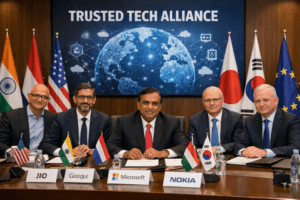
More Than Just a Telecom: How Jio Seats Itself at the Global High Table with the “Trusted Tech Alliance”
The news hit the wires late on a Friday evening: Reliance Jio, India’s digital juggernaut, was rubbing shoulders with the titans of global technology. The headlines, splashed across business media, screamed of a “big leap” as Jio joined the likes of Google, Microsoft, and Nokia . But beyond the press releases and the flurry of stock market optimism lies a more profound story—one that isn’t just about business expansion, but about the very architecture of trust in an increasingly divided digital world.
At the Munich Security Conference—a forum typically reserved for discussing defense, geopolitics, and international order—a group of 15 companies from 10 countries announced the formation of the Trusted Tech Alliance (TTA) . The venue alone signals that this is not your average industry consortium. This is a strategic pact, and Mukesh Ambani’s Jio Platforms is the sole Indian representative at this high-stakes table.
What Exactly is the Trusted Tech Alliance?
To understand why this matters, we have to look at the landscape of 2026. The digital world is fracturing. Concepts like “digital sovereignty” and “technological decoupling” are no longer abstract ideas discussed in think tanks; they are national policies. Countries are building walls around their data, their clouds, and their AI models, wary of foreign influence and espionage.
The TTA is a direct response to this fragmentation. Launched with 15 founding members—including Anthropic, AWS, Cassava Technologies, Cohere, Ericsson, Google Cloud, Hanwha, Jio Platforms, Microsoft, Nokia, Nscale, NTT, Rapidus, Saab, and SAP—the alliance is essentially a pledge of interoperability and trust in an age of skepticism .
As Ericsson’s President and CEO, Börje Ekholm, put it, “No single company or a country can build a secure and trusted digital stack alone. Rather, trust and security can only be achieved together.” . In a world where a undersea cable or a cloud server farm can become a geopolitical bargaining chip, the TTA aims to build a “digital stack”—from semiconductors to software—that is verifiably secure, transparent, and reliable, regardless of where it is physically located .
The Five Pillars of Trust
The alliance isn’t just a vague “friendship club.” It is built on five specific, binding principles that members must adhere to . These are worth examining because they represent the new currency of the global economy: Trust.
- Transparent Corporate Governance and Ethical Conduct: This goes beyond simple compliance. It mandates that companies operate with a moral compass, ensuring that their business practices are open to scrutiny.
- Operational Transparency, Secure Development, and Independent Assessment: This is the “trust, but verify” clause. Members agree to build technology securely and allow independent experts to kick the tires. In the world of AI and 5G, where a single vulnerability can have cascading effects, this is non-negotiable.
- Robust Supply Chain and Security Oversight: Hardware matters. Members commit to holding their suppliers to the highest global security standards, ensuring that the physical components of the digital world aren’t its weakest link.
- Open, Cooperative, Inclusive, and Resilient Digital Ecosystem: Despite the rise of sovereign clouds and national firewalls, the TTA members pledge to keep the ecosystem open. This is crucial for innovation, ensuring that small startups and large enterprises alike can build on a stable foundation.
- Respect for the Rule of Law and Data Protection: In an era of data leaks and surveillance capitalism, this principle aims to restore user confidence, ensuring that privacy is protected by design .
Why Jio? Why Now?
For the casual observer, Jio might still be synonymous with cheap data and the disruption of India’s telecom market. But for those watching the Ambani empire closely, the trajectory has been clear: Jio is transforming from a connectivity provider into a deep-tech powerhouse.
This move into the TTA is a logical, albeit ambitious, next step. Here is why Jio’s inclusion is a game-changer, both for India and for the alliance itself.
- India as a Trusted Alternate HubThe TTA includes players from the US (Microsoft, Google), Europe (Ericsson, Nokia, SAP), Japan (NTT, Rapidus), and South Korea (Hanwha). However, as the West seeks to diversify supply chains away from sole reliance on specific geopolitical rivals, India emerges as the natural “neutral” powerhouse. Jio represents a massive market of over 500 million users and, more importantly, a proving ground for technology deployed at scale . If a technology stack works in India—with its diversity, density, and cost-sensitivity—it can work anywhere. By including Jio, the TTA effectively brings the “India stack” (UPI, Aadhaar, etc.) into the global trust framework.
- The AI and Cloud ImperativeKiran Thomas, CEO of Jio Platforms, articulated the company’s vision perfectly:“Through collaboration with global partners, we aim to strengthen resilience, expand digital opportunity, and build long-term confidence in next-generation connectivity, cloud, and AI systems.” . Jio is not just a consumer of AI; it is building its own. Mukesh Ambani has previously announced the creation of Reliance Intelligence and partnerships with Google Cloud to establish AI-ready data centers powered by clean energy in Jamnagar . By joining the TTA, Jio ensures that its AI ambitions are aligned with global standards of safety and transparency, making its future offerings palatable to international clients who might otherwise be wary of “Made in India” AI.
- The IPO NarrativeThis strategic move comes just months ahead of Jio’s much-anticipated IPO, slated for the first half of 2026 . In the world of high finance, valuation is driven by narrative. Being seen as a peer of Microsoft, a partner of Google, and a standard-bearer of “trust” alongside defense giants like Saab adds immense intangible value. It tells global investors that Jio isn’t just a domestic utility; it is a global technology infrastructure player.
A “United Nations of Tech” or a New Bloc?
Critics might argue that the TTA is simply a Western-led attempt to create a tech bloc that excludes rivals. The Times of India aptly described it as a potential “United Nations of Tech” in response to “digital sovereignty” movements . However, the presence of Jio (India), NTT (Japan), and Hanwha (South Korea) suggests a broader coalition. It is an acknowledgment that the digital future cannot be built in isolation. “We are proud to join the Trusted Tech Alliance to promote secure and reliable digital infrastructure. Through this initiative, we want to contribute to increased digital security and foster innovation through international cooperation,” noted Micael Johansson, President and CEO of Saab, highlighting that this cooperation is not just “a good step” but a “necessary one” .
What This Means for the Average User
For the billions of users served by these companies, the TTA is a silent shield. It means that when you use a Jio SIM, stream content via a Google Cloud-backed app, or connect via Nokia’s 5G gear, there is an implicit promise that the underlying technology meets a high bar for security.
It means that the “smart” devices in your home and the critical infrastructure in your city are less likely to be vectors for cyberattacks. In an age where data is the new oil, the TTA’s principles on data protection and the rule of law offer a framework to ensure that this oil doesn’t spill—or get weaponized.
The Road Ahead
The Trusted Tech Alliance is more than just a press release from Munich. It is the beginning of a new world order in technology—one where trust is the ultimate differentiator. For Mukesh Ambani’s Reliance Jio, joining this league isn’t just about keeping up with the Joneses (or the Googles). It is about ensuring that as India builds its digital future, it does so on a foundation that the rest of the world respects and trusts.
As the alliance grows and its principles trickle down from boardroom strategies to the devices in our pockets, one thing is clear: the future of technology won’t just be about who builds the fastest chip, but about who builds the most trustworthy ecosystem. And Jio has just secured its seat at that table.
You must be logged in to post a comment.