
Monsoon Mayhem & Winter’s Grip: Decoding India’s 3-Day Weather Crisis and What It Means For You
The India Meteorological Department (IMD) has issued a significant three-day weather alert highlighting a stark climatic divide across the nation, where a relentless winter grip in the north collides with a stubbornly active monsoon in the south. While Punjab, Haryana, Delhi-NCR, and Western Uttar Pradesh endure dense, disruptive fog and a penetrating cold that slows life and jeopardizes health and travel, Kerala, Karnataka, Tamil Nadu, and the Andaman Islands brace for heavy post-monsoon thunderstorms and lightning, raising risks of flash floods and agricultural disruption. Simultaneously, Himalayan states like Himachal Pradesh and Uttarakhand face a dual threat of heavy rain and snowfall, triggering landslide concerns and travel advisories, all underscoring a period of heightened environmental vulnerability that demands region-specific precautions from citizens.
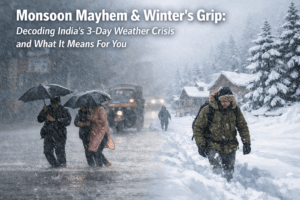
Monsoon Mayhem & Winter’s Grip: Decoding India’s 3-Day Weather Crisis and What It Means For You
As dawn broke on a chilly December morning, a significant portion of India found itself caught between two powerful seasonal forces: a retreating but resentful monsoon and an advancing, assertive winter. The India Meteorological Department’s (IMD) latest alert isn’t just a routine forecast; it’s a narrative of climatic transition gone awry, painting a complex picture of a subcontinent grappling with contrasting extremes. For the next 72 hours, the weather map of India is split into distinct, challenging chapters, each with profound implications for daily life, agriculture, and travel.
The Northern Front: A Blanket of Fog and Biting Cold
In the plains of North India, the story is one of stillness and reduced visibility. Punjab, Haryana, Delhi-NCR, and Western Uttar Pradesh are ensnared in a dense, persistent fog—a phenomenon more intricate than simple winter mist. This “radiation fog” forms under clear night skies, calm winds, and ample moisture near the surface, often from post-harvest crop residue or water bodies. The result is more than a scenic veil; it’s a disruptive force.
The Human and Economic Impact: The slowdown of vehicular traffic is just the surface symptom. Flight schedules are thrown into chaos, train services face delays, and the economic ripple effect is substantial. For the early-morning commuter, the farmer, and the logistics manager, this fog translates to lost hours, missed appointments, and heightened risk. Furthermore, the combination of low temperatures and high humidity creates a “wet cold” that seeps into bones, exacerbating health issues for the elderly and vulnerable, and increasing the demand for power at a time when supply is often constrained.
Why This Chill is Notable: While winter cold is expected, its early persistence and intensity this December raise questions. Some climatologists point to broader patterns, including the possible influence of snowfall events in the western Himalayas and the absence of cloud cover, which allows maximum terrestrial radiation loss at night. This isn’t just a “cold wave”; it’s a sustained, penetrating chill that defines the rhythm of life for the next three days.
The Southern and Coastal Saga: The Monsoon’s Reluctant Retreat
Contrast this with the scene in South India. Here, the Southwest Monsoon, which should have made a clean exit, is staging a stubborn rearguard action. The IMD’s warning of heavy rain in Kerala, Karnataka, Tamil Nadu, and Puducherry, along with the Andaman and Nicobar Islands, points to a still-active trough of low pressure and the presence of moisture-laden winds from the Bay of Bengal.
Beyond “Just Rain”: For Kerala and coastal Karnataka, this isn’t merely a pleasant shower. The prediction of thunderstorms and lightning transforms the event into a hazard. Post-monsoon rains can be intense and localized, leading to:
- Flash Flooding: Saturated grounds from the recent monsoon cannot absorb sudden heavy downpours, raising the risk of urban waterlogging and flash floods in low-lying areas.
- Agricultural Dilemma: For farmers, this untimely rain is a double-edged sword. While it may benefit some perennial crops, it threatens harvested yields, particularly spices and pulses left to dry, and can promote fungal diseases in standing horticulture crops.
- Landslide Threat: In the ghats and hilly terrains of these states, the additional rainfall on already soaked slopes keeps the threat of landslides firmly in the yellow zone.
The Himalayan Precinct: A Dual Alert of Snow and Rain
Perhaps the most critical alert is for the Himalayan states—Himachal Pradesh, Uttarakhand, Jammu & Kashmir, and Ladakh. The IMD has issued warnings for both heavy rainfall in the lower reaches and snowfall in the higher altitudes. For Himachal, still nursing the wounds of a destructive monsoon season that saw significant loss of life and infrastructure damage, this fresh alert is a trigger for anxiety and precaution.
The Science of the Warning: This activity is typically driven by western disturbances—extra-tropical storm systems that originate over the Mediterranean-Caspian region and move eastwards, colliding with the Himalayas. When these disturbances interact with residual monsoon moisture, they can produce significant precipitation. Snowfall above 2,500-3,000 meters is a boon for winter tourism and freshwater reservoirs, but rain in the lower hills is a known trigger for road blockages and landslides.
Travel Advisory Implicit: This three-day forecast essentially serves as a soft travel advisory for those planning trips to hill stations. The charm of a winter getaway can quickly turn into a logistical nightmare on blocked, slippery roads.
The Anomalous Middle: Rajasthan and Delhi’s Unique Pattern
The mention of Rajasthan and Delhi experiencing a “noticeable chill” due to a different weather pattern is intriguing. Rajasthan, typically dry in winter, may be experiencing cold air incursions from the north, moderated by its arid landscape. Delhi’s chill, amplified by urban pollution trapping cold air (the winter inversion layer), is a separate but equally potent phenomenon. The “noticeable chill” phrase underscores the subjective human experience of temperature—a combination of actual mercury levels, wind speed, and humidity—that defines our perception of “cold.”
Adding Genuine Human Insight: Reading Between the Weather Lines
- The Climate Change Context: While no single weather event can be directly attributed to climate change, the pattern of intense, out-of-season rainfall and persistent fog aligns with broader predictions of increased climate variability. The monsoon’s extended activity and the severity of fog episodes could be part of a larger trend of climatic destabilization.
- Preparedness Over Panic: The real value of this 3-day alert lies in preparedness. For the North, it means checking vehicle lights and fog lamps, ensuring warm clothing for extended outdoor exposure, and the elderly taking necessary health precautions. For the South and hills, it means staying updated on local flood warnings, securing loose objects outdoors, and postponing non-essential travel to vulnerable areas.
- The Agricultural Calendar Stress: Such forecasts put immense stress on India’s agricultural calendar. The overlapping of harvesting in the north (threatened by fog and cold) and secondary crop cycles in the south (threatened by rain) requires nimble, localized responses from farmers, for whom weather apps have become as crucial as farming tools.
The 72-Hour Guide: A Region-Wise Checklist
- North India (Punjab to Delhi-NCR): Drive with dipped headlights, not high beams. Use fog lights if available. Keep emergency kits in vehicles. Layer clothing to trap heat.
- South India (Kerala, Karnataka, TN): Avoid venturing near rivers or steep slopes. Be cautious of lightning—seek shelter in substantial buildings. Secure drainage paths around homes.
- Himalayan States: Confirm road status before travel. For high-altitude areas, ensure vehicles are equipped for snow (chains). Follow local administration directives diligently.
- Coastal & Islands (Andaman & Nicobar): Fishermen and small boat operators must heed warnings strictly. Coastal communities should be alert for gusty winds.
Conclusion: A Nation in Climatic Transition
This three-day forecast is a masterclass in India’s geographical and meteorological diversity. It’s a reminder that the country doesn’t experience one weather story, but several simultaneously. The “Monsoon Alert” in the headline, therefore, is only half the tale; the other half is written in the cold, dense fog of the north. By understanding the “why” behind the rain, snow, and fog, citizens move from being passive recipients of information to active, prepared participants in their own safety and well-being. The next 72 hours call for vigilance, adaptation, and respect for the power of nature’s contrasting moods.
FAQ: Your 3-Day Weather Alert Questions Answered
Q: Why is the monsoon still active in December? A: The retreat of the Southwest Monsoon is a gradual process, not a switch. Sometimes, favorable conditions like low-pressure areas and moisture feed from the Bay of Bengal can reactivate rainfall, even in December, especially over southern peninsular India.
Q: Is this dense fog in Delhi-NCR also smog? A: Often, it’s a harmful mix. Winter fog (mist) combines with pollutants (like PM2.5 from vehicles, industry, and stubble burning) to form smog. This smog is more hazardous than pure fog as it poses serious respiratory health risks.
Q: What does a “heavy rainfall warning” mean in practical terms? A: The IMD issues such warnings based on expected intensity. “Heavy” means 64.5 mm to 115.5 mm in 24 hours. Practically, this can lead to significant water accumulation, reduced visibility, traffic disruptions, and potential flash floods in susceptible areas.
Q: How reliable are these 3-day forecasts? A: Short-range forecasts (1-3 days) are generally highly accurate due to advances in satellite data and modeling. However, the exact location and intensity of hyper-local events (like a thunderstorm over a specific town) can sometimes vary. It’s best to follow hourly nowcasts as the event nears.
You must be logged in to post a comment.